About & Origin
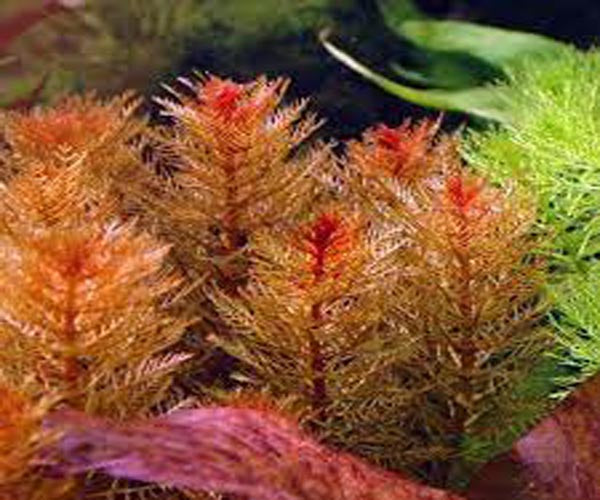
Red Myrio is a feathery, fine-leaved aquarium stem plant — Myriophyllum tuberculatum, also sold as Red Watermilfoil, native to shallow, sunlit streams and wetlands across Southeast Asia and Australia. It belongs to the wider Myriophyllum (watermilfoil) genus, a group of finely divided, feather-leaved aquatic plants found across many continents, several of which are grown in aquariums for their delicate, needle-like foliage.
Its leaves are finely dissected into thin whorled segments, giving the whole stem a soft, feathery texture. Under strong light it develops striking red-to-orange colouration, which makes it a popular contrast plant against green fine-leaved species in the midground of aquascapes.
In the wild, watermilfoils like this typically grow rooted in shallow water with their feathery stems reaching up toward full sun, often forming dense underwater meadows alongside similarly fine-textured native plants — the same soft, textured look that makes them prized in aquascaping for breaking up the visual weight of broader-leaved neighbours. Because the foliage is so finely divided, the whole plant reads visually more like a soft "cloud" of colour than a distinct leaf shape, which is exactly the texture contrast aquascapers are usually chasing when they plant it next to something like Anubias or a broad-leaved Echinodorus.
The genus name Myriophyllum literally means "countless leaves," a reference to how densely the tiny leaflets are packed along each whorl — under strong light and good CO2, a single stem can carry dozens of these fine segments per node, which is what gives a well-grown group its dense, bushy, almost coral-like appearance rather than a sparse, twiggy one. Colour ranges from a warm orange-red near the growing tips (where light exposure and new growth are most concentrated) fading to a more muted green-red lower down the stem, a natural gradient that many aquascapers deliberately show off by planting it where the tips catch the most direct light.
Requirements
Red Myrio is a rewarding but genuinely more demanding stem plant than most easy beginner greens — it's worth knowing that going in.
Light: needs strong, intensive lighting to hold a tight, needle-dense growth form and good red colour; under weaker light it grows leggier and duller.
CO2: pressurized CO2 injection is close to essential for keeping this plant looking its best — it can survive without it, but growth slows and colour fades toward a muted green.
Nutrients: benefits from consistent nitrate and phosphate dosing plus regular liquid iron/micronutrients to support both growth and colour.
Placement & trimming: typically grown in the midground or background in groups; trim the tips regularly and replant healthy cuttings to keep the group dense rather than sparse and stringy. Because the fine leaves are fragile, handle cuttings gently — rough handling can strip segments off the stem.
Fragility & algae risk: the delicate, finely divided foliage is more prone than broad-leaved plants to trapping debris and being smothered by hair or thread algae, especially if light and CO2/nutrients fall out of balance — keeping flow and nutrient dosing consistent matters more here than for tougher plants.
Not for beginners as a first plant: it's honest to say this one is best suited to someone who already has a stable, reasonably well-equipped planted tank (real lighting, ideally CO2) rather than a first foray into live plants — it will noticeably struggle and thin out in a low-tech, low-light setup where an easier stem plant would simply grow more slowly but stay healthy.
Spacing: plant stems with a little room between them rather than tightly packed, since a fully bushed-out group takes up noticeably more lateral space than the thin cutting it started as.
Compatibility
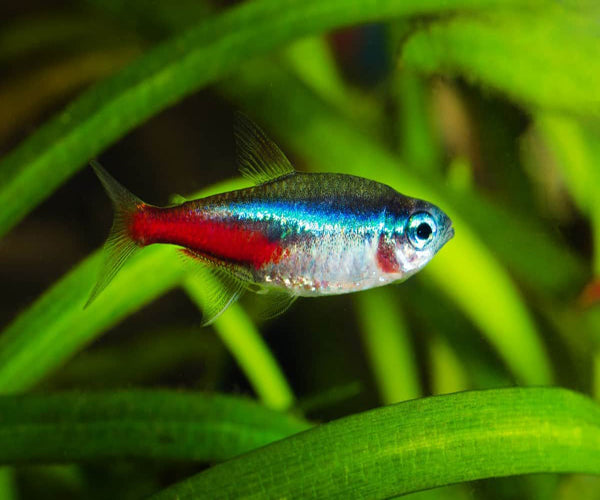
Water & Care Conditions
More demanding than most easy stem plants — these are the conditions it actually needs to thrive rather than merely survive:
- pH: soft, acidic to neutral water, roughly 5.0–7.0
- Water hardness: soft water is preferred
- Temperature: 18–28°C (65–82°F)
- Light: high/intensive lighting is genuinely needed for dense, well-coloured growth
- CO2 & nutrients: pressurized CO2 plus regular nitrate, phosphate and iron dosing are what keep the fine needle-like foliage dense rather than thin and see-through
- Water flow: gentle to moderate circulation through the foliage helps prevent detritus and algae from settling in the fine leaf whorls
- Photoperiod: a stable, timer-controlled 8-10 hour lighting schedule gives more consistent colour than an irregular one, since colour intensity tracks cumulative light exposure
This is a plant that rewards a properly dosed, well-lit planted tank far more than it tolerates neglect — treat it as a step up from easy beginner stem plants. If it starts thinning, dropping lower leaves, or fading toward plain green, that's usually a signal that light, CO2 or nutrient dosing has fallen behind what the plant needs to sustain its more demanding growth rate, rather than a sign of disease — increasing whichever of the three is weakest link is generally the fix, rather than reaching for a treatment or medication.
Because the fine foliage offers so much surface area, it's also a genuinely good fry and shrimplet refuge in a breeding or shrimp tank, giving very small, vulnerable animals somewhere dense to hide from adult fish — a practical secondary benefit worth factoring in alongside its purely decorative role. That same surface area does mean it should be rinsed gently and inspected before adding it to a tank, since fine foliage like this can carry hitchhiking snail eggs or algae spores more readily than a smooth broad leaf would.