About & Origin
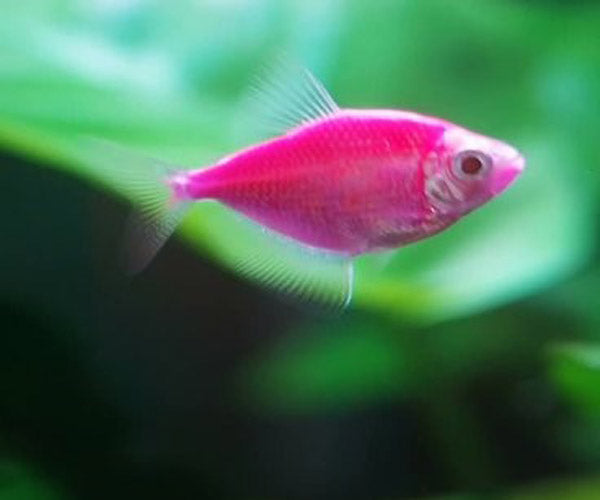
The "widow tetra" sold in colour variants like this red form is Gymnocorymbus ternetzi, the Black Widow Tetra (also called the Black Skirt Tetra), native to the Paraguay River basin across Paraguay, Argentina, and southeastern Brazil. The naturally occurring wild-type fish is smoky grey-black, fading from pale grey at the head to solid black across the rear half and long, flowing "skirt" fins.
Vivid colour variants like this red form are not a naturally occurring wild colour — they're typically produced either through dye injection or, less commonly, selective breeding of colour morphs, which is worth knowing upfront since the colouring is cosmetic and applied to a base fish that is otherwise the ordinary, hardy black widow tetra. Buyers who prefer an undyed, natural-coloured fish should look for the standard black or gold/white widow tetra forms instead.
Underneath the colouring, this is the same genuinely easy, hardy tetra species long popular in the hobby — active, shoaling, and notably less fussy about water chemistry than many other tetras, tolerating a wider pH and hardness range than soft-water specialists like cardinals.
This combo pack supplies a starter shoal at once, matching how this naturally social, group-shoaling species should always be kept.
The undyed, naturally-coloured black form of this same species remains widely available and is worth considering as an alternative for keepers who'd prefer not to support the dyeing trade — it offers identical hardiness, shoaling behaviour, and ease of care, just without the added colour.
The red colouring on this variant tends to be most saturated across the head and forward body, fading toward the naturally darker rear "skirt," which gives red-form widow tetras a distinctive two-tone look that stands out clearly even from a distance in a mixed community tank.
Requirements
Buy the full shoal in one combo rather than building it up fish by fish over several trips -- for a species this dependent on proper group size (6 or more), a thin starting group of 2-3 will spend weeks redirecting nervous, territorial energy into fin-nipping tankmates and each other, which a same-day full shoal avoids entirely.
60 litres or more suits a shoal comfortably, ideally with darker substrate and some shaded planting -- red colouring genuinely reads more vivid against a dark background and under moderate rather than harsh lighting, so tank aesthetics aren't purely cosmetic here, they affect how the fish actually looks day to day.
If the red on this stock is dye-based rather than a bred colour strain (worth asking the seller directly, since both are sold under this name), give newly arrived fish gentler-than-usual acclimation -- slow drip acclimation over 20-30 minutes rather than a quick float-and-release -- since the dyeing process itself is a stressor on top of ordinary transport stress.
Diet is unfussy: a good flake or micro-pellet base, with live or frozen bloodworm, daphnia, or brine shrimp worked in a few times a week both for variety and because the added carotenoids in these foods genuinely help maintain red/orange colour intensity over time, in the same way they do for other red-toned aquarium fish.
Fin-nipping toward slow, long-finned tankmates (bettas, fancy guppies, angelfish) is a real trait of this species regardless of colour form -- plan tankmates around that rather than assuming a striking colour form somehow means a calmer fish.
Compatibility
Water & Care Conditions
Red colour retention is the main practical difference in day-to-day care versus the plain black form -- everything else about keeping this fish healthy is standard, easy-tetra husbandry:
- pH: 6.0–7.5
- Hardness: 2–20 dGH, soft to moderately hard -- unusually wide tolerance for a characin
- Temperature: 20–27°C (68–81°F), tolerating the cooler end better than most tropical shoalers
- Oxygenation: ordinary community-tank filtration and gentle-to-moderate flow is plenty
A fading or washed-out red is almost always the fish telling you something rather than just cosmetic bad luck: stale water (overdue water change), too-bright lighting bleaching the colour out visually, or -- for genuinely colour-strain (non-dyed) stock -- an unbalanced diet lacking the carotenoid-rich foods that support red pigmentation over time.
Weekly partial water changes around 20-25% are the single biggest lever for both general health and keeping colour saturated, since nitrate buildup dulls colour in most brightly-toned small tetras well before it becomes a health problem in its own right.
This species breeds readily in a settled community tank with enough fine-leaved plant cover for scattered eggs to fall into and hatch undisturbed -- without that cover, adults (including the parents) will simply eat the eggs and fry, as is typical for egg-scattering characins.
Its broad pH/hardness tolerance means it rarely needs the water chemistry adjusted specifically for it -- it settles into whatever stable parameters a mixed community tank already runs at, which is part of why it pairs so easily with a wide range of other easy species.