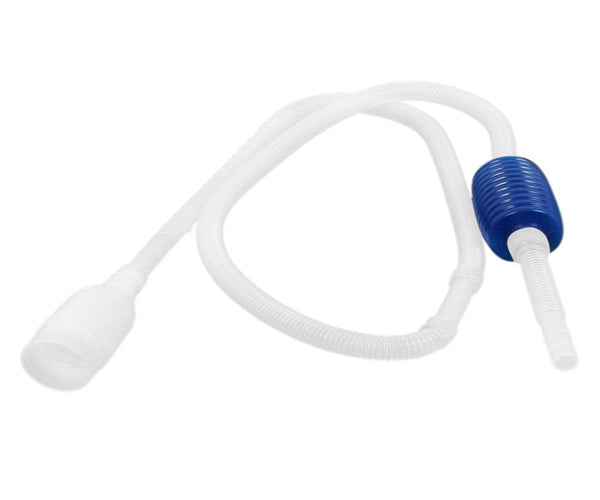
About & Function
A siphon pipe (gravel vacuum) is one of the most basic and genuinely essential tools in the fishkeeping hobby: a length of tubing, usually with a wider rigid tube at one end, used to pull water — and with it, waste — out of the tank during a water change. Once flow is started (either by a squeeze bulb, a pump action, or the classic faucet-attachment style that uses running tap water to create suction), gravity keeps the water moving through the tube and out.
This particular design attaches to a faucet: the stream of water running through it creates suction that pulls tank water through the siphon and straight down the sink drain, rather than into a bucket. That removes one of the more tedious parts of a manual water change — hauling full buckets back and forth — at the cost of needing the sink or drain to be within hose reach of the tank.
Beyond simply draining water, the wider intake tube is normally worked down into the substrate during use, so it also vacuums up settled fish waste, uneaten food, and debris from between the gravel or sand — the real reason gravel vacuums matter more than a plain hose would.
Regular partial water changes done this way are one of the single most important routine tasks in fishkeeping, arguably more important than the filter itself for long-term water quality — a filter processes ammonia and nitrite into nitrate, but nitrate itself still builds up over time and is only actually removed from the system by water changes (or heavy plant uptake). A siphon makes that removal straightforward rather than a chore requiring buckets and cups.
Requirements
No electricity is needed — this is a fully manual, passive tool. What it does need is a nearby faucet or drain within reach of the hose length, and (for the faucet-attachment style) a tap fitting that the adapter can seal against; unusual or non-standard taps may need a separate universal adapter.
Using it safely means keeping the intake moving rather than parking it in one spot, both to avoid stressing bottom-dwelling fish or invertebrates and to avoid pulling in gravel/sand along with the debris (most gravel-vacuum tubes are sized so coarser substrate falls back out while waste is carried away, but very fine sand can still get drawn up if the flow is too strong).
Before starting, it's worth double-checking the drain destination is genuinely appropriate (a kitchen sink used for food prep is best avoided for aquarium wastewater) and that new water added back afterward is properly dechlorinated and roughly temperature-matched to the tank, since large sudden temperature or chemistry swings from a water change can stress fish more than the change itself needed to.
Hose length matters in practice more than it seems at first: measure the real distance from the tank to the nearest usable faucet/drain before buying, accounting for any obstacles or doorways the hose needs to route around, rather than assuming any standard length will comfortably reach.
Compatibility

Specifications & Maintenance
Real-world specifications and upkeep:
- Power: none — fully manual/passive, driven by tap water flow or a manual pump/squeeze action
- Recommended use: as part of a regular partial water change routine, typically weekly to fortnightly depending on stocking level, removing roughly 10–25% of tank volume along with vacuumed debris
- Cleaning after use: rinse the tube and any faucet adapter with clean water after each use to prevent debris or algae buildup inside the tubing
- Storage: coil loosely and store dry between uses; kinked or sharply bent tubing can crack or develop permanent kinks over time
- Wear: check faucet adapter seals/gaskets periodically, since a worn seal is the most common cause of reduced suction
- Substrate care: work the vacuum tube gently rather than forcefully to avoid disturbing rooted plants or stirring up more debris than intended
- Water change size: avoid removing an unusually large percentage of the tank's volume in one go on an established tank, since a very large sudden change can shock water chemistry as much as neglecting changes altogether
- New water: always dechlorinate and roughly temperature-match replacement water before adding it back
- Reach check: confirm hose length actually covers the real distance and any obstacles between tank and drain before relying on it