About & Origin
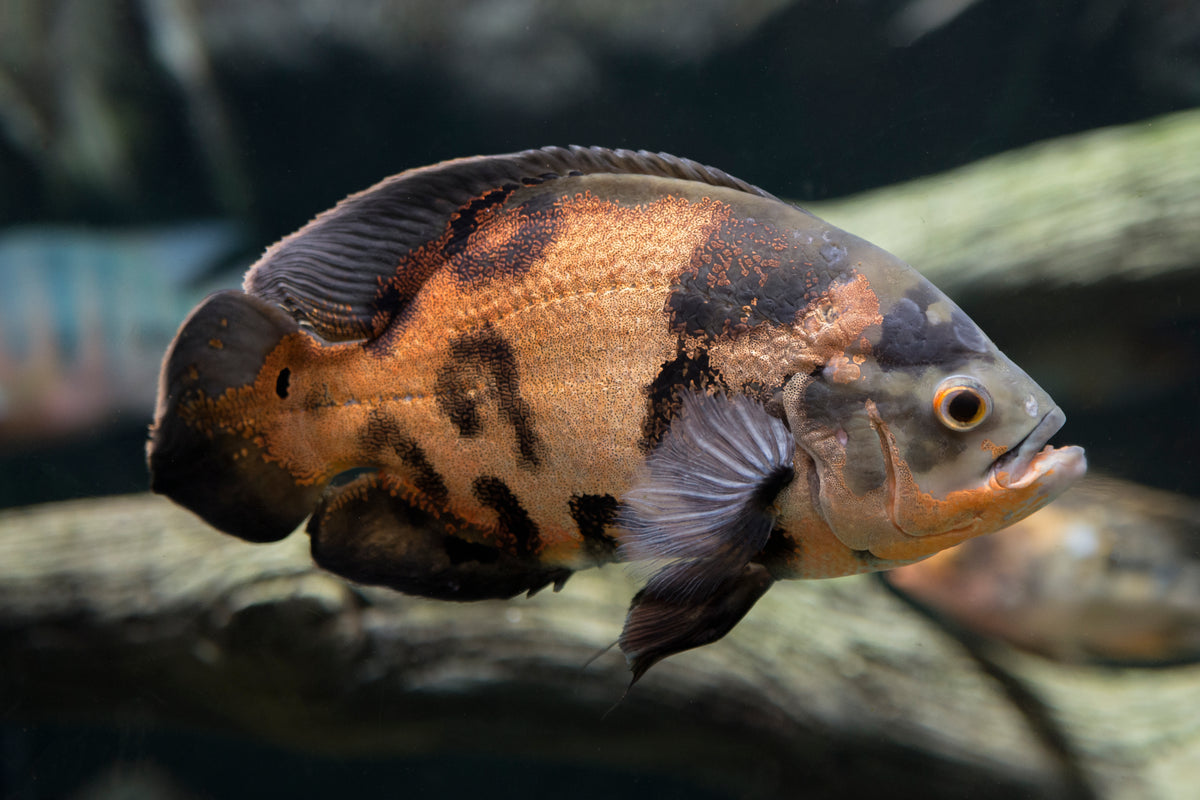
The oscar (Astronotus ocellatus) is a large South American cichlid from the slow-moving, often turbid waters of the Amazon, Rio Negro, and Paraná river basins. The albino tiger-patterned seen in this listing is a selectively bred colour form of the same wild species, not a different fish.
Oscars are famous in the hobby for their intelligence and personality -- they recognise their owner, learn to anticipate feeding time, and are often described as 'the dog of the aquarium world' for how interactive they become once settled in.
In the wild they're ambush predators, hanging in cover near submerged wood and vegetation before lunging at passing prey, a hunting style that carries straight over into tank behaviour.
The albino tiger form combines two separate selectively-bred traits: the albino reduction that removes dark pigment (giving the pale, pinkish-white ground colour and typically pink or red eyes) and the tiger-style irregular blotching pattern layered over it in a warmer orange-red tone rather than the dark mottling seen on wild-type Oscars. The result is a strikingly pale, high-contrast fish quite different in overall look from a standard-coloured Oscar despite sharing identical size, temperament, and care needs.
Individual pattern intensity and placement vary fish to fish even within the same batch, since the tiger blotching is not a fixed, uniform trait the way a solid colour strain would be — no two albino tiger Oscars look quite identical.
Requirements
Same space and stocking rules as any oscar, tiger-albino pattern included: at least 250-300 litres (65-75 gallons) for a single adult given their 30-35cm typical adult size, secured hardscape and minimal or potted planting since they redecorate enthusiastically by digging and uprooting, and only large, robust tankmates -- oscars are food-driven predators that treat anything mouth-sized as a meal, not a companion.
The marbled tiger patterning is purely a selectively-bred cosmetic trait on top of the standard albino colour reduction -- it doesn't change temperament, growth rate, or care beyond the same light-sensitivity consideration any reduced-pigment oscar has. Diet is standard oscar fare: a quality cichlid pellet as the staple over feeder fish (which carry real disease and nutrition risks), supplemented with prawn or earthworm for conditioning, with genuine discipline needed around portion size since this species begs persistently and readily overeats.
Décor and behaviour: like any Oscar, this fish redecorates its tank as a matter of course, shifting loose substrate and uprooting unanchored plants -- heavy, securely placed rock and potted or artificial planting hold up far better than a delicate aquascape. Its ambush-predator instincts mean anything small enough to fit in its mouth will eventually be treated as food rather than a tankmate, regardless of how docile the fish otherwise seems day to day.
Growth planning: a young albino tiger Oscar sold small will reach the same substantial adult size as any other colour form within a year or two of good care, so tank size and filtration should be planned around that adult size from the outset rather than upgraded reactively later.
Compatibility
Water & Care Conditions
Same chemistry tolerance as any oscar -- pH 6.0-8.0, hardness 5-20 dGH, 23-27°C -- with filtration and bioload the real limiting factor rather than exact water numbers: canister or sump filtration well above the tank's nominal rating, plus 25-30% weekly water changes, given how much waste a fish this size produces.
The reduced pigmentation behind both the albino base colour and the pale ground of the tiger pattern brings the same mild light-sensitivity as other albino oscars -- shaded retreat spots or floating cover are worth including rather than bright, uniform lighting all day. "Hole in the head" disease and ich remain the two most common health issues across all oscar colour forms, both largely preventable with a varied diet and consistent water quality.
Eye sensitivity: because albino fish generally lack the pigment that shields the eye from bright light, keeping ambient tank lighting on the moderate side rather than intense is worth doing specifically for this colour form, alongside providing shaded areas the fish can retreat to if it wants to avoid direct light.
As with any Oscar, weekly water changes in the 25-30% range paired with filtration rated well above the tank's nominal size are the baseline for keeping a fish this large and this messy healthy long-term — skimping on either is the most common root cause when an otherwise well-fed Oscar starts showing health problems.