Ich in Fish (White Spot Disease): Life Cycle, Heat and Salt Treatment
Published: 2026-10-29 · FishyKart Blog
Ich (Ichthyophthirius multifiliis), also called white spot disease, is a single-celled parasite that covers freshwater fish in small white spots about the size of a grain of salt. It is one of the most common aquarium diseases and is treatable, but only if you treat through the whole life cycle, which takes a few days in warm tropical water and several weeks in cold water. Stopping when the spots disappear is the main reason ich comes back.
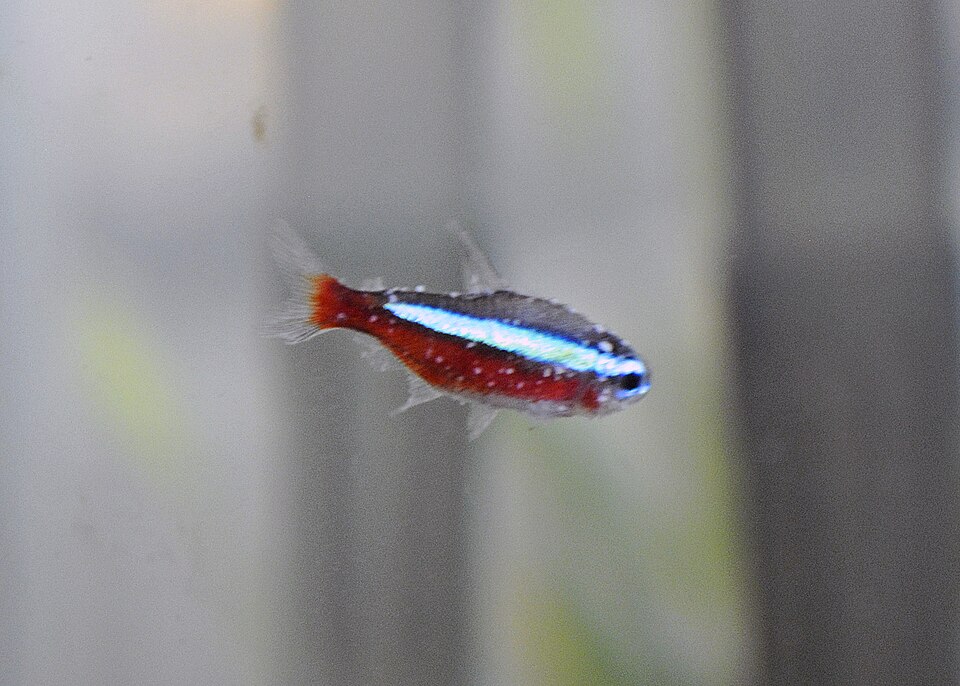
Photo: D. Herdemerten Hannibal21 - Wikimedia Commons, CC BY 3.0
Signs of Ich
- White spots on the body, fins or gills that look like sprinkled salt.
- Scratching or flashing against rocks and decor.
- Clamped fins, hiding, loss of appetite.
- Fast breathing or staying near the surface if the gills are infected.
Neon tetra disease and fin rot look different: ich spots are raised and sharply defined, not pale patches or ragged fins.
The Ich Life Cycle
| Stage | What happens |
| Trophont (white spot) | Parasite feeds under the skin, protected from medication |
| Tomont (cyst) | Mature parasite drops off and forms a cyst on gravel, plants or glass |
| Dividing cyst | Inside the cyst it divides into hundreds or more young parasites |
| Theront (swimmer) | Free-swimming stage that must find a fish quickly or die |
Treatments only kill the parasite in the water, mostly the free-swimming stage. That is why treatment must continue until every spot has dropped off and all cysts have hatched.
Treatment by Temperature
Warmer water makes the cycle run faster, so the vulnerable swimming stage appears sooner. Many keepers raise tropical tanks slowly, about 1-2 F (0.5-1 C) per day, to around 86 F (30 C) and hold it there for about 10 days, or until a few days (commonly 3-7) after the last spot has gone, whichever is longer. Check that every species in the tank tolerates this: white cloud minnows, hillstream loaches and some corydoras prefer cooler water, so keep it below about 82 F (28 C) for them, and add strong aeration because warm water holds less oxygen.
- Add an air stone, because warm water holds less oxygen.
- Do not heat coldwater fish such as goldfish this high. In cooler tanks, treat longer instead.
- If you cannot raise the temperature, expect treatment to last much longer.
Treatment with Salt
Aquarium salt (plain sodium chloride, no additives) is a common ich treatment for salt-tolerant fish. Aquarium keepers commonly add it gradually, about 1 g per liter (about 4 g per US gallon) per day, up to around 2-3 g per liter, dissolved in tank water first. At these doses salt alone is a weak treatment and works best together with heat. Keep it for the same treatment period, then remove it with gradual water changes. Salt is not removed by evaporation, so only add more after water changes.
Caution: Scaleless Fish, Plants and Invertebrates
- Scaleless and small-scaled fish such as clown loaches, kuhli loaches, corydoras and other catfish are sensitive to salt and to many medications. Use lower doses, heat where tolerated, and follow the label strictly.
- Shrimp and snails such as cherry shrimp and nerite snails can be killed by copper-based medicines and stressed by salt. Move them to another tank before treatment. Ich only infects fish, so it cannot live on shrimp or snails as hosts.
- Live plants: salt can damage or kill many freshwater plants, so treat plant-heavy tanks in a separate hospital tank.
Mistakes to Avoid
- Stopping treatment as soon as the spots vanish.
- Skipping quarantine. Keep new fish separate for at least 4 weeks, ideally 4-6, before adding them.
- Combining several medicines at once, or adding salt and medicine without checking that they can be used together.
- Leaving carbon in the filter, which removes many medicines.
If fish are very weak, consult an aquatic vet or experienced local fish shop.