Sailfin Molly: Care, Size and the Hard-Water Rule
Published: 2026-11-06 · FishyKart Blog
The sailfin molly (Poecilia latipinna) is the molly with the flag: mature males raise a tall, sail-like dorsal fin that runs almost the length of the back. It is a separate species from the common short-fin molly (and from the larger giant sailfin, Poecilia velifera), grows to about 5 inches, needs a tank with at least a 30 x 15 inch base, and is happiest in hard, alkaline water at 70-79°F (21-26°C). It is also one of the few aquarium fish that is native to the United States.
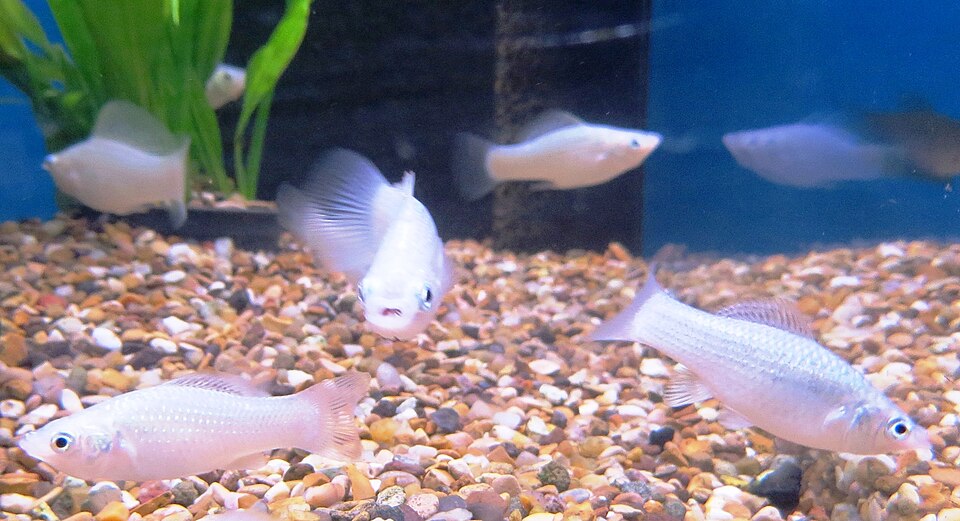
Photo: Bjoertvedt - Wikimedia Commons, CC BY-SA 3.0
Quick Reference
| Parameter | Sailfin molly | Short-fin molly (for comparison) |
|---|---|---|
| Scientific name | Poecilia latipinna | Poecilia sphenops and hybrids |
| Adult size | About 5 in (125 mm SL) | About 3.1 in (8 cm SL) |
| Minimum tank base | 30 x 15 in (about 23 gallons) | 36 x 12 in (about 21 gallons), see molly tank size |
| Temperature | 70-79°F (21-26°C) | See molly temperature |
| pH / hardness | 7.0-8.5 / 15-35 dGH | Also hard, alkaline |
| Diet in the wild | Almost entirely algae and plant matter | Omnivore with a plant bias |
| IUCN status | Least Concern (assessed 2019) | - |
Sources: SeriouslyFish species profile for Poecilia latipinna (size, tank base, temperature, pH, hardness, diet, behavior, hybrids); FishBase species summary (native range, male length, habitat, gestation, brood size, IUCN status, introductions).
A Wild Fish From the US Coast
FishBase places the native range from the Cape Fear drainage in North Carolina along the Atlantic and Gulf coasts to Veracruz in Mexico. There the sailfin molly lives in "still or gently flowing warm water of small creeks and drains", including salt marshes and coastal ditches. That origin explains its two needs that matter in a home tank: mineral-rich water and a diet built on algae. It also explains a rule many keepers forget: outside that range, released mollies are an invasive species, and FishBase lists several countries with adverse ecological effects after introduction. Never release aquarium fish or empty a tank into a drain or pond.
Tank Size: Plan for the Sail
SeriouslyFish recommends a tank base of 30 x 15 inches (76 x 38 cm), about 23 US gallons. Standard US tanks that meet it:
- 29 gallon (30 x 12 in): slightly narrower than the guideline; fine for 3-4 sailfins, such as one male and two or three females.
- 40 gallon breeder (36 x 18 in): the better choice. Males need swimming room and depth to raise a full sail without tearing it on decor.
- 55 gallons and up: a mixed group of several males, which reduces fighting by spreading displays.
A 10 or 20 gallon tank is too small for adults. Mollies produce a lot of waste for their size, so use a filter rated for a larger tank and keep the lid on: sailfins are strong swimmers and can jump.
Water: Hard and Alkaline, Salt Optional
SeriouslyFish lists 70-79°F, pH 7.0-8.5 and 15-35 dGH, and addresses the salt question directly: the species "is often referred to as a brackish species but can live perfectly well in freshwater provided it is not soft and/or acidic." In practice:
- Hard tap water (common in much of the US Midwest, Texas and the Southwest) usually needs no changes.
- Soft or acidic water: add crushed coral or aragonite to the filter or substrate to raise pH and hardness, and test weekly.
- Salt is optional. A small dose can help in soft water, but it rules out salt-sensitive tank mates such as corydoras and many plants.
If a sailfin starts "shimmying" (rocking slowly from side to side), test pH and hardness first. See molly fish temperature and water chemistry for target numbers and adjustments.
Feeding a Grazer
SeriouslyFish notes that wild sailfin mollies are "almost exclusively herbivorous, feeding on algae and other plant material". In a tank that means a vegetable-based flake or spirulina as the staple, blanched zucchini or spinach once or twice a week, and protein foods such as brine shrimp only as a treat. Sailfins graze algae off glass and plants all day, so a little natural algae growth helps them. A diet of pure protein flakes is the most common reason for dull color and stunted sails.
Males, Sails and Tank Mates
Males have a gonopodium (the modified anal fin of livebearers) and the large dorsal sail, which they flare at females and rival males. SeriouslyFish warns that "males can be aggressive to one another, particularly when spawning" and that adults "may pick on smaller fish". Keep two or three females per male and choose tank mates that like the same hard water and are not tiny:
- Other livebearers: swordtails, platies and short-fin mollies (they may crossbreed).
- Peaceful barbs and danios: cherry barbs, zebra danios.
- Hard-water bottom dwellers: bristlenose pleco, nerite snails.
Avoid soft-water fish such as neon tetras and discus, and long-finned slow fish such as bettas. More options are in molly fish tank mates.
Breeding and Hybrids
Like all mollies, the sailfin gives birth to live young. FishBase records a gestation of about 28 days and broods of 10-100 young; SeriouslyFish gives up to 50 young per brood. Adults eat fry, so dense plants or a separate grow-out tank are needed if you want to raise them. Fry grow fastest on frequent small meals of crushed flake and baby brine shrimp.
SeriouslyFish also notes that P. latipinna has been crossbred with other mollies, particularly P. sphenops. Many fish labeled "sailfin" in stores, including gold, white, black and dalmatian sailfins, carry hybrid genes. That is why some never grow a full sail, and why the sailfin trait also turns up in molly varieties such as balloon sailfins. For a true tall-sailed male, buy from a seller who keeps sailfins separately.
Browse Mollies & Platies → All Molly Types →