About
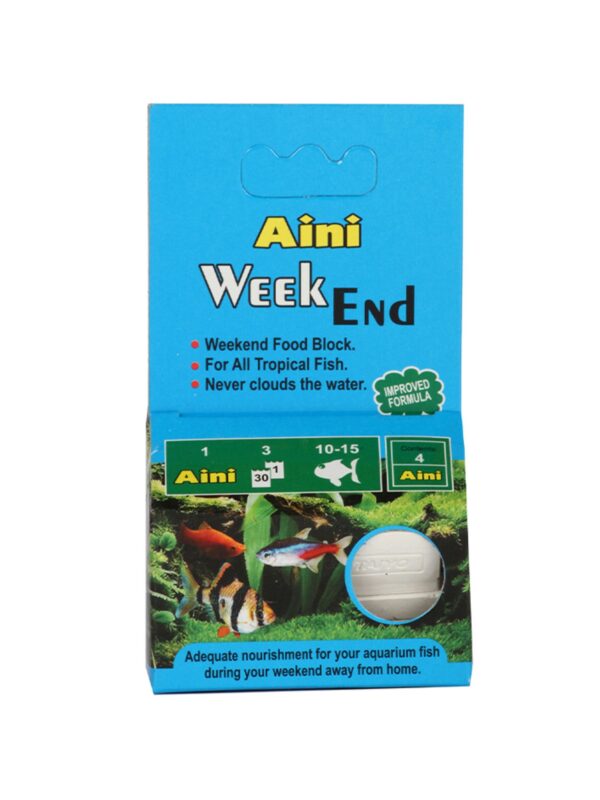
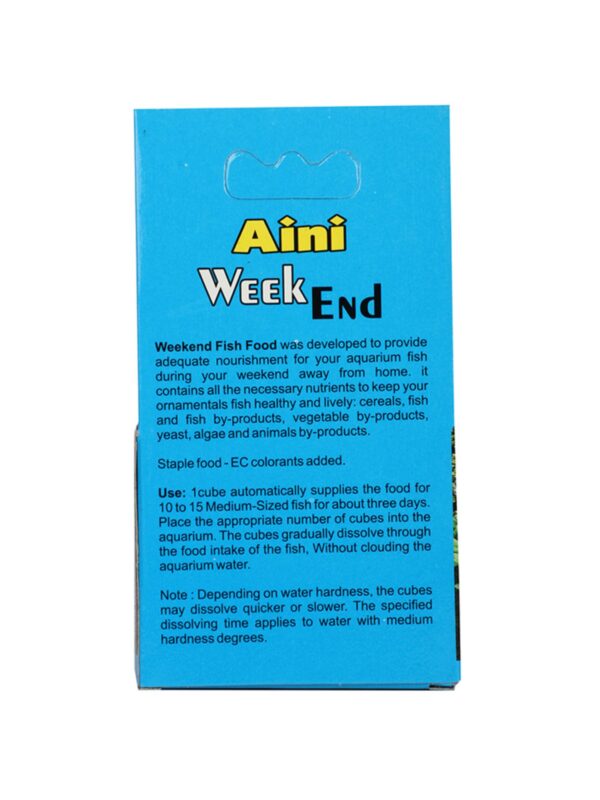
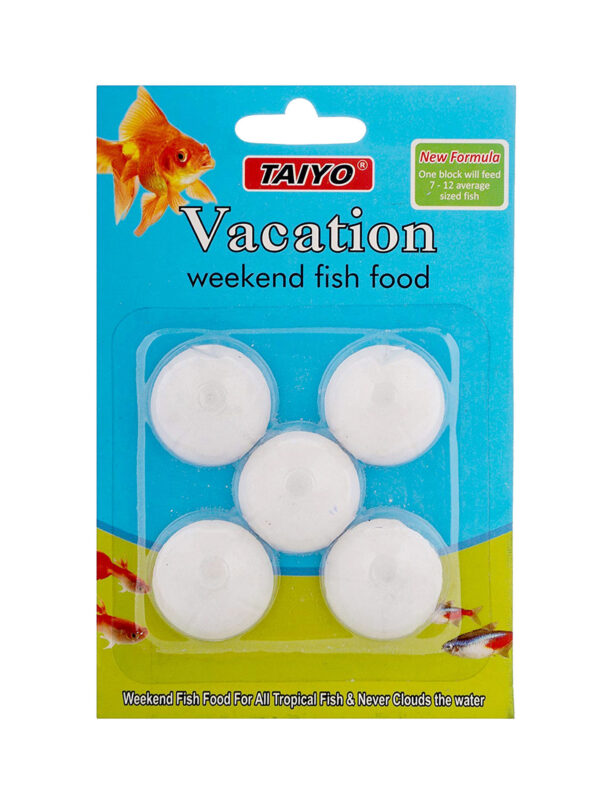
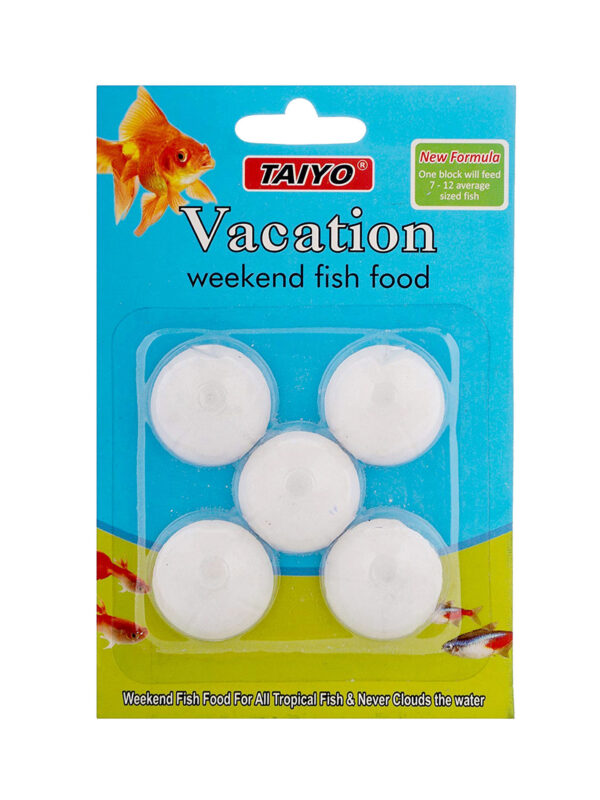
Aini Weekend Food is a slow-release feeding block formulated for short absences of a few days — a weekend trip, not a full two-week holiday. It's a compressed, porous block (usually gypsum- or gelatin-bound with a mix of fish meal, plant matter, and binders) that sits in the tank and gradually dissolves, releasing small amounts of food over time instead of one large dose all at once.
The idea is to mimic a light, steady grazing supply rather than a single big feeding that a fish can't fully use and that fouls the water. It's meant as a stand-in for your normal feeding routine while you're away, not a everyday replacement for regular pellets or flakes.
Mechanically, the block works by controlled erosion: the binder matrix resists rapid dissolving, so only the outer surface breaks down at a time, exposing fresh food material gradually as fish nibble and water slowly wears it away. This is different from a plain flake or pellet dropped in bulk, which either gets eaten immediately or sits and rots — the block is engineered specifically to release food at roughly the rate a tank can use it, spread across the whole absence rather than front-loaded on day one.
It suits most community tropical fish that graze opportunistically throughout the day — tetras, barbs, livebearers, rasboras, and similar mid-water and bottom-dwelling omnivores that will pick at a stationary block. It is not a substitute for proper daily nutrition long-term, and it is not appropriate for fussy or highly food-driven species that need a specific diet (fry, some cichlids, obligate carnivores, or fish that only recognize live/frozen food and may simply ignore a block entirely).
Because it's a passive food source, fish that are naturally shy, slow feeders, or lower in a tank's social hierarchy may end up getting less of it than more assertive, faster-moving tankmates, exactly as would happen with any shared food source. This is rarely a problem over a two-to-four day span for an otherwise healthy tank, but it's worth keeping in mind for a mixed-species community where feeding competition is already a known issue.
Requirements
Use one block per the size guidance on the packaging relative to your tank volume — oversized or multiple blocks in a small tank can cloud the water and spike ammonia as unused material breaks down. Drop it in just before you leave, not days in advance, so it's fresh when it starts dissolving.
Because it dissolves continuously, water quality will drift a little more than usual over a few days — this is expected and normally not a problem for an otherwise healthy, established tank with a working filter, but it isn't recommended in a very small or newly-cycled tank where the bioload swing is proportionally larger. A tank under roughly 20 litres, or one still cycling, is a poor candidate for any feeding block since there's less water volume to buffer the extra organic load.
Before leaving, it's worth doing a normal water change and a filter check so the tank starts the absence in the best possible state — a block is meant to bridge a gap in an otherwise stable system, not compensate for a tank that's already struggling. If you have a friend or neighbour able to check in even once, that's still worth arranging even with a feeding block in place, since it can't substitute for someone noticing an equipment failure (a stopped filter or heater) the way a daily visit would.
Store unused blocks in a cool, dry place, sealed against moisture — a block that's absorbed humidity will crumble and dissolve much faster than intended, effectively dumping most of its food in the first day instead of spreading it out. Check the pack date and don't use blocks that are visibly damp, cracked, or past their shelf life, since a compromised block can foul water faster than it feeds fish.
Compatibility

Feeding Guidelines
Aini Weekend Food is meant to be used occasionally, not as a daily staple. Treat it the same way you'd treat any temporary feeding solution — convenient for a short gap, not a long-term routine:
- Duration: intended for roughly a weekend (2–4 days), shorter than dedicated 7–14 day vacation blocks — don't stretch it across a longer trip expecting the same steady release
- Dosing: one block per the tank-size guidance on the packaging; don't add extra "to be safe," since oversizing the dose is the single most common cause of a fouled tank on return
- Placement: drop it somewhere with reasonable water flow so dissolved particles circulate rather than settling in one dead spot; avoid wedging it directly against a filter intake
- Storage: cool, dry, sealed container, away from direct sunlight and humidity, ideally in its original resealable packaging
- Shelf life: check the printed date and discard anything visibly crumbling, discoloured, or damp before use — a degraded block dissolves unpredictably fast
- After use: remove any undissolved remainder once you're back and resume normal feeding immediately; don't leave a partially-dissolved chunk sitting in the tank
- First feeding back: do a partial water change and a quick water-quality check (ammonia/nitrite) on your return before resuming a full feeding schedule, just to confirm the block behaved as expected
- Not a habit: reach for this only when actually away — for normal daily feeding, a measured pinch of regular flake or pellet food that's fully eaten within a couple of minutes is always the better routine
- Combining with other approaches: for trips longer than a weekend, pair this with an automatic feeder or a trusted person doing a quick check rather than relying on the block alone to stretch further than it's designed for