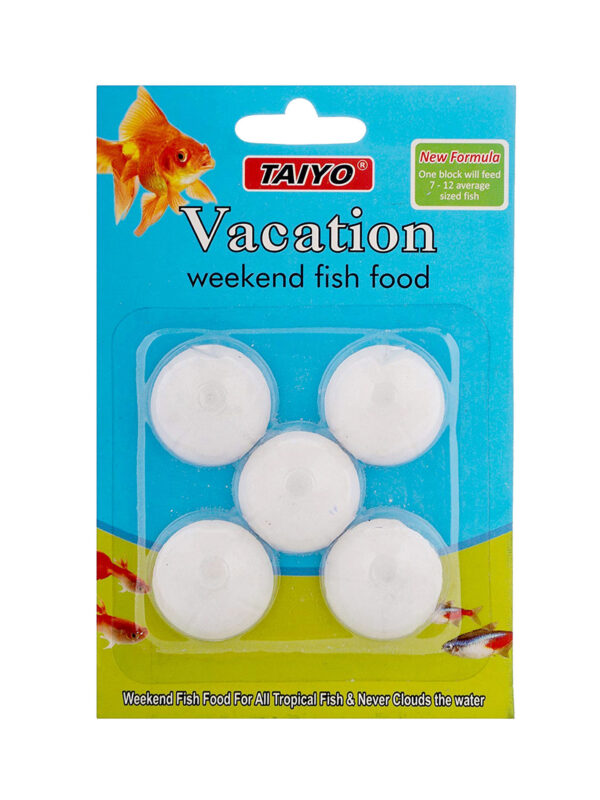
About
Holiday Food is a slow-release feeding block designed to feed your fish automatically while you're away for an extended trip — typically covering roughly one to two weeks, longer than a short "weekend" block. It's a compressed, slow-dissolving block that releases small amounts of food gradually rather than all at once.
The intent is to approximate a light, steady food supply during your absence, not to replicate your normal feeding routine exactly — it's a stopgap measure for when no one is available to feed the fish directly, not a long-term replacement for regular feeding.
Because the intended duration is longer than a weekend block, the block itself is typically denser and larger, formulated to erode more slowly so it lasts the full one-to-two-week span without dissolving away in the first few days. That slower erosion rate is exactly why correct sizing matters more here than with a short-trip product — a block that's too small for the trip length will simply run out early, while an oversized one for the tank volume risks overloading the water with more organic material than the trip's water changes (which, by definition, aren't happening) can buffer.
It's generally suited to most community omnivorous fish that will graze on it opportunistically — tetras, barbs, danios, livebearers, and similar mixed feeders. It isn't a good substitute for species with very specific dietary needs, or for a heavily-stocked or otherwise unstable tank where the added bioload from a dissolving block, sustained over a much longer period than a weekend block, is proportionally riskier.
Most healthy adult fish can also comfortably fast for a week or more without a feeding block at all — it's a convenience for peace of mind and for tanks with more food-driven or smaller fish that do better with a steady trickle of nutrition, not a strict biological necessity for every species. Weighing that against the water-quality tradeoff of a dissolving block is worth doing before assuming one is automatically the right choice for every tank.
Requirements
Use one block sized appropriately to your tank volume per the packaging guidance — more blocks or an oversized block for a small tank will over-supply food and can spike ammonia as excess material breaks down unused. For a trip this long, err toward the smaller end of the recommended range if your tank is lightly stocked, since accumulated excess over one to two weeks is far more consequential than it would be over a single weekend.
Add the block just before leaving so it's fresh for the full duration of your trip. Water quality will drift somewhat more than during normal feeding as the block continuously dissolves — this is expected in a healthy, established tank, but it's not a good idea in a newly-cycled or very small tank, both of which have much less buffering capacity to absorb a week or two of steadily building organic load without any water changes in between.
Because the absence is longer, it's worth treating equipment reliability as seriously as the food itself: a filter that clogs, a heater that fails, or a light left on 24 hours a day for two weeks can all do more harm than the feeding gap ever would. A timer for lighting and, where practical, a second person checking in partway through the trip are both worth arranging alongside the food block, not instead of it.
On your return, remove any undissolved remainder promptly and resume your normal feeding schedule rather than continuing to leave the block in — don't let it linger "just in case," since a stale, partially-dissolved block sitting in the tank longer than intended is more likely to cloud the water than to still be useful as food.
Compatibility
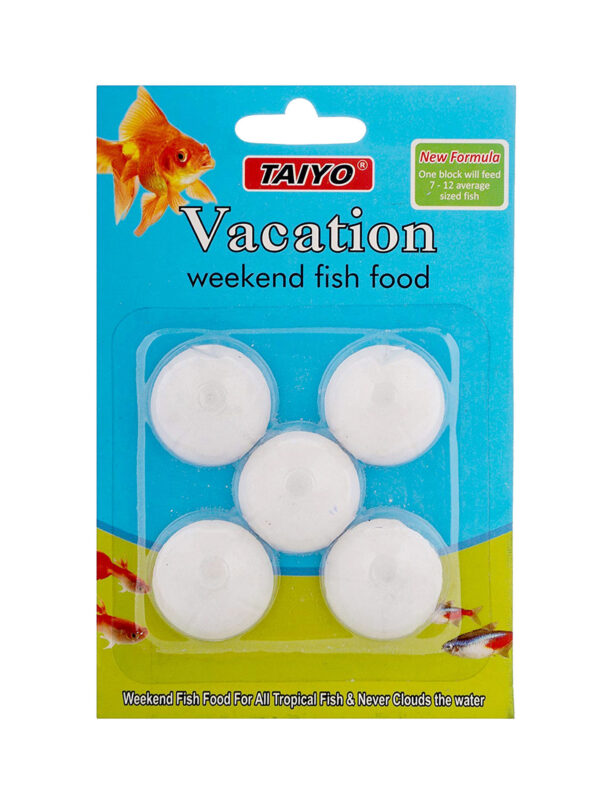
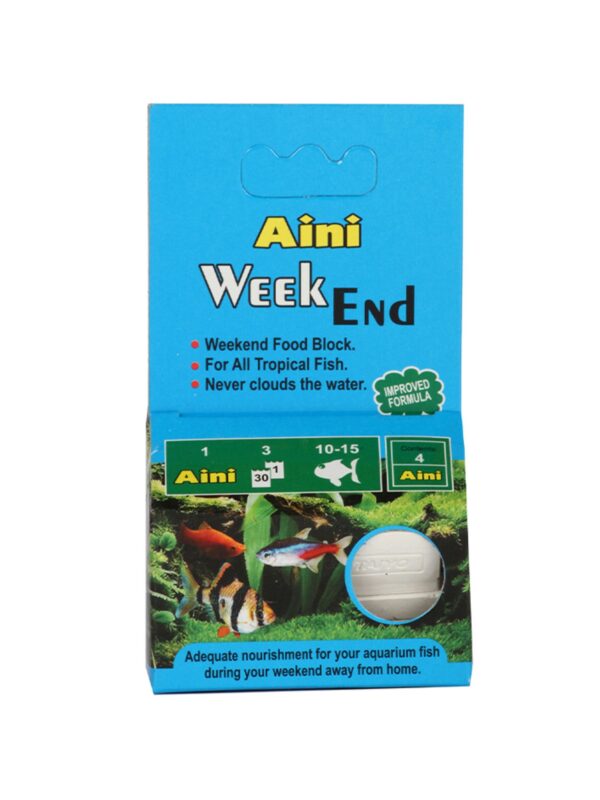

Feeding Guidelines
Because it's meant for extended absences, dosing correctly for your tank size matters more than with everyday food, and there's less room to correct a mistake mid-trip:
- Duration: designed for roughly one to two weeks, longer than a weekend-only block — check the packaging for the specific coverage window before your trip length
- Dosing: one block sized to tank volume per packaging guidance; for a lightly-stocked tank, lean toward the lower end of the size range rather than the higher end
- Placement: position it where there's some water movement so dissolved material disperses rather than settling and fouling one corner
- Storage: cool, dry, sealed away from humidity before use, ideally in its original packaging until the day you leave
- Pre-trip check: confirm the filter, heater, and any lighting timer are all working normally before you go — a food block can't compensate for an equipment failure over a one-to-two-week absence
- After use: remove leftover block material and resume normal feeding immediately on return; do a partial water change and check ammonia/nitrite before assuming everything is fine
- Shelf life: check for a printed use-by date and don't use a block that's cracked, discoloured, or feels damp — a compromised block dissolves unpredictably and can release its full load far faster than intended
- Not a routine: reserve this for genuine extended absences; for normal day-to-day feeding, a small measured amount of regular food eaten within a couple of minutes is always better for water quality
- Backup plan for longer trips: if you'll be away much longer than two weeks, pair this with a battery-powered automatic feeder or a trusted person doing periodic checks rather than relying on a single block to stretch indefinitely