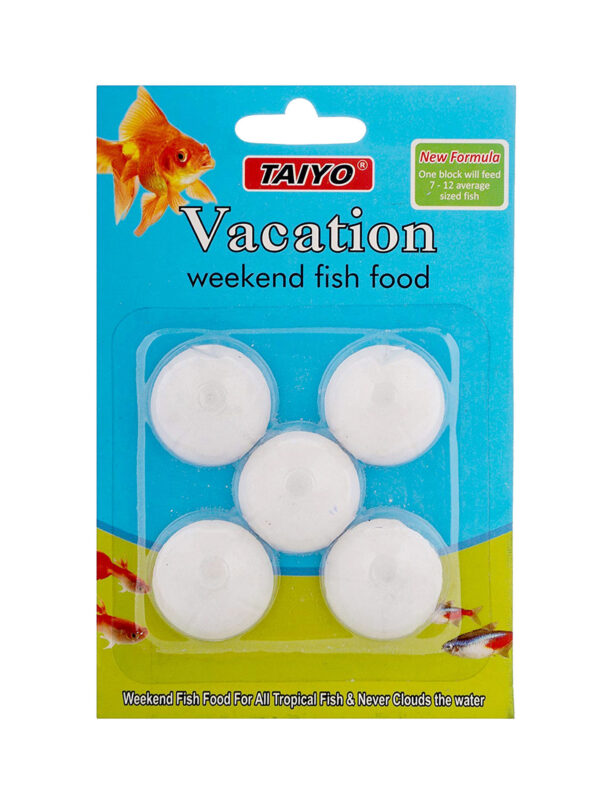
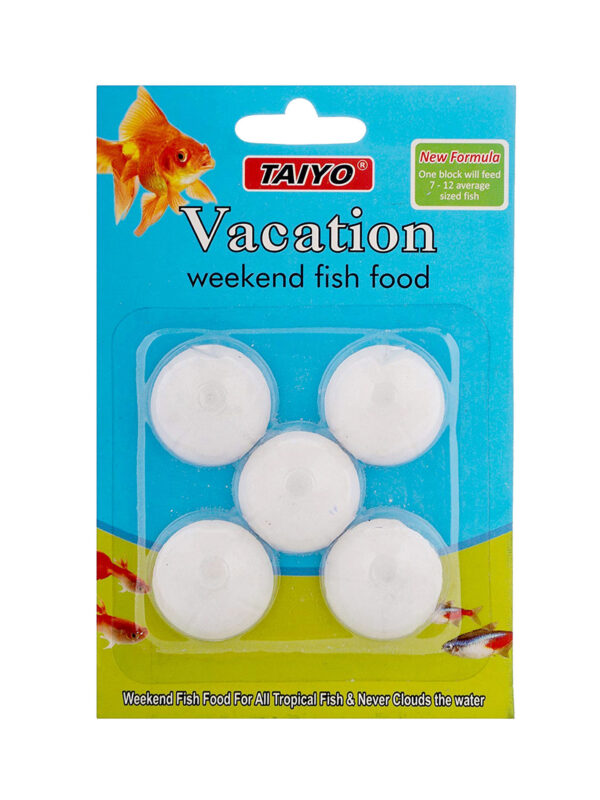
About
Taiyo Vacation Food is a slow-release feeding block from the Taiyo brand, designed to feed fish automatically over an extended absence — typically around one to two weeks — by gradually dissolving and releasing small amounts of food rather than delivering it all at once.
Like other vacation-feeding blocks, it's meant as a stopgap for when no one can feed the fish directly, approximating a light steady food supply rather than replicating a normal feeding routine. Taiyo is an established name in the Indian aquarium-food market known primarily for everyday staple foods (their standard packet food is a common budget-friendly choice for community tanks), and this vacation block is their extended-absence counterpart to that regular line rather than a separate specialty product.
The block itself is a compressed, mineral- or gelatin-bound matrix of fish meal and plant-based filler that erodes gradually in water rather than dissolving instantly, so fish get a trickle of food across the whole trip instead of one large dump on day one that would just as quickly turn into waste. This controlled-release mechanism is really what distinguishes a purpose-built vacation block from simply leaving a larger-than-normal pile of ordinary flake food in the tank, which would dissolve and foul the water far too quickly to actually help.
It suits most community omnivorous fish that graze opportunistically — tetras, barbs, danios, mollies, platies, and similar mixed feeders. It isn't a good substitute for fish with specialised diets (strict carnivores, fry needing frequent small feedings), and isn't recommended in small, newly-established, or already heavily-stocked tanks where the added bioload is riskier relative to the water volume available to dilute it.
Most established fish tolerate a week or two without feeding at all quite well biologically — this product exists mainly for peace of mind and to keep smaller, more food-driven fish from losing condition, rather than as a strict survival necessity. Whether it's worth using at all for a given tank is worth weighing against that background fact, especially for a robust, well-fed adult population.
Requirements
Use one block sized to your tank volume per the packaging guidance — oversized or multiple blocks can over-supply food and spike ammonia as unused material breaks down. When in doubt between two size options, the smaller one paired with a healthy existing tank is generally the safer choice.
Add it just before leaving so it's fresh for your full trip. Expect some water-quality drift during use, which is normal for a healthy established tank with a mature filter and reasonable stocking, but not advisable in an unstable, newly-cycled, or very small tank where there's less buffering capacity to absorb the steady trickle of extra organic material over one to two weeks.
Since the trip is long enough that no one will be checking daily, equipment reliability matters as much as the food itself — confirm the filter and heater are both functioning normally before leaving, and put any tank lighting on a timer rather than leaving it running continuously or off entirely for the whole absence.
It's also worth doing a routine water change and a light gravel clean in the days before you leave, so the tank starts the unattended period as clean as possible — the block is meant to bridge a feeding gap in an already-stable system, not compensate for a tank that was already due for maintenance.
If your tank has a mix of fast, assertive feeders and slower or shyer ones, be aware the block won't distribute itself evenly among them any more than a normal feeding would — it simply sits in place and whichever fish reach it first get the most benefit. This is rarely a serious problem over one to two weeks in an already-healthy community, but it's a real limitation worth knowing about rather than assuming perfectly even feeding.
On returning, remove any undissolved remainder and resume your normal feeding schedule promptly rather than leaving the block in longer than needed — a lingering, mostly-spent block adds more to the bioload than it contributes in usable food at that point.
Compatibility
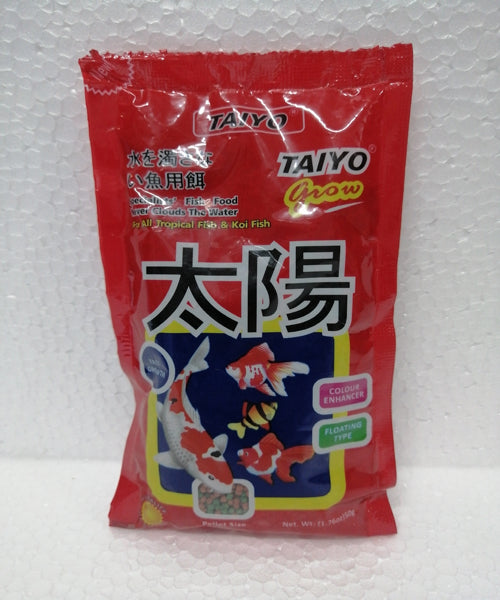
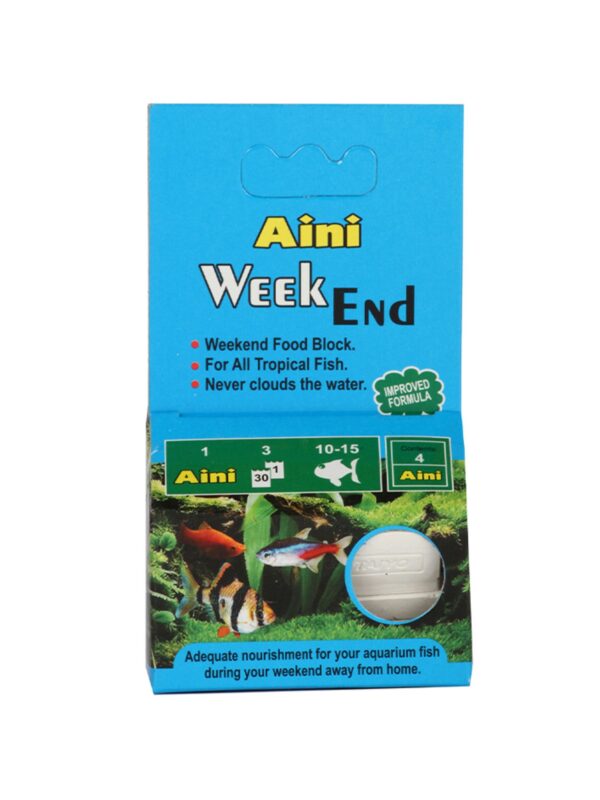
Feeding Guidelines
As with any vacation block, correct dosing for tank size and prompt cleanup afterward matter most for keeping water quality stable across the whole absence:
- Duration: designed for roughly one to two weeks — check the specific packaging for the exact window before matching it to your trip length
- Dosing: one block sized to tank volume per packaging guidance; lean toward the smaller recommended size for a lightly-stocked tank
- Placement: set it somewhere with mild water movement so dissolved material disperses evenly rather than concentrating in one spot
- Storage: cool, dry, sealed away from humidity before use, ideally left in its original packaging until departure day
- Pre-trip equipment check: confirm filter and heater are both working, and set lighting on a timer, before relying on the block to handle feeding alone
- Shelf life: avoid using a block that's cracked, crumbling, or feels damp, since a compromised block dissolves unpredictably fast
- After use: remove leftover material and resume normal feeding on return; a partial water change and a quick ammonia check are good practice before assuming everything went smoothly
- Not for daily use: this is an occasional-trip product, not a routine replacement for measured daily flake or pellet feeding, which remains better for water quality and lets you actually watch each fish eat and check on its condition
- Longer trips: if you'll be away well beyond two weeks, combine this with an automatic feeder or a trusted person checking in rather than expecting one block to stretch indefinitely
- Uneven distribution: faster, more assertive fish will tend to get more of the block's food than shy or slow tankmates, same as with any shared food source, so this isn't a guarantee of perfectly equal feeding across a mixed community