About & Origin
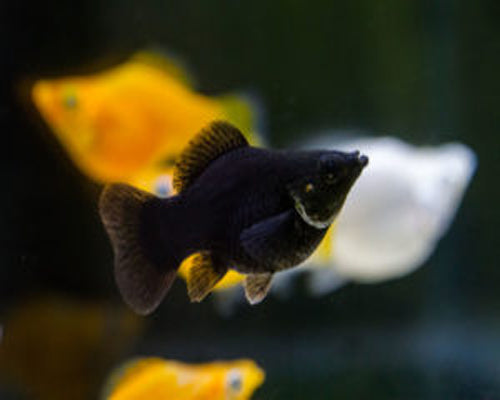
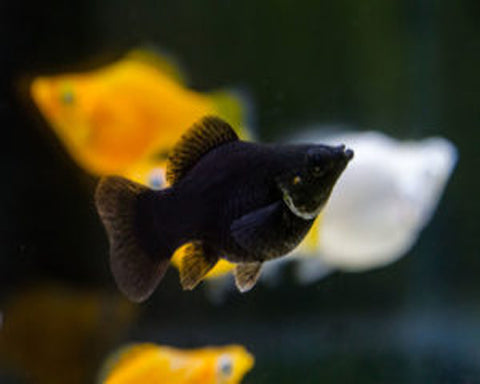
The Black Balloon Molly is a selectively bred, solid-black colour and body-shape variant of Poecilia sphenops, the short-finned molly — a livebearer fish whose wild ancestors are native to fresh, brackish, and coastal waters of Central America and parts of the southern United States and Mexico.
The "balloon" body shape -- a shortened, rounded, compact body compared to a standard molly's more torpedo-like profile -- is the result of decades of selective aquarium breeding for a spinal curvature, not a trait found in wild molly populations. We think it's worth being upfront about this: balloon-form fish are more prone to internal organ compression and some swimming difficulty compared to standard-bodied mollies, which is a genuine trade-off some keepers prefer to avoid.
Behaviourally, Black Balloon Mollies are identical to other mollies -- active, hardy livebearers that do well in groups and give birth to live, free-swimming young rather than laying eggs.
Despite the compact body shape, this variant remains a genuinely hardy fish overall and, kept in appropriate water chemistry, can live a normal molly lifespan of 3-5 years. Swimming can look slightly more laboured or less streamlined than a standard molly, particularly noticeable when the fish darts quickly, but day-to-day feeding, socialising, and general activity are typically unaffected in a healthy individual. The deep, solid black colouring is fixed by selective breeding and doesn't fade or pattern-shift with age the way some other molly colour strains can.
Requirements
Standard molly husbandry applies (hard/alkaline water, tolerates a light dash of aquarium salt, female-heavy groups, grazing omnivore diet with vegetable matter, standard filtration) — but the balloon body shape adds real, honest caveats worth knowing before buying.
The balloon shape is a spinal deformity, selectively bred for: the rounded body comes from a shortened, curved spine, not extra body fat. This is a genuine welfare trade-off some keepers choose not to support — the curvature can affect swimming ability and, in some individuals, internal organ function and lifespan compared to a standard-bodied molly.
Tank size: the same 75cm/30in+ guideline as standard mollies applies, but balloon mollies are typically weaker swimmers, so avoid strong current that a curved-spine fish would struggle against.
Diet and feeding: the compressed body means less internal space for digestion, so smaller, more frequent feedings of vegetable-inclusive food suit this shape better than one or two large feedings a day.
Tankmates: keep with calm, similarly hard-water-tolerant fish rather than fast or boisterous species that could outcompete a slower-swimming balloon-bodied fish at feeding time.
Sourcing: buy from a source that keeps breeding stock in good condition, since balloon-form livebearers bred from weak or overly inbred lines show welfare issues more severely than well-maintained lines.
Compatibility
Water & Care Conditions
- pH: 7.5–8.5 (alkaline)
- Hardness: moderately hard to hard, roughly 15–30 dGH
- Salinity: freshwater to brackish; tolerates a small dose of aquarium salt
- Temperature: 24–28°C (75–82°F)
- Water changes: weekly 20-25%
Watch for "shimmying" (a side-to-side sway without forward movement), which signals soft/acidic or unstable water more than illness on its own. On a balloon-bodied fish, also watch for buoyancy problems or difficulty holding position in the water column — these can stem from the spinal curvature itself rather than water chemistry, so don't assume every swimming issue is fixable by adjusting parameters.
With correct hard/alkaline chemistry this strain is reasonably hardy, though as with any balloon-shaped livebearer its natural lifespan and swimming ability run somewhat behind a standard-bodied molly's. Not a good match for a soft, acidic community tank.
A gently sloped, buffered substrate (crushed coral or aragonite sand mixed into a standard substrate) is a common, low-effort way to help maintain the harder, more alkaline water this species prefers over the long term, particularly in regions where tap water runs naturally soft.
Consistent weekly maintenance matters more for this shape than exact numbers -- stable hard, alkaline water with regular partial changes keeps a balloon molly in noticeably better condition than water that's merely "acceptable" but fluctuates.