About & Origin
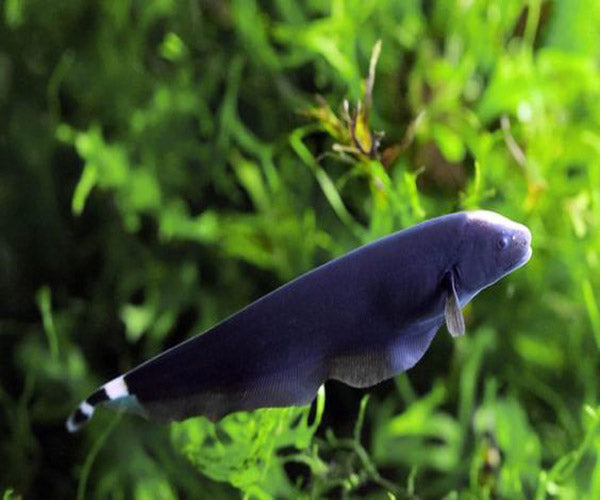
The black ghost knifefish (Apteronotus albifrons) is a nocturnal, electricity-sensing knifefish that comes from slow-flowing, murky stretches of the Amazon and other South American river systems, where it hunts at night using a weak electric field to sense its surroundings and prey rather than relying on eyesight.
Its body is a smooth, uniform black with two thin white rings near the tail and a white blaze on the nose, and it swims by rippling a long ventral fin rather than its (essentially absent) tail -- it can move forwards and backwards with equal ease, a trait that makes it one of the more mesmerising fish to watch after dark.
It's shy and largely nocturnal, especially when young, and spends daylight hours tucked into a cave, pipe, or dense planting, becoming much more active and visible once the lights go down.
The electric organ that gives this fish its "weakly electric" classification generates a continuous, low-voltage field around its body, and an array of sensitive receptor cells along its skin reads distortions in that field caused by nearby objects, prey, or other fish -- effectively a form of electrolocation that lets it navigate and hunt in complete darkness or murky water without relying on sight at all. This is the same broad sensory system used by the distantly related electric eel, though at a fraction of the voltage and purely for sensing rather than stunning prey.
In the wild it can live well over a decade, and captive specimens with good care regularly match or exceed that, making it a genuine long-term commitment rather than a short-lived novelty fish.
Despite its striking, almost eel-like silhouette, the black ghost knifefish isn't closely related to true eels or to electric eels at all -- it belongs to the Apteronotidae family of South American ghost knifefish, a group defined by that shared electrogenic sensing ability rather than by body shape alone.
Requirements
This is a fish that outgrows its cute juvenile size -- adults commonly reach 45-50cm, so a young specimen needs to be planned for a large tank eventually, generally 300+ litres (75+ gallons) for a full-grown adult, with soft sand (its chin barbels and sensitive skin dislike rough gravel) and plenty of hiding spots like PVC pipe or driftwood caves.
It's an electric fish and is sensitive to electrical interference and to being netted or handled roughly, which can damage its electric organ -- move it with a container, not a net, when you must move it at all.
It's a predator: anything small enough to fit in its mouth, including small fish and shrimp, will eventually be eaten. It accepts live and frozen bloodworms, brine shrimp, and eventually sinking pellets once settled in.
Because it's a shy, largely nocturnal feeder, newly introduced individuals can be slow to start eating in a brightly lit, busy tank -- feeding after lights-out or in dim light for the first weeks often gets a nervous new arrival eating reliably much sooner than trying to feed it in full daytime lighting alongside more assertive tankmates.
A tight-fitting lid is worth having too: like many knifefish, it's a capable jumper when startled, and an open tank top is a real escape risk.
Territorial behaviour is worth planning for as it matures: adult black ghosts can become possessive of their favoured daytime hiding spot and may spar with a similarly sized tankmate over it, so providing several separate caves or pipes spread around the tank -- rather than just one -- reduces the chance of ongoing disputes over a single prime hiding place.
Its long, undulating ventral fin is also delicate and can tear on sharp decor edges or aggressive nipping from boisterous tankmates, so smooth-edged hardscape and calm, appropriately sized companions matter for keeping it looking its best.
Compatibility
Water & Care Conditions
It comes from calm, slow-flowing blackwater and whitewater habitats, so avoid replicating a fast, turbulent river setup:
- pH: 6.0–7.5
- Water hardness: soft, 2–15 dGH
- Temperature: 24–28°C (75–82°F)
- Oxygenation: moderate, gentle flow -- avoid strong direct current, which this slow-water species doesn't naturally encounter
- Substrate: soft sand rather than gravel -- its chin barbels and sensitive skin are prone to irritation and injury on sharp or coarse substrate
- Lighting: dim to moderate, with shaded hiding spots -- this is a nocturnal species and bright, shadow-free lighting keeps it stressed and permanently hidden
- Electrical sensitivity: avoid stray electrical current in the water (check heater/pump seals and grounding) -- this species is unusually sensitive to it given its own electric-sensing organ
- Handling: never net this fish if avoidable -- use a soft container to scoop and move it, since rough handling or contact with a net can damage its electric organ
- Water quality: sensitive to poor water quality and ammonia/nitrite spikes despite its otherwise tolerant chemistry range -- weekly partial water changes and stable, mature filtration matter more here than chasing exact numbers
- Acclimation: can be slow to settle and start eating after transport -- give a newly arrived fish several quiet, dimly lit days with minimal disturbance before expecting normal feeding behaviour
- Tank cover: a secure, tight-fitting lid is essential -- this species can jump when startled, and gaps around equipment cutouts are worth checking and blocking
- Longevity planning: a well-kept individual can live over a decade, so its housing and tankmates are worth choosing for the long term rather than for a temporary setup
- Feeding schedule: feed once daily, ideally after lights-out or in dim light, matching its natural nocturnal, low-visibility feeding behaviour rather than a bright midday routine