About & Origin
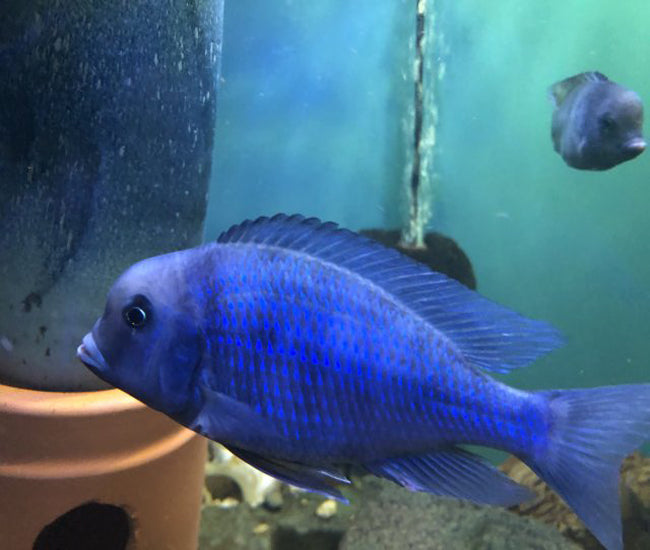
The Malawi Blue Dolphin (Cyrtocara moorii) is a Lake Malawi cichlid, named for the pronounced nuchal hump males develop on the forehead as they mature, giving the profile a dolphin-like curve. In the wild it's found over open sandy stretches and intermediate rock/sand zones of Lake Malawi in East Africa, where it forages by sifting through sand for buried invertebrates — sometimes even following larger cichlids that disturb the substrate, picking off whatever gets stirred up.
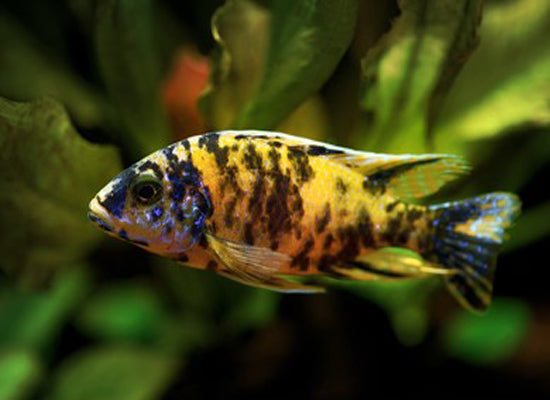
As an adult this species develops the striking powder-blue body colour it's best known for, deepening with age and diet. It's one of the calmer Lake Malawi cichlids, notably peaceful for a rift lake species, and does best kept in a small group rather than alone.
Adults reach around 20–25 cm (8–10 inches), with males developing the characteristic head hump; this is a mid-to-large, long-term commitment fish, not a starter cichlid for a small tank. This listing is for young 3-4 inch juveniles, which are still mostly grey-blue and haven't developed the full hump or depth of colour yet — buyers should plan tank size around the adult, not the juvenile, size.
Like other Lake Malawi haps, it's a maternal mouthbrooder: the female carries fertilized eggs in her mouth for roughly three to four weeks after spawning over open sand, releasing free-swimming fry once they can fend for themselves. It's a genuinely easy species to breed by accident in a mixed Malawi community once fish mature.
A well-kept individual can live eight to ten years or more, so this juvenile listing represents a genuinely long-term stocking decision — worth planning the eventual tank size and tankmate roster around from the outset rather than upgrading reactively as the fish grows.
Colour deepens gradually with age, and a young 3-4 inch fish will look considerably plainer than the fully-coloured adult it will grow into — this is entirely normal, not a sign of poor condition.
Requirements
A minimum of 350+ litres (90+ US gallons) is recommended for a small group as adults, with a fine sand substrate — this species sifts sand constantly and can injure itself on coarse gravel.
Temperament: unusually peaceful for a Malawi cichlid, which makes it a good "calming" addition to a mixed Malawi community, though it's still large enough to hold its own. It's naturally social and does best kept in a small group of three or more rather than alone.
Diet: omnivorous — a good quality cichlid pellet plus occasional live or frozen food (brine shrimp, mysis); avoid high-protein foods meant for carnivorous fish, as Malawi cichlids are prone to Malawi bloat on rich diets. Small, frequent feedings suit this grazing, sand-sifting species better than one large daily meal.
Filtration: Malawi cichlids generate a heavy bioload for their size, so filtration rated well above the tank's nominal volume helps avoid the cloudy water and creeping nitrates a marginal filter tends to produce — worth budgeting for from the start rather than upgrading later.
Tankmates: pairs naturally with other similarly hard-water Malawi haps and peacocks; avoid mixing with the more combative mbuna, which can bully this species' unusually calm temperament, or with any soft-water fish whose chemistry needs directly conflict with Rift Lake conditions.
Décor: open sandy areas for foraging alongside some rockwork for other tankmates to claim as territory — this species itself doesn't need caves. Live plants rooted directly in the substrate rarely survive this fish's constant sand-sifting, so potted or hardscape-mounted plants work better if greenery is wanted.
Tankmates: pairs well with other similarly hard-water Malawi haps and peacocks rather than the more combative mbuna, which can bully its calmer temperament.
Compatibility
Water & Care Conditions
These parameters follow the natural chemistry of Lake Malawi's Rift Valley water — they aren't flexible in the way softer-water community fish can be:
- pH: 7.8–8.6 (Lake Malawi is naturally hard and alkaline — this is not optional, low-pH water stresses these fish over time)
- Water hardness: 10–20 dGH (200–350 ppm); many keepers add crushed coral or aragonite sand to the substrate/filter to hold pH and hardness up long-term
- Temperature: 24–28°C (75–82°F)
- Oxygenation: strong surface agitation and filtration — Malawi cichlids are messy, heavily-stocked-tank fish that need robust biological filtration and large, regular water changes
- Ammonia/nitrite: zero at all times in a mature tank — stress from poor water quality is a common trigger for Malawi bloat, which progresses quickly and is far easier to prevent than treat
- Water changes: weekly changes of 25-30% with hardness/temperature-matched water hold parameters steady, which matters more for rift lake cichlids than for most community fish since they evolved in a remarkably stable natural environment
Test kits for pH, ammonia, nitrite, and nitrate are worth running weekly while a tank is still cycling and maturing, then monthly once stable, since buffering material like crushed coral gradually loses effectiveness and can let pH drift down without any obvious visual warning sign until fish begin to show stress. Watch for the early signs of Malawi bloat -- appetite loss, laboured breathing, pale stringy faeces, and abdominal swelling -- since it is much easier to head off early with a water change and a short fast than to treat once advanced. New water used for changes should be matched to tank temperature and, ideally, hardness before it goes in, rather than added straight from a typically softer tap supply, to avoid repeated swings in chemistry.
This item is sold at the 3–4 inch juvenile stage — the head hump and full powder-blue colour develop with age.