About & Origin
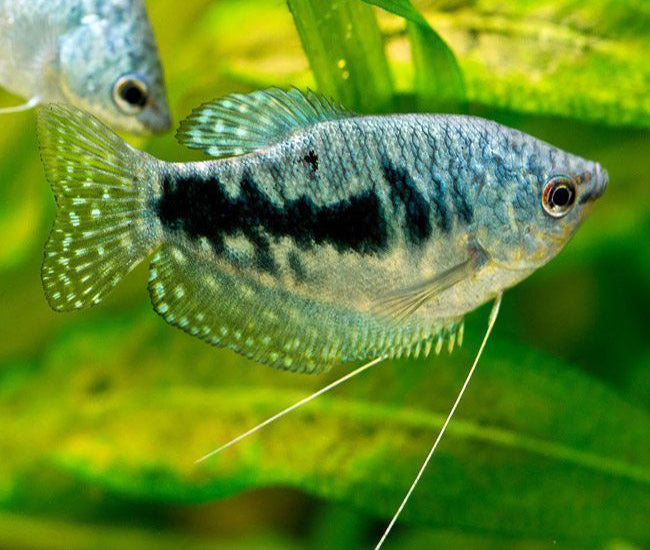
The Blue Gourami is a colour form of the three-spot gourami, Trichopodus trichopterus, a labyrinth fish native to the still and slow-moving waters of Southeast Asia — the floodplains, rice paddies, ponds, and swamps of Thailand, Cambodia, Vietnam, and neighbouring countries. Like all labyrinth fish, it has evolved a specialised organ that lets it breathe atmospheric air directly at the surface, an adaptation to the warm, often oxygen-poor, densely vegetated waters it comes from.
The name "three-spot" refers to two visible dark spots along the body (the "third spot" is the eye itself, completing the pattern), though on the solid blue form those spots are much fainter or barely visible against the deep, powdery blue body colour. It's a substantial gourami by aquarium standards, with long, trailing pelvic fins that the fish uses almost like feelers to sense its surroundings.
Blue Gouramis are intelligent, curious fish that will often approach the front of the tank and seem to "watch" activity in the room, learning fairly quickly to associate their owner with feeding time — a personable quality that has made them a long-standing favourite in the hobby despite their more assertive adult temperament. They are also relatively long-lived for a community fish, commonly reaching four to six years or more with good care, which is worth factoring into the long-term commitment of keeping one.
In their native range, three-spot gouramis are found in shallow, densely vegetated, often warm and slow-flowing waters that can seasonally drop in dissolved oxygen — exactly the conditions their labyrinth organ evolved to handle, letting them survive in habitats that would leave many purely gill-breathing fish struggling. This background also explains their comfort near the water's surface and their general tolerance for a wide range of water conditions in captivity, since the wild populations experience considerable seasonal variation themselves between wet and dry periods.
Requirements
Blue Gouramis are easy to keep and undemanding about water chemistry, but they grow considerably larger and become more territorial than a beginner might expect from their calm, unassuming appearance as juveniles in a shop tank.
Tank size: adults reach 10–15 cm (4–6 inches) and need a minimum of roughly 75–100 litres (20+ gallons) with plenty of open swimming space at the middle and upper levels, plus some planted or decorated cover to break up sightlines and give more timid tankmates somewhere to retreat.
Temperament: juveniles are generally peaceful and can be housed in a community setup without issue, but as they mature — particularly males, and especially if more than one male is present — they can become territorial and occasionally aggressive toward other gouramis, similarly shaped fish, or slow, long-finned tankmates that can't get out of the way. One Blue Gourami per tank, or a carefully chosen, well-spaced group in a genuinely large tank, is the safer long-term approach.
Labyrinth organ: because they must periodically surface to gulp air, the airspace directly above the water should not be sealed off, and shouldn't be noticeably colder than the water itself — breathing cold air at the surface can chill and stress the fish even when the water temperature is fine.
Diet: omnivorous and thoroughly unfussy — a good-quality flake or pellet as a daily staple, supplemented with live or frozen foods (bloodworm, brine shrimp) and some vegetable matter for a well-rounded diet and good long-term condition.
Decor and hiding spots: providing broken sightlines with plants, driftwood, or rockwork gives a Blue Gourami — and any tankmates — places to retreat and establish loose territories, which noticeably reduces the amount of open-water chasing and confrontation compared to a bare tank with nowhere to break line of sight.
Compatibility
Water & Care Conditions
Blue Gouramis are tolerant, adaptable fish thanks to their labyrinth organ and their naturally variable native habitat, and they generally do well within these ranges:
- pH: 6.0–8.0 — a genuinely wide comfortable range, reflecting the variable floodplain and rice-paddy waters they naturally inhabit through the seasons
- Hardness: soft to moderately hard, roughly 5–18 dGH
- Temperature: 24–28°C (75–82°F)
- Oxygenation: notably undemanding compared to most fish, since they can breathe atmospheric air directly at the surface — this makes them unusually tolerant of lower dissolved oxygen than most community fish, though normal filtration and water quality still matter a great deal for their overall health and immune resistance
Because they rely on gulping air at the surface, avoid strong surface agitation or a design that would make reaching the surface difficult, and always leave an accessible, unobstructed airspace above the waterline rather than a fully sealed lid with no gap.
Routine maintenance is otherwise standard for a community tank of this size — a weekly or fortnightly partial water change of 20–25%, regular filter maintenance, and periodic water testing are enough to keep a Blue Gourami healthy for its full, relatively long lifespan.
Because they're naturally tolerant of variable conditions, Blue Gouramis are also a reasonable choice for a tank going through its early cycling period, provided ammonia and nitrite are monitored closely rather than assumed to be harmless just because the fish looks fine on the surface — tolerance for imperfect water isn't the same as immunity to it, and a fish showing no obvious symptoms can still be under real physiological stress.
Watch for a few labyrinth-fish-specific health signs: laboured or unusually rapid surfacing to gulp air can indicate poor water quality or a labyrinth organ infection, and any damage to the fine, feeler-like pelvic fins (from rough tankmates or sharp decor) is worth keeping an eye on, since these fins are used constantly to sense the environment and don't regenerate quickly once damaged.