About & Origin
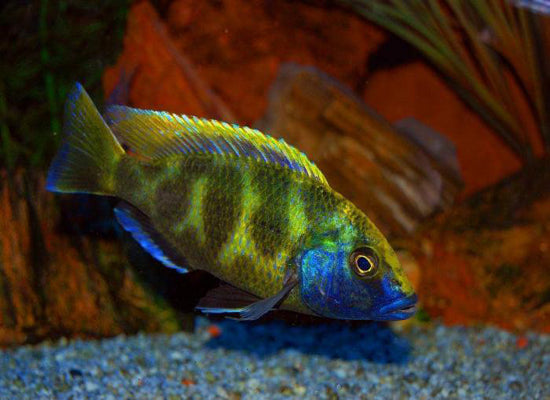
The Venustus (Nimbochromis venustus, often sold simply as "Venus cichlid") is a large Lake Malawi cichlid (a "hap") known for its distinctive marbled, leopard-like blotching over a golden-cream base — genuinely one of the more unusual patterns among Malawi cichlids, most of which trend toward solid or barred colouring instead.
It's also known for an unusual hunting behaviour in the wild: venustus will lie motionless on the sandy lake bottom, using its blotched camouflage to mimic a dead or dying fish, then strike at smaller fish that approach to investigate — a genuine example of "playing dead" as a predatory strategy in cichlids.
Males develop a striking blue face as they mature, contrasting with the golden-brown blotched body, and reach a substantial 20–25 cm (8–10 inches) as adults — a large, predatory Malawi hap, not a peaceful community peacock.
Like other Malawi haps, it's a maternal mouthbrooder, with females carrying fertilized eggs for roughly three to four weeks before releasing free-swimming fry. This is a genuinely long-term-commitment fish given both its eventual size and typical cichlid lifespan of eight to ten years or more in a well-kept tank, so buyers should plan tank size and stocking around the adult it will become, not the juvenile it's sold as.
The genus name Nimbochromis references this "playing dead" hunting strategy directly, and it's one of the better-documented examples of deceptive/ambush predation in freshwater cichlids — a genuinely interesting behavioural trait for anyone who enjoys observing natural fish behaviour rather than just colour. Juveniles show a paler, less developed version of the adult blotching, which intensifies with age and size, and the male's blue face develops gradually as he matures and establishes territory rather than being present from a young age.
Requirements
300+ litres (75+ US gallons) given its adult size and predatory nature.
Temperament: semi-aggressive to predatory — genuinely dangerous to fish small enough to fit in its mouth, given its ambush-hunting instincts described above. Safe with similarly-sized Malawi haps and peacocks, not with small fish of any kind.
Diet: meaty foods — this is one of the more predatory Malawi species, so a cichlid pellet plus regular frozen or live meaty food suits it better than a vegetable-forward mbuna diet.
Décor: open sand areas (it hunts from the substrate) alongside rockwork for other tankmates' territories.
Filtration and water changes: given the adult size and meaty diet, oversized filtration plus weekly 25-30% water changes with temperature- and hardness-matched water keep waste and nitrates under control in a way a marginal setup won't manage long-term.
Growth rate: this species grows quickly when well fed, so buyers should be prepared to upgrade tank size on a realistic timeline rather than assuming a small starter tank will suffice for more than the first several months.
Ambush setup: a patch of open sand where the fish can lie still and "play dead" is a genuine behavioural need, not just aesthetic — without it, this natural hunting display simply won't happen, though the fish will still feed normally from a bowl or the substrate directly, and remains an impressive, large showpiece fish either way.
Tankmate sizing rule of thumb: as a general guide, any fish small enough to be swallowed whole is at risk — this includes most small tetras, rasboras, and juvenile cichlids, so stock only species that will grow to a comparable size well before they're introduced together, and expect any borderline-sized tankmate to eventually be at risk as the venustus continues growing toward its full adult length.
Compatibility
Water & Care Conditions
These parameters follow the natural chemistry of Lake Malawi's Rift Valley water — they aren't flexible in the way softer-water community fish can be:
- pH: 7.8–8.6 (Lake Malawi is naturally hard and alkaline — this is not optional, low-pH water stresses these fish over time)
- Water hardness: 10–20 dGH (200–350 ppm); many keepers add crushed coral or aragonite sand to the substrate/filter to hold pH and hardness up long-term
- Temperature: 24–28°C (75–82°F)
- Oxygenation: strong surface agitation and filtration — Malawi cichlids are messy, heavily-stocked-tank fish that need robust biological filtration and large, regular water changes
- Ammonia/nitrite: zero at all times in a mature tank — stress from poor water quality is a common trigger for Malawi bloat, which progresses quickly and is far easier to prevent than treat
- Water changes: weekly changes of 25-30% with hardness/temperature-matched water hold parameters steady, which matters more for rift lake cichlids than for most community fish since they evolved in a remarkably stable natural environment
Test kits for pH, ammonia, nitrite, and nitrate are worth running weekly while a tank is still cycling and maturing, then monthly once stable, since buffering material like crushed coral gradually loses effectiveness and can let pH drift down without any obvious visual warning sign until fish begin to show stress. Watch for the early signs of Malawi bloat -- appetite loss, laboured breathing, pale stringy faeces, and abdominal swelling -- since it is much easier to head off early with a water change and a short fast than to treat once advanced. New water used for changes should be matched to tank temperature and, ideally, hardness before it goes in, rather than added straight from a typically softer tap supply, to avoid repeated swings in chemistry.
Given its predatory hunting style, never keep this species with fish small enough to be swallowed.