About & Origin
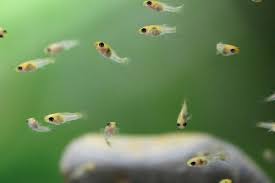
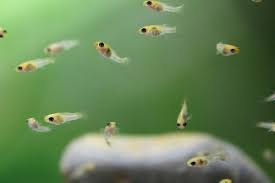
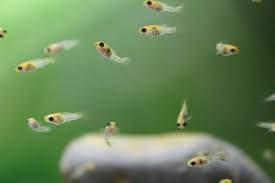
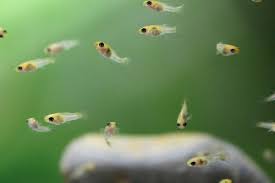
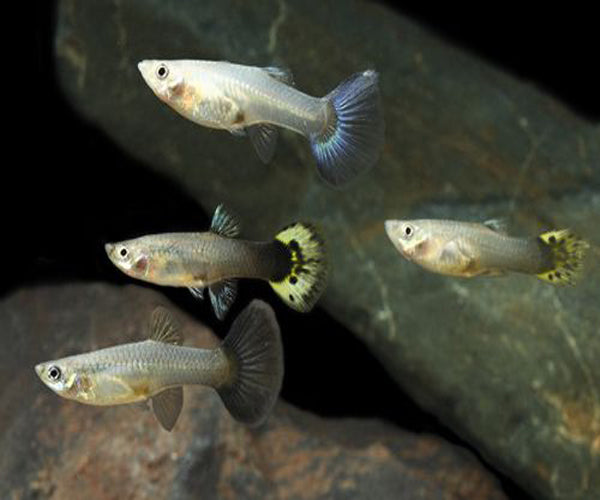
These are ordinary common guppies — a small livebearing freshwater fish, Poecilia reticulata — sold specifically as budget-priced feeder stock rather than as display fish — typically bought in bulk to provide live food for large predatory fish such as oscars, flowerhorns, and arowana, which take live prey readily and benefit from the enrichment and natural hunting behaviour that live feeding provides. They are the same hardy, fast-breeding livebearer species native to Venezuela, Trinidad, and northern South America that underpins every fancy-strain guppy in the hobby, just without the selective colour breeding.
Because they aren't bred for ornamental colour, feeding guppies are typically a plain grey-green or mixed, unremarkable colouration rather than the bright patterns of show-strain guppies — the emphasis here is on cost and breeding speed rather than appearance.
They are, biologically, exactly the same easy, adaptable fish as any other guppy, and there's nothing stopping a buyer from simply keeping a group as ordinary community fish instead of using them as feeders — they'll settle in, colour up somewhat with good food over a few generations, and breed readily either way, since the underlying genetics for bright colouration are still present, just not selected for.
Live feeding of small livebearer fish to larger predatory species is a long-standing, common practice in the hobby, particularly for fish like arowana and larger cichlids that are natural hunters and benefit from the movement and enrichment live prey provides — though many keepers also successfully raise these same predators on prepared foods (pellets, frozen items) once the fish is trained onto them, so live feeding is a choice rather than a strict requirement for most species.
Guppies are a common choice as feeder fish partly because of exactly the traits that make them a good beginner pet — they're cheap to produce in bulk, breed fast enough to be continually restocked, and are hardy enough to survive handling and transport well, unlike some more delicate feeder species.
Requirements
Whether kept as feeders or as regular community fish, feeding guppies have exactly the same basic biological needs as any other guppy strain — the difference is purely in how they're managed and housed before use.
If used as live feeders: it's worth holding a dedicated stock tank rather than adding fish directly from the bag into a predator's display tank — a short quarantine period of at least a week or two reduces the real risk of introducing disease or parasites to the predator's main tank, a genuine and fairly common concern with live feeder fish generally. Feed the stock tank normally so the guppies stay in reasonable condition and nutritional value until they're used.
If kept as display/community fish: a group does perfectly well in a 40-litre (10-gallon) tank and up, ideally with more females than males to reduce breeding pressure on individual females, and some floating or fine-leaved plants for fry to hide in if ongoing breeding is wanted.
Breeding: guppies are livebearers and breed prolifically without any special intervention at all — a small starting group, whether destined as feeders or as pets, will multiply quickly on its own given stable conditions and enough food, which is exactly why they're such a cost-effective feeder option in bulk.
Diet: omnivorous and easy to feed on a good flake or small pellet as a staple, supplemented with live or frozen foods to keep condition and nutritional value up, which matters both for their own welfare and for the predator eventually eating them.
Gut-loading: some keepers feed feeder fish a specifically nutrient-rich diet in the day or two before use ("gut-loading"), on the reasoning that a well-fed feeder passes on more nutritional value to the predator eating it — a straightforward, low-effort step worth considering if feeders are a regular part of a predator's diet.
Compatibility
Water & Care Conditions
Feeding guppies tolerate the same wide range of conditions as any guppy strain:
- pH: 6.8–7.8
- Hardness: moderate to hard, roughly 8–20 dGH
- Temperature: 22–28°C (72–82°F)
- Oxygenation: standard filtration and surface movement is sufficient; a holding/stock tank doesn't need to be elaborate, just clean and stable
Because they're often held in bulk, keeping stocking density reasonable and water quality stable in a feeder tank matters just as much as in any display tank — crowded, poorly maintained holding tanks are where disease and parasite outbreaks take hold fastest, which then risks being passed straight on to the predator's main display tank.
A simple, well-cycled stock tank with a sponge filter and a regular partial water change schedule (roughly 20-25% weekly) is enough to keep a feeder colony healthy without needing the more elaborate setup a display tank might warrant. Avoiding overcrowding — giving the guppies enough swimming space and surface area relative to their numbers — is the single most useful thing a keeper can do to prevent disease building up in a bulk holding tank.
Because feeding guppies are bred and sold cheaply and in volume, it can be tempting to under-invest in their holding conditions, but a healthier, better-fed feeder fish is also a more nutritious meal for the predator eating it — a starved or stressed feeder fish carries proportionally less nutritional value and a higher disease risk than one kept in reasonable, if basic, conditions.
A brief visual health check before use — active swimming, no visible spots, sores, or ragged fins, clear eyes — is a quick, worthwhile habit, since feeding a visibly sick fish to a predator is one of the more common ways disease gets introduced into an otherwise healthy display tank.