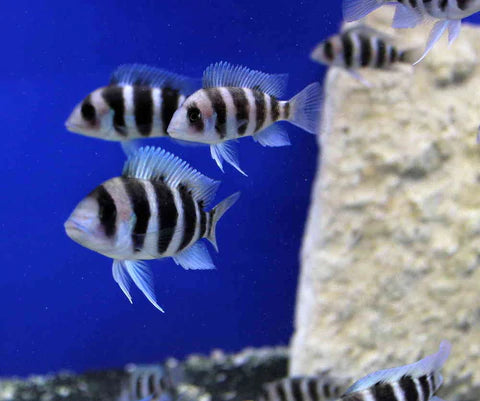
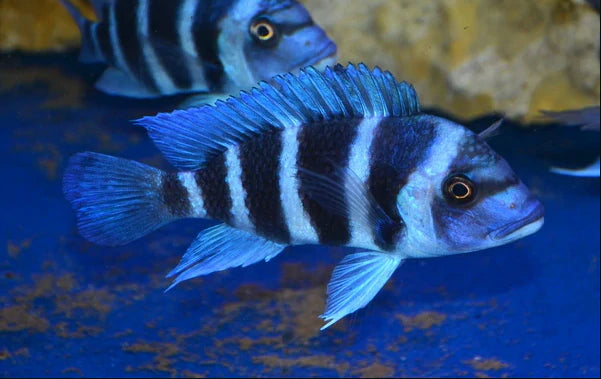
- Frontosas are hunters who like to work smart, not hard.
- They hunt for food at dusk, just when their prey would be falling asleep thus making themselves easy targets. In an aquarium setting, this fish will eat a variety of frozen and live foods in addition to prepared flakes and pellets. These carnivorous predators are best kept in large groups much like the colonies they are found in naturally but they require an abundance of space because of their potential size.
- Multiple males can be kept together for this particular species as long as you provide them with adequate hiding places that are large enough for them to dart in and out of. Be sure to secure rocks and caves so that injuries do not occur when they do retreat clumsily.
- I say they are clumsy because they are not conditioned to moving quickly unless there is a need to do so, for this reason, they are much more graceful at a slower pace.
About & Origin
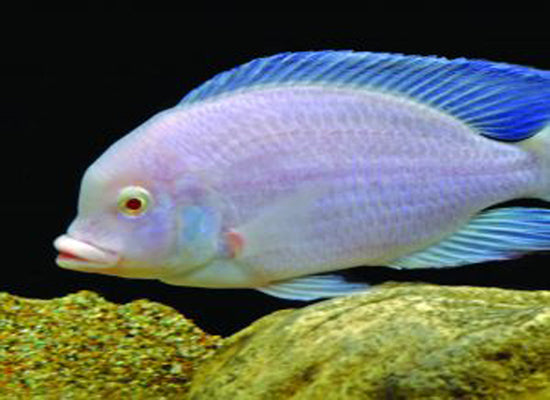
Cyphotilapia frontosa is a large, deep-water Rift Lake cichlid that comes from Lake Tanganyika rather than Lake Malawi — a different East African rift lake, but similarly ancient, deep, and mineral-rich. In the wild frontosa live in loose colonies over deep, rocky drop-offs, often well below where light penetrates strongly, which is part of why they're naturally slow-moving and unhurried compared to the frantic energy of most Malawi cichlids.
Adults develop a pronounced nuchal hump and bold vertical blue-and-white or blue-and-black striping, growing to a substantial 30+ cm (12+ inches) over several years — this is one of the largest, longest-lived, and slowest-growing cichlids commonly available, closer to a decade-plus commitment than a typical tropical fish.
This item is sold as a 1–2 inch juvenile; the calm demeanour and full colouration take real time to develop, and frontosa in particular do poorly rushed — they're a patience fish from day one.
In the wild, frontosa are grouped into several recognised colour-morph populations named for their collection point along the lake — Burundi and Kigoma populations typically show six body stripes, while Mpimbwe, Kipili, and other southern populations more often show seven, along with subtle differences in hump size and blue intensity. Hobbyists and breeders take this geographic origin seriously, since crossing different populations is generally discouraged to preserve each strain's distinct look.
Their deep-water lifestyle has shaped their biology in a few notable ways: frontosa have a well-developed swim bladder for hovering motionless over structure with minimal effort, and their large eyes and generally unhurried movements reflect a habitat with less light and fewer fast-moving threats than the shallower zones most other rift-lake cichlids occupy.
Frontosa are also maternal mouthbrooders, like most Tanganyikan and Malawian cichlids: after spawning, the female collects the fertilised eggs in her mouth and carries the developing brood for roughly six to eight weeks — an unusually long incubation period compared with the two-to-three-week average of Malawi mbuna — during which she typically eats little and can look visibly gaunt, which is entirely normal for the species rather than a sign of illness.
Requirements
Juveniles can start smaller, but plan for 400+ litres (100+ US gallons) as this species matures and reaches its full adult size — this is not a fish to buy without the eventual tank size already planned.
Temperament: unusually calm and non-aggressive for a large cichlid, but does best kept in a group (ideally one male with several females, a harem structure of 1:4 or more) to establish natural hierarchy and reduce stress — a lone frontosa in a busy tank can become withdrawn, and a single male without females may direct excess aggression at tankmates instead.
Diet: meaty foods — frontosa are natural predators of smaller fish in the wild, ambushing prey at dusk when it's least alert. Feed sparingly relative to body size, two to three times a week rather than daily once mature; this slow-metabolism species is prone to obesity and bloat if overfed on a fast schedule, and bloat is a genuine, sometimes fatal risk in this genus if diet and feeding frequency aren't managed carefully.
Décor: deep rockwork with caves, dim lighting reflecting its natural deep-water habitat, and plenty of open swimming room given its eventual size. Avoid harsh, bright lighting, which this species finds stressful compared with the subdued light of its natural depth.
Tank maturity: frontosa are best introduced to an already-established, fully cycled tank rather than a brand-new setup, since their sensitivity to ammonia/nitrite spikes and slow growth rate reward a stable, mature biological filter from the start.
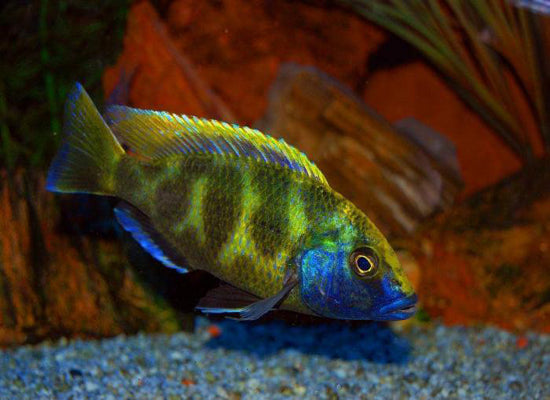
Long-term planning: because of the eventual tank size and years-long time horizon involved, it's worth deciding upfront whether you're committing to a dedicated Tanganyika species tank, since mixing frontosa with Malawi mbuna (which prefer faster, more turbulent water and a very different social structure) is common in the hobby but not ideal for either group's natural behavior.
Compatibility
Water & Care Conditions
Lake Tanganyika water is, if anything, even harder and more alkaline than Lake Malawi's:
- pH: 7.8–9.0
- Water hardness: 10–20 dGH, on the higher end preferred
- Temperature: 24–27°C (75–81°F)
- Oxygenation: strong filtration and stable parameters matter more than turnover speed — frontosa are sensitive to sudden swings and do best with gradual, consistent maintenance rather than large, infrequent water changes
- Water changes: smaller, more frequent changes (10-15% weekly) are gentler on this species than the large, infrequent changes some hardier cichlids tolerate
Feed and change water on a gentle, predictable schedule — this is a slow, steady species in every sense, and it applies to growth too: frontosa are notably slow-growing even by cichlid standards, often taking three to five years to reach full adult size and colouration. Rushing that process with excessive feeding or unstable conditions tends to produce a stressed, poorly-coloured fish rather than a faster-maturing one.
Mineral-rich, alkaline water is non-negotiable for long-term health — if your tap water runs soft or neutral, buffering with crushed coral or an aragonite substrate mixed into the decor is a common, low-maintenance way to keep pH and hardness in the right range without constant manual dosing.
Because a full grow-out takes years, it's worth testing water parameters regularly rather than assuming a "set and forget" approach — a slow drift in pH or hardness that a hardier fish would shrug off can, over the long timescale frontosa live on, gradually stress the fish and dull its colour well before any acute symptoms appear. A basic monthly test kit check for pH, GH, and nitrate is a small habit that pays off considerably over a decade-long fishkeeping relationship with a fish this long-lived and slow to show visible stress.