About & Origin
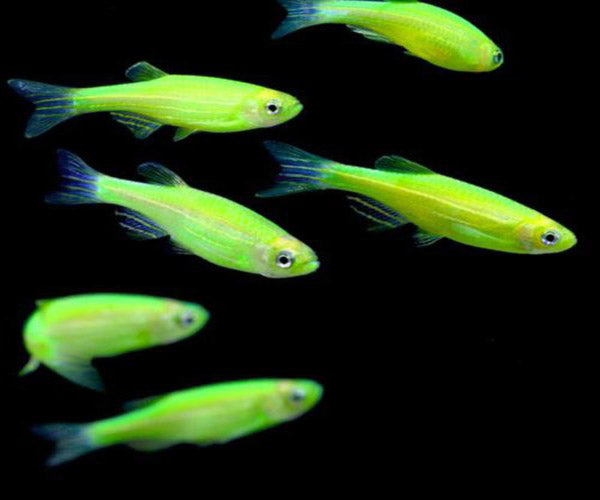
This green-coloured fish is a genetically modified strain of the Zebra Danio (Danio rerio), a small, hardy shoaling fish native to slow-moving streams, rice paddies, and floodplains across the Indian subcontinent. Unlike dyed fish, GloFish-type colour strains carry a fluorescent protein gene (often originally sourced from jellyfish or coral research) that is expressed throughout the fish's own tissue and passed on genetically to offspring — the colour is a permanent, heritable trait, not a coating or injection.
The underlying species, the common zebra danio, is one of the most widely kept, hardiest small fish in the hobby (and one of the most-used research fish in the world), known for constant, energetic swimming and genuine ease of care regardless of colour strain.
Wild-type zebra danios show the classic horizontal blue-and-gold stripes running the body length; the fluorescent colour strains overlay a bright, uniform hue (green, in this case) that's typically most vivid under blue/actinic aquarium lighting, though still visible under standard white light.
This combo pack supplies a starter shoal at once, matching how zebra danios should always be kept — as an active, always-moving group.
GloFish-branded zebra danios were among the first genetically modified ornamental fish to reach the aquarium trade, originally developed for environmental-pollutant research (their fluorescence was designed to activate in the presence of certain toxins) before being bred and marketed purely for their appearance — a notable piece of aquarium-hobby history behind an otherwise very ordinary, easy community fish.
Adults reach only around 4–5cm, and the species' short generation time and famously robust genetics have also made it one of the most heavily studied vertebrates in developmental biology, alongside its long-standing popularity purely as a beginner aquarium fish.
Requirements
Zebra danios are constant, fast-swimming shoalers and should be kept in groups of 6 or more — a small group is more skittish and prone to fin-nipping/chasing each other, a behaviour that settles down considerably in a properly sized shoal.
A tank of at least 60–75 litres with a long footprint (danios prioritise horizontal swimming space over height) suits a shoal of this size well, ideally with a lid, since danios are strong, enthusiastic jumpers.
They are genuinely undemanding, tolerant fish — one of the most commonly recommended species for a beginner's first community tank — and accept virtually any quality flake, pellet, or frozen food without fuss.
Zebra danios are energetic and can be boisterous with slow, long-finned tankmates, so pairing them with similarly active, robust community fish generally works better than pairing with delicate, slow-moving species.
Because this is a genetically modified strain, availability and legality vary by region/country in a few jurisdictions — this is worth being aware of if importing, breeding, or reselling, though it is broadly legal and extremely widely kept in the hobby overall.
Because zebra danios are such enthusiastic, fast swimmers, tank decor with plenty of open horizontal swimming lanes suits them better than a densely obstructed layout — they use their speed and schooling coordination as their main defence and coping behaviour in the wild, and a tank that lets them express that natural behaviour tends to produce calmer, better-adjusted fish.
This species handles the ordinary swings of a new fishkeeper's early mistakes better than most, which is a large part of its beginner-friendly reputation — but "hardy" doesn't mean immune, and a fully cycled tank with an established biological filter is still the right way to start, rather than relying on the fish's tolerance to cover for an uncycled setup.
Compatibility
Water & Care Conditions
Zebra danios (and their colour strains) are among the most chemistry-flexible community fish in the hobby:
- pH: 6.5–7.5, and tolerant of a notably wide range beyond this
- Hardness: soft to moderately hard (5–19 dGH)
- Temperature: 18–24°C (64–75°F) — notably cooler-tolerant than most tropicals, and can be kept without a heater in many climates, though standard tropical temperatures are also fine
- Oxygenation: not demanding; thrives across a wide range of flow and filtration setups
This broad tolerance is a major reason zebra danios (in wild-type and colour-strain forms alike) are so consistently recommended as a resilient beginner fish.
This species is also one of the more commonly used fish for fishless cycling by experienced keepers specifically because of its hardiness, though a properly fishless cycle (using pure ammonia rather than live fish) is now the more widely recommended, fish-welfare-friendly approach.
A sponge pre-filter or guarded intake is a sensible precaution in any tank housing this shoal, since fast-swimming small fish like zebra danios can occasionally be drawn toward strong, unguarded filter intakes while actively exploring the tank.
Regular weekly partial water changes (around 20–25%) are still worthwhile even given this species' tolerance for imperfect conditions — hardiness buys forgiveness for occasional lapses, not a reason to skip routine maintenance altogether, and consistently good water quality is what keeps the fluorescent colouring at its brightest.
Because this strain tolerates a genuinely wide temperature band, it also adapts well to being housed alongside either true coldwater fish or standard tropical community fish, making it one of the more flexible shoaling species to plan a tank around.
Watch general activity level as the simplest health check for this species — a normally hyperactive zebra danio that becomes lethargic, clamps its fins, or separates from the shoal is usually signalling a water-quality problem well before more obvious symptoms appear.