About & Origin
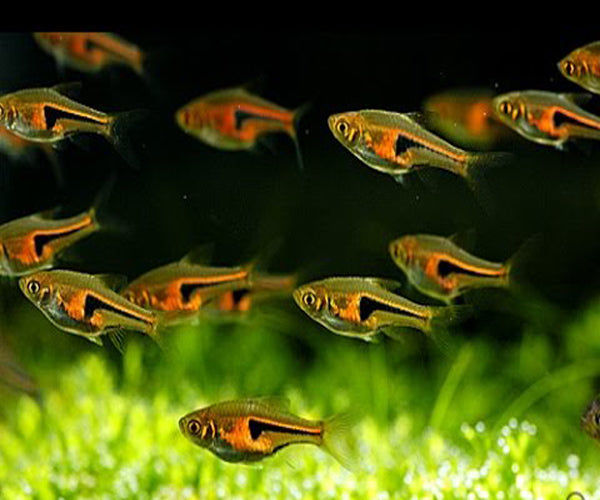
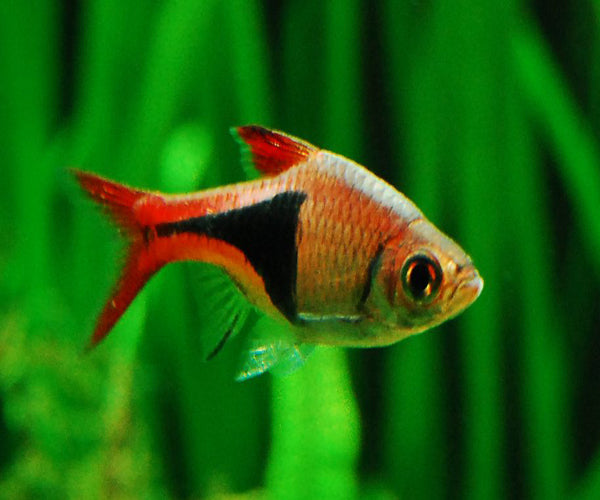
Hengel's Rasbora (Trigonostigma hengeli) is a close relative of the more familiar Harlequin Rasbora, native to blackwater streams and peat swamps of Sumatra and Borneo in Southeast Asia. It's smaller and more slender-bodied than the Harlequin, with a similar coppery body but a thinner, more elongated black wedge marking along its flank.
Like its relative, it evolved shoaling in soft, acidic, tannin-stained water heavily shaded by overhanging forest canopy — classic Southeast Asian blackwater habitat, low in minerals and often the colour of weak tea from dissolved plant tannins.
It's a less commonly seen but well-established species among aquascapers and softwater specialists who appreciate its slightly more delicate, elegant profile compared to the chunkier Harlequin.
Hengel's Rasbora (Trigonostigma hengeli) is a close relative of the Harlequin Rasbora, distinguished by a slimmer body and a more elongated, less triangular black marking, plus a more coppery-orange overall tone.
It's native to blackwater streams and peat swamp forests in Sumatra and parts of Borneo, environments defined by soft, acidic, tannin-stained water and dense leaf litter cover.
Like its close relatives, it's a peaceful, active schooling fish that spends most of its time in the middle water column moving through planted or leaf-littered areas.
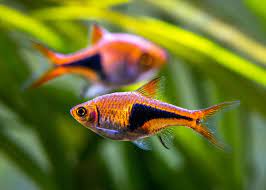
The Hengel's Rasbora (Trigonostigma hengeli) is a close relative of the more common Harlequin Rasbora, native to similar blackwater peat-swamp habitats in Sumatra and Borneo. It is slightly smaller and slimmer than the Harlequin, with a more sharply defined, straighter-edged black wedge marking rather than the Harlequin's broader triangular patch, and a warmer copper-gold body tone.
It is somewhat less commonly available than the standard Harlequin Rasbora but is equally easy to keep and often preferred by aquascapers for its slightly more delicate proportions.
Requirements
A true shoaling species — keep in groups of 8 or more for the fish to settle, display natural schooling behaviour, and show their best colour.
Being a blackwater species, it appreciates softer, more acidic water than many community staples, and does best in a planted tank with some cover — floating plants or driftwood with dim, filtered lighting suit it particularly well. It's peaceful toward all similarly sized tankmates.
Feeding is easy with a good quality micro pellet or flake, sized for its small mouth; occasional live or frozen micro foods are appreciated.
A true shoaling species best kept in groups of 8 or more; in smaller numbers it becomes noticeably shyer and less likely to display its natural colour and behaviour.
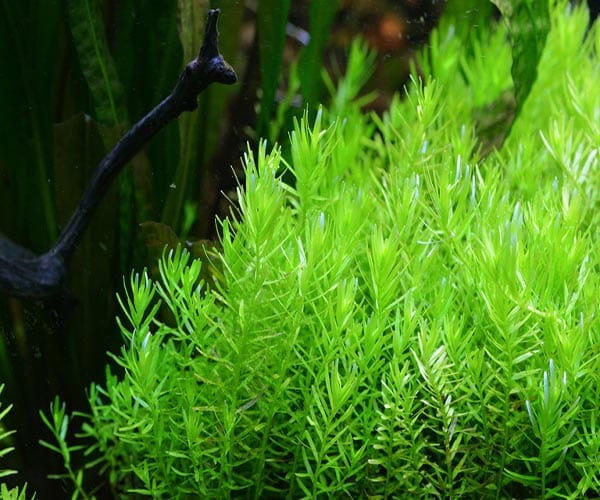
Suits a well-planted tank with some open swimming space, subdued lighting, and ideally some driftwood or leaf litter reflecting its natural blackwater habitat.
Small foods suit it best given its modest mouth size — micro pellets, crushed flake, and small live/frozen foods like daphnia.
Like its relative, it does best in a well-established shoal of eight or more in a densely planted, subdued-light aquarium, and is peaceful with all but the smallest fry and shrimp, which it may eat opportunistically. Blackwater-style tannin-tinted water brings out its best colour, though it adapts to ordinary community tap water conditions.
Feed small amounts of flake or micro pellets suited to its small mouth, and keep the tank well planted with some open swimming space so the shoal has both cover and room to display normal schooling behaviour.
Regular partial water changes and a mature, established filter matter more to long-term colour and health than chasing one exact water parameter, and it settles well in most soft-to-moderate community setups.
Compatibility


Water & Care Conditions
Prefers genuinely soft, acidic blackwater-style conditions more strictly than many community tetras:
- pH: 5.5–7.0, ideally on the softer, more acidic side
- Salinity / hardness: freshwater only, soft water (1–10 dGH)
- Temperature: 23–28°C (73–82°F)
- Light: subdued, with floating plants or shade appreciated
- Oxygenation: gentle filtration and low to moderate flow; avoid strong current in a species adapted to still, sheltered forest streams
- Distinguishing feature: the straighter-edged, more triangular-pointed black marking (versus the Harlequin's broader wedge) is the easiest way to tell the two species apart
- Water conditions: shows its richest copper-gold tones in soft, slightly acidic, tannin-tinted water
- Feeding: small, frequent feedings of micro-sized food suit its small mouth
- Longevity: commonly lives 5+ years in stable, well-maintained conditions
- Tank position: stays mainly in the lower-to-middle water column, especially near planted areas
- Filtration: gentle filtration suits this species well, matching its calm native swamp-forest habitat
- Substrate: dark substrate and driftwood bring out its best colour, matching its native blackwater habitat
Soft, acidic, tannin-stained water most closely matches this species' native habitat and tends to intensify its colour, though it adapts reasonably well to moderate hardness in a typical community tank.
Gentle filtration and minimal current suit it well, reflecting its slow-moving swamp and forest-stream origins.
Weekly partial water changes of 20-30% help keep this species colourful and active, since like most small characins and rasboras it's sensitive to accumulating nitrates and organic waste over time even though it isn't considered a delicate species.
A mature, cycled tank with established biological filtration is a much safer home for a new shoal than a freshly set-up system, since ammonia and nitrite spikes during cycling are a common cause of losses in small schooling fish.