About & Origin
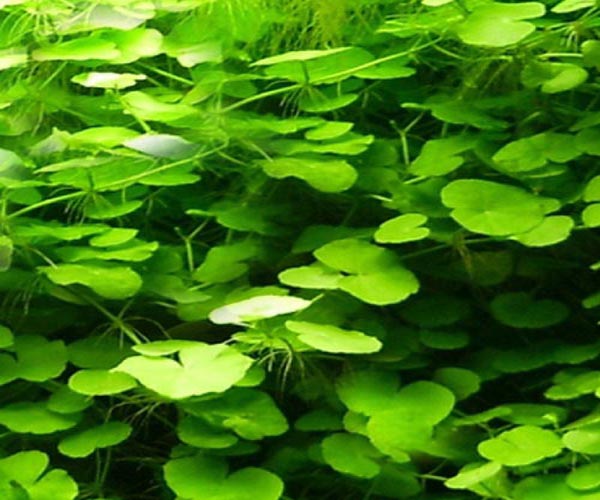
Brazilian pennywort, Hydrocotyle leucocephala, is native to Central and South America, where it grows as a creeping, semi-aquatic plant along the muddy banks and shallow margins of streams and wetlands — often sprawling partly out of the water into damp, humid air.
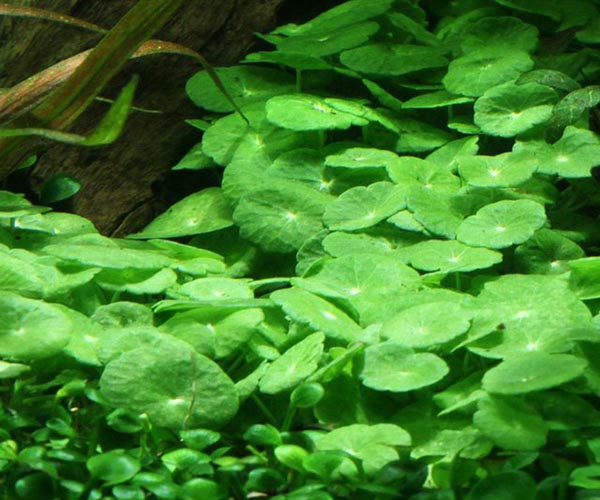
Its rounded, slightly scalloped leaves sit on long, jointed stems that root at each node, giving it a naturally sprawling, vine-like growth habit. Grown fully submerged in an aquarium it becomes a fast, easy stem plant that can be trained along the substrate as a creeper or left to climb toward the light.
It's a long-standing favourite in the hobby precisely because it asks so little and still looks lush — bright green, round-leafed, and quick to fill in bare space.
In its native range it's a genuinely amphibious plant, equally at home rooted in shallow water with its leaves emersed in open air as it is fully submerged — a trait that shows in how versatile it is in the aquarium too. Grown emersed above the waterline (trailing out of an open-top tank, for instance) it tends to produce larger, more rounded leaves and can even flower with small white blooms, something it never does kept fully underwater. Left to trail across the water's surface it forms a dense floating mat that shades the tank below, which some keepers use deliberately to diffuse strong light for shade-loving species, while others prefer to keep it trained low and rooted to avoid it blocking light to everything underneath.
The genus name Hydrocotyle comes from the Greek for "water cup," a nod to the leaf shape shared across the wider pennywort genus, of which Brazilian pennywort is one of the most widely traded aquarium members alongside species like whorled pennywort. It's sold under a handful of common names in the trade — Brazilian pennywort, water pennywort, and sometimes just "hydrocotyle" — all referring to the same plant.
Requirements
Brazilian pennywort is one of the more forgiving stem plants and adapts to a wide range of setups.
Light: low to moderate light is enough to keep it growing steadily; more light simply speeds it up and keeps the leaves more compact.
CO2 and nutrients: not required, though it responds well to both if available — a genuinely low-tech-friendly plant.
Planting: can be rooted in substrate as a stem plant, left to float and trail its roots in open water, or trained along the surface as a creeper — it will root wherever a stem node touches the substrate. Because it grows quickly, regular trimming keeps it from shading out lower plants.
Propagation: simply cut a healthy stem section with a node and replant or let it float — new roots form readily.
Training and placement: because it roots at every node it touches down, it's genuinely useful as a "carpet on demand" for midground or background areas — pin a stem section along the substrate with a small weight or a piece of mesh until it anchors itself, and it will spread laterally rather than shooting upward. Left untrained it tends to grow toward the light and can quickly reach the surface, where it's just as happy to keep spreading horizontally as a floating mat.
Maintenance: its main downside is exactly its biggest strength — fast growth means it needs trimming every one to two weeks in a well-lit tank to stop it shading out slower-growing neighbours or clogging filter intakes with loose floating stems. Trimmed tops can simply be replanted elsewhere rather than discarded, making it one of the cheapest plants in the hobby to fill a tank out from a single starter bunch.
Compatibility
Water & Care Conditions
Brazilian pennywort tolerates a broad range of freshwater conditions:
- pH: 6.0–7.8
- Hardness: soft to fairly hard, roughly 2–20 dGH
- Temperature: 18–28°C (64–82°F) — unusually tolerant of cooler, unheated tanks too
- Light: low to moderate is sufficient; it doesn't need intense lighting to thrive
It's genuinely one of the more forgiving species on this range — most tap water and typical community-tank conditions suit it without special adjustment.
Because it's not fussy about CO2 or fertilisation, it's a reliable choice for a newly-set-up or low-tech tank where water chemistry hasn't fully stabilised yet, and its rapid growth makes it a genuinely useful nutrient sponge early on — it competes well against algae for the same nitrates and phosphates while the tank finds its balance. If growth slows noticeably or leaves turn pale, that's usually a sign of a genuine nutrient shortfall (particularly nitrogen or iron) rather than a chemistry-range problem, since it's tolerant enough that pH and hardness are rarely the limiting factor. Watch for melting or yellowing of the lower/older leaves when transitioning a stem from emersed (grown in humid air, as it's sometimes propagated commercially) to fully submerged growth — this is a normal adjustment period, not a sign of poor water quality, and new submerged-form growth typically appears within a couple of weeks.
Its wide temperature tolerance also makes it one of the few genuinely useful stem plants for unheated or coldwater setups (down toward 18°C), where far fewer aquarium plant species remain reliably healthy — worth keeping in mind if it's being planted alongside coolwater-tolerant fish rather than a fully tropical community.
One practical note on flow and placement: if left to float rather than rooted, its dense mat of trailing stems and roots can catch debris and reduce surface gas exchange if it's allowed to cover the entire surface, so in a floating arrangement it's worth leaving open water elsewhere in the tank for oxygenation, or thinning the mat back periodically the same way you'd trim a rooted planting.