About & Origin
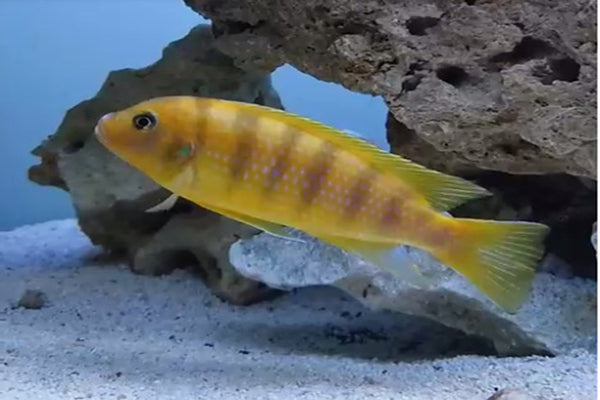
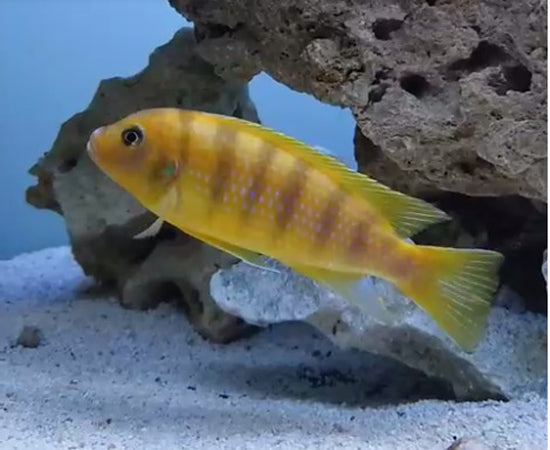
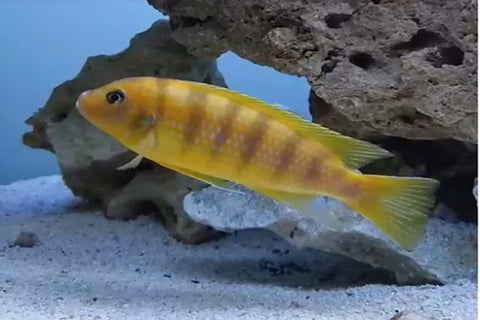
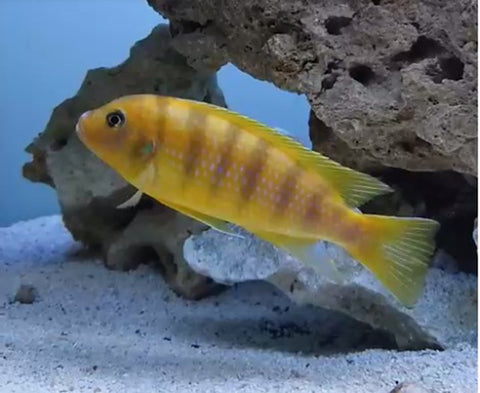
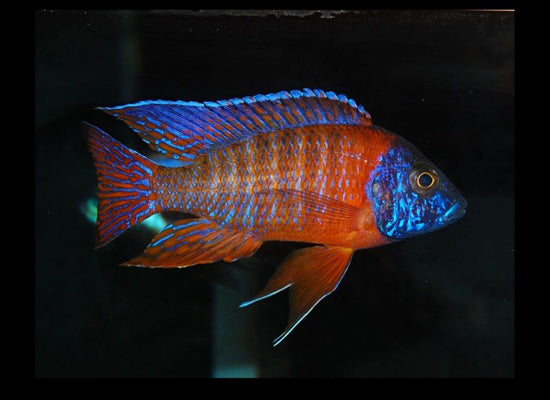
Orange Marf is a Malawi peacock cichlid — one of the most sought-after "Marf" colour lines of Aulonocara sp. in the hobby — and this is the solid, saturated-orange version of that strain, bred for depth and evenness of colour rather than pattern or contrast, which is what separates it from patterned peacock strains like Redbird or Yellowbird.
Wild Aulonocara forage over sand and mixed rock/sand zones along Lake Malawi's shoreline, using a sensitive, pore-covered snout to detect invertebrates buried in the substrate — a foraging style worth replicating with open sand area in the tank, not just rockwork.
As with all peacocks, only mature males show the strain's namesake colour; females and juveniles stay a plain silvery-grey throughout their lives, so a young Orange Marf typically needs several months to fully colour up.
Aulonocara peacocks are maternal mouthbrooders: after spawning, the female collects the fertilised eggs in her mouth and carries them — without eating — for roughly three to four weeks until the fry are large enough to swim and feed independently. In a mixed-sex group this happens readily without any special intervention, and holding females can be left in the main tank or moved to a breeding trap if you want to maximise fry survival, since other tankmates will happily eat any fry that wander off unsupervised.
When choosing individuals, look for a fish with clear eyes, an even, undamaged fin edge, and — in males — colour that's already showing rather than a washed-out juvenile pattern, since colour intensity in adulthood is difficult to predict from a very young fish. Peacocks are also prone to the same Malawi bloat and internal parasite issues as other rift lake cichlids if kept on a high-protein or poor-quality diet, so a stable, appropriate diet from the start matters more for long-term health than tank decor.
Requirements
Same core Malawi peacock requirements apply as the rest of the range: 200+ litres (55+ gallons) for a small group with one male, semi-aggressive but calmer than mbuna, African cichlid pellets plus frozen brine or mysis shrimp, rockwork for territory with open sand left for foraging, and slow drip acclimation for new arrivals since sudden pH swings are the biggest risk with rift lake cichlids.
Stocking this strain specifically: because Orange Marf is a solid single-colour strain rather than a patterned one, it's more likely to be visually confused with other solid-orange or red-orange peacocks (like Red Peacock) by a dominant male — avoid stocking two visually similar solid-colour males together even in a larger community, since territorial and mating aggression in peacocks is driven largely by how alike rival males look.
Sexing: males show the full orange once mature; females and juveniles stay silvery-grey, which makes ratio planning straightforward at point of purchase once fish are old enough to sex.
Group ratio: keep one male with several females (roughly 1:3 or more) to spread out breeding attention and reduce stress on any single female, standard practice across the whole peacock cichlid range. A single dominant male in too small a group, or too few females, tends to focus aggression rather than diffuse it, so err on the side of more females than the minimum ratio suggests.
Compatibility
Water & Care Conditions
- pH: 7.8–8.6, hard and alkaline like the rest of the Malawi peacock range — not optional for this species
- Water hardness: 10–20 dGH (200–350 ppm)
- Temperature: 24–28°C (75–82°F)
- Water changes: 25–30% weekly, with strong filtration for the bioload
Because this is a solid single-colour strain, an uneven or blotchy orange — rather than a clean loss of colour entirely — is often the first visible sign worth checking against water quality, ahead of more obvious symptoms.
Newly acquired fish can take several weeks to show their full colour as they settle in and establish territory; a persistently dull or clamped-fin fish beyond that window is worth investigating rather than writing off as normal settling-in behaviour. Ammonia and nitrite should both read zero once cycled — most "unexplained" losses in a Malawi tank trace back to filtration or stocking, not fragility in the fish itself. Well-kept peacocks of this type commonly live 6–8 years, and a buffered substrate (crushed coral or aragonite mixed in) helps hold the required hard, alkaline chemistry stable over the long term, particularly where tap water runs soft. Feed a varied diet -- African cichlid pellets as the staple, with occasional frozen mysis or brine shrimp -- since diet variety directly supports both growth and the intensity of the strain's signature orange colouring.