About & Origin
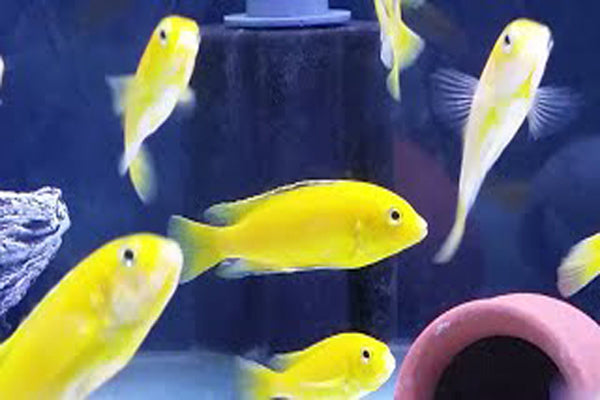
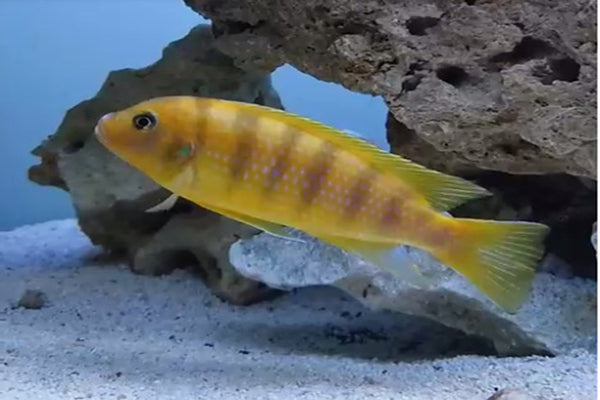
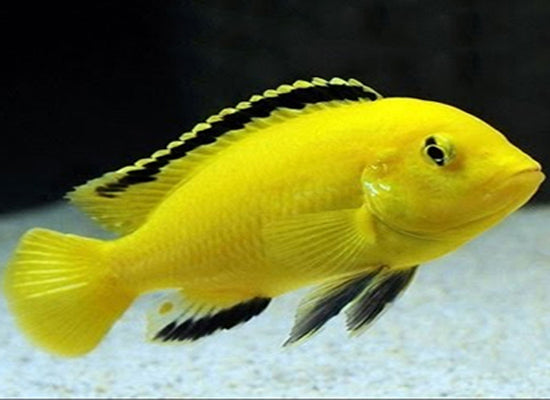
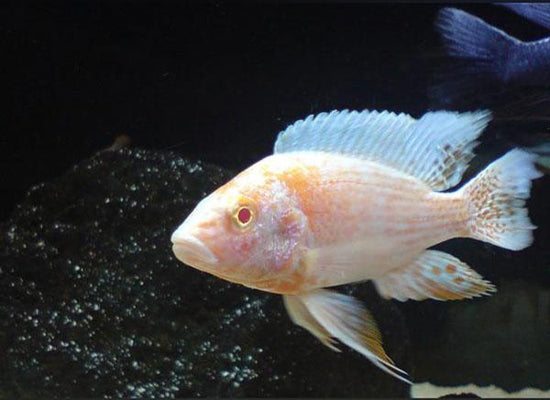
"Yellow Marf" is a Malawi peacock cichlid (Aulonocara sp.) -- specifically a hobby trade name for a bright, all-yellow colour strain of it. The name describes the solid banana-yellow body colour males display at maturity rather than a distinct species. Like other peacocks, it comes from the sandy and intermediate rock/sand habitats along Lake Malawi's shoreline in East Africa, where it forages for small invertebrates in the sand using a sensitive, pore-covered snout.
Females and juveniles are considerably plainer — silvery-grey — with the vivid yellow developing gradually in males as they mature and establish territory, so a young "yellow marf" often looks unremarkable until it colours up over several months.
Like other peacocks, it's a calmer, more manageable rift lake cichlid than the aggressive mbuna group, and a popular choice for stocking colour into a mixed Malawi peacock/hap community tank.
Aulonocara peacocks are maternal mouthbrooders: after spawning, the female collects the fertilised eggs in her mouth and carries them — without eating — for roughly three to four weeks until the fry are large enough to swim and feed independently. In a mixed-sex group this happens readily without any special intervention, and holding females can be left in the main tank or moved to a breeding trap if you want to maximise fry survival, since other tankmates will happily eat any fry that wander off unsupervised.
When choosing individuals, look for a fish with clear eyes, an even, undamaged fin edge, and — in males — colour that's already showing rather than a washed-out juvenile pattern, since colour intensity in adulthood is difficult to predict from a very young fish. Peacocks are also prone to the same Malawi bloat and internal parasite issues as other rift lake cichlids if kept on a high-protein or poor-quality diet, so a stable, appropriate diet from the start matters more for long-term health than tank decor.
Requirements
200+ litres (55+ US gallons) for a small group with one male to avoid territorial fighting between rival males in a smaller space.
Temperament: semi-aggressive, calmer than mbuna, generally safe in a mixed peacock/hap Malawi community.
Diet: cichlid pellets formulated for carnivorous/omnivorous African species, supplemented with frozen brine shrimp or mysis shrimp.
Décor: rockwork for territory plus open sand for natural foraging behaviour.
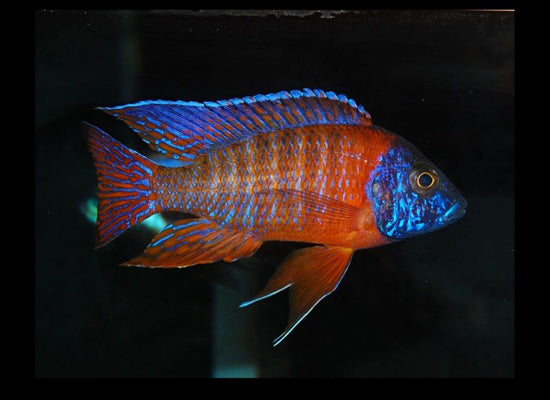
Stocking: keep one male per tank (or one male to several females) unless the tank is large enough to support multiple male territories without constant overlap — two similarly-coloured males in a small space will fight persistently. A mixed peacock/hap community works well because different species/colour strains tend to only seriously compete with their closest look-alikes for territory and female attention.
Sexing: straightforward once mature — males hold the bright colour described above, while females stay a plain silvery-grey their whole lives, useful both for stocking ratios and for telling breeding-ready fish apart at a glance.
Tank setup: arrange rockwork into distinct piles with sightline breaks between them so a dominant male can't see and constantly harass rivals across the whole tank — this single change dramatically reduces stress-related aggression in a Malawi community. Leave the front two-thirds of the tank as open swimming and foraging space over sand, with rockwork concentrated toward the back and sides.
New arrivals should be acclimated slowly (drip acclimation over 30–60 minutes is worth the extra effort for rift lake cichlids, since a sudden pH swing on introduction is genuinely more likely to cause problems than almost anything else in their care) and, where possible, added to the tank all at once rather than one at a time, since introducing fish as a group makes it harder for any single existing resident to single out and bully a newcomer.
Compatibility
Water & Care Conditions
These parameters follow the natural chemistry of Lake Malawi's Rift Valley water — they aren't flexible in the way softer-water community fish can be:
- pH: 7.8–8.6 (Lake Malawi is naturally hard and alkaline — this is not optional, low-pH water stresses these fish over time)
- Water hardness: 10–20 dGH (200–350 ppm); many keepers add crushed coral or aragonite sand to the substrate/filter to hold pH and hardness up long-term
- Temperature: 24–28°C (75–82°F)
- Oxygenation: strong surface agitation and filtration — Malawi cichlids are messy, heavily-stocked-tank fish that need robust biological filtration and large, regular water changes
- Feeding schedule: small meals once or twice daily rather than one large feeding — this species has a relatively small stomach and is prone to bloat if overfed, especially on protein-heavy foods not formulated for African cichlids
- Water changes: 25–30% weekly is typical for a well-stocked Malawi tank; because these fish evolved in an enormous, extremely stable lake, they're actually more sensitive to swings in parameters than to the parameters simply being on the harder, more alkaline end
Ammonia and nitrite should both read zero once the tank is cycled — Malawi cichlids are unforgiving of poor water quality despite their reputation for hardiness, and most "unexplained" losses in a peacock tank trace back to an under-filtered or overstocked setup rather than the fish itself being delicate.
Newly acquired Aulonocara can take several weeks to settle in and show full colour — stress, unfamiliar surroundings, and establishing a place in the tank's pecking order all suppress colour intensity temporarily, so don't judge a new fish's true appearance too quickly. A consistently dull or clamped-fin fish beyond the first couple of weeks, however, is worth investigating as a possible water-quality or disease issue rather than dismissed as "just settling in."