About & Origin
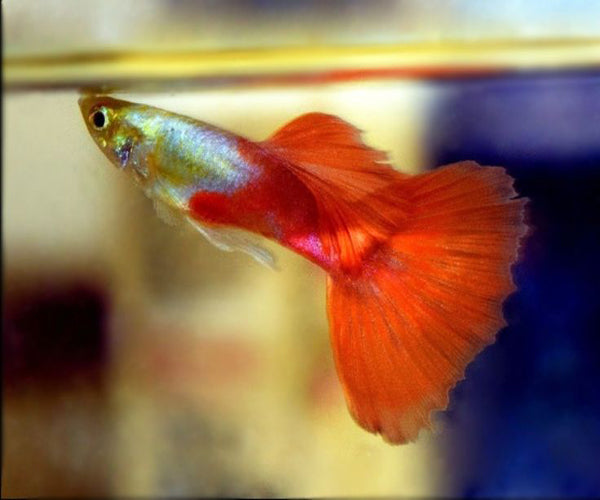
The Platinum Red Guppy combines a metallic platinum body with red finnage in the guppy species Poecilia reticulata. Wild guppies originate from streams, ponds, and coastal waters across Venezuela, Trinidad, Guyana, and northern Brazil, and this strain is a purely ornamental color selection from that same adaptable species.
In the wild, guppies live in shallow, warm, often nutrient-rich water and are famous among biologists for how fast they adapt to local conditions — including to predators, which has made them one of the most studied fish in evolutionary biology. In the aquarium hobby, that same adaptability is exactly what makes guppies such a reliable beginner fish.
"Platinum" describes a metallic body-color gene that gives the entire body an iridescent, almost mirror-like sheen — a step further than the plainer "silver" or grey-bodied wild type — created by an unusually dense, reflective layer of guanine-based iridophore cells in the skin. It's one of the more dominant, easy-to-fix metallic traits in guppy genetics, which is part of why platinum-bodied strains combined with a contrasting fin color (red, in this case) have remained a stable, popular combination in the trade for decades. Under direct light the platinum body can look almost white-silver, while in shade it reads a cooler grey-blue, so lighting affects how vivid this strain appears more than it does with pigment-based (rather than structural/iridescent) colors.
Because the platinum sheen is structural rather than a simple flat pigment, tank lighting choice makes a real visible difference here — warmer or dimmer lighting tends to bring out a softer glow, while brighter, cooler-toned lights make the metallic body flash more sharply against the red fins.
The Platinum Red Guppy strain sold here is bred and raised for the aquarium trade specifically for its coloring and finnage; its care, temperament, and water needs are identical to any other guppy variety.
fishykart.com ships healthy, actively-colored stock, not fish pulled straight from a wholesale feeder tank.
Requirements
Standard guppy husbandry applies (10 gallon/38 litre minimum for a group of 6+, roughly 2 litres per adult, female-heavy sex ratio, omnivorous flake/micro-pellet diet with occasional live/frozen foods, floating or fine-leaved plants for fry cover, a tight lid since they jump, fry every 4-6 weeks once mature).
This strain specifically: the combination of a reflective platinum body with red-pigmented finnage means the two traits are inherited somewhat independently — offspring from this strain can split toward more platinum, more red, or a even mix, so fry from a home-bred group won't always match the parents evenly. Feeding for colour (carotenoid-rich food occasionally) mainly deepens the red in the fins rather than affecting the platinum body sheen.
The platinum trait itself: the metallic sheen comes from an increased layer of reflective iridocytes (pigment cells that scatter light rather than absorb it) across the body, the same underlying biology responsible for "metallic" and "moscow" guppy strains more broadly — it's a structural colour effect, not a pigment, which is why it can look different under different lighting angles and intensities.
Group composition: keep more females than males — roughly 2 to 3 per male — to spread out the near-constant courtship behaviour males display and reduce stress on any single female.
General upkeep: a 10-gallon (38-litre) tank suits a starter group of six or more, roughly 2 litres per adult given how small this species stays as an adult. They're easy omnivorous feeders on flake or micro-pellet, and a secure lid matters more than people expect since guppies are capable jumpers when startled or stressed. Occasional live or frozen food such as brine shrimp or daphnia rounds out the diet and supports both condition and colour intensity over a plain flake-only diet.
Compatibility

Water & Care Conditions
- pH: 6.8–7.8
- Salinity / hardness: freshwater, moderately hard (10–20 dGH)
- Temperature: 24–28°C (75–82°F)
- Oxygenation: moderate surface movement, avoid stagnant water
Stability matters more than an exact number. Red fins fading toward pale pink or the platinum body looking dull are both worth treating as early water-quality warnings on this strain.
Weekly 20-25% water changes keep colour and finnage healthy and cut fin rot/ich risk; acclimate new arrivals slowly (20-30 minute drip) rather than a quick release.
Captive-bred and generally adaptable to ordinary dechlorinated tap water once roughly in range. Well-kept guppies typically live 2-3 years.
A 10-gallon (38-litre) tank suits a starter group of six or more comfortably, roughly 2 litres per adult given how small this species stays. They're easy omnivorous feeders — quality flake or micro-pellet as a staple, with the occasional carotenoid-rich food (brine shrimp, colour-boosting flake) helping maintain the red finnage specifically. A secure lid is worth taking seriously; guppies jump more readily than their calm swimming style suggests, particularly if startled or if water quality has quietly declined. Fin rot and ich are the most common issues, and both are overwhelmingly linked to unstable water conditions rather than any inherent fragility in the strain — consistent partial water changes prevent most problems before they start. Because the platinum sheen is a structural, light-reflecting effect rather than a fixed pigment, it can genuinely look duller under weak or discoloured (tannin-tinted) lighting even on a perfectly healthy fish — worth remembering before assuming a dimmer platinum body means declining health. Females store sperm internally and can produce repeated broods for months from a single mating, so even a female purchased alone may still give birth weeks after arriving home — worth knowing if you weren't planning to breed.