About & Origin
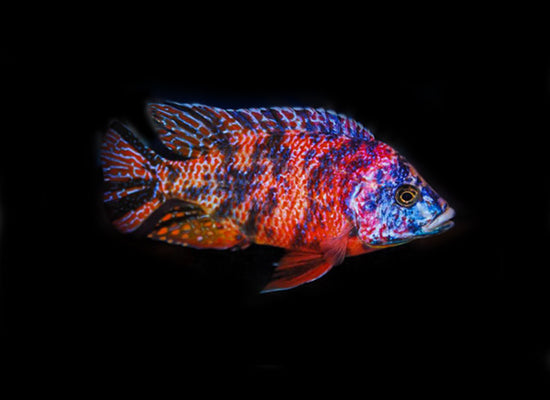
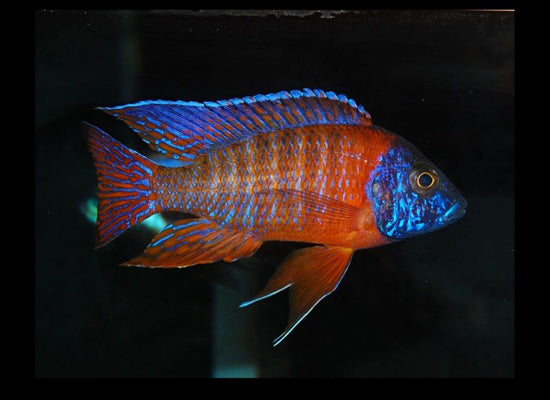
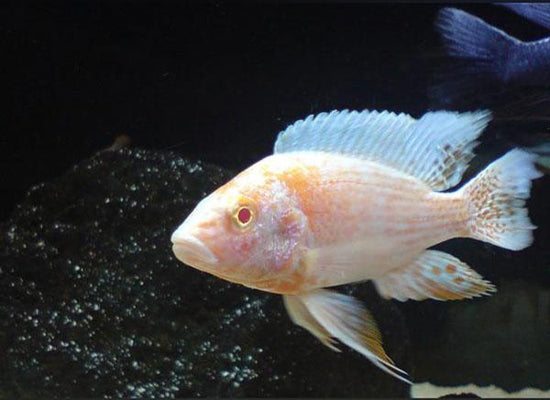
Unlike the solid single-colour Malawi peacock (Aulonocara sp.) lines, Redbird is a Malawi peacock cichlid, a two-tone strain — a red body set against a contrasting blue face and fins — bred for the sharpness of that colour break rather than depth of a single hue. It's one of the more visually striking peacock lines partly because of that contrast.
Wild Aulonocara forage across sand and mixed rock/sand habitat along Lake Malawi's shoreline, using a pore-covered snout to sense buried invertebrates — reflected in the tank by leaving real open sand rather than covering the whole floor in rock.
As with other peacocks, only mature males carry the strain's namesake colour; females and juveniles stay silvery-grey, and the red/blue contrast takes several months to fully develop as a young male grows and claims territory.
Aulonocara peacocks are maternal mouthbrooders: after spawning, the female collects the fertilised eggs in her mouth and carries them — without eating — for roughly three to four weeks until the fry are large enough to swim and feed independently. In a mixed-sex group this happens readily without any special intervention, and holding females can be left in the main tank or moved to a breeding trap if you want to maximise fry survival, since other tankmates will happily eat any fry that wander off unsupervised.
When choosing individuals, look for a fish with clear eyes, an even, undamaged fin edge, and — in males — colour that's already showing rather than a washed-out juvenile pattern, since colour intensity in adulthood is difficult to predict from a very young fish. Peacocks are also prone to the same Malawi bloat and internal parasite issues as other rift lake cichlids if kept on a high-protein or poor-quality diet, so a stable, appropriate diet from the start matters more for long-term health than tank decor.
Requirements
The usual Malawi peacock requirements carry over: 200+ litres (55+ gallons) for a small group with one male, semi-aggressive but calmer than mbuna, African cichlid pellets plus frozen brine or mysis shrimp, rockwork broken into distinct territories with open sand left for foraging, and slow drip acclimation for new arrivals.
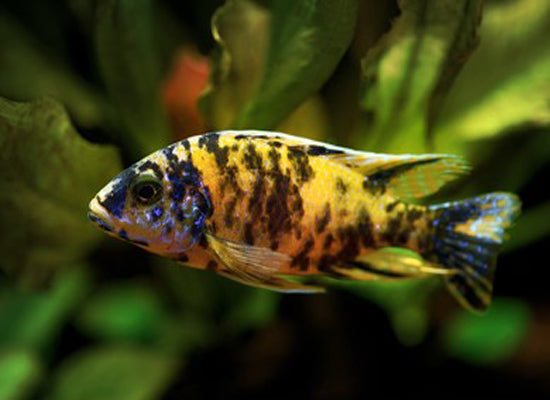
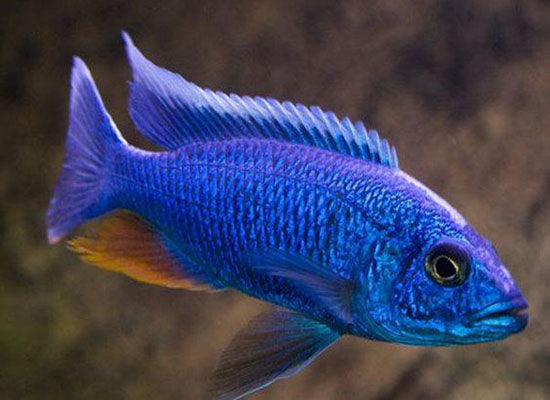
Stocking this strain specifically: because Redbird's pattern (not just colour) is distinctive, it tends to stand out clearly even alongside solid-colour peacocks like Orange Marf or Red Peacock, making mixed-strain community tanks easier to plan without worrying about males mistaking each other for rivals — pattern difference reduces territorial confusion more than colour difference alone does.
Sexing: males show the full red/blue split once mature; females and juveniles remain plain silvery-grey.
Diet: a good-quality African cichlid pellet as the daily base, supplemented a few times a week with frozen brine shrimp, mysis, or bloodworm for variety — avoid feeder-fish or high-fat foods, which are a common trigger for the bloat and digestive problems Malawi cichlids are prone to. Two or three smaller feedings a day suit their foraging behaviour better than one large meal, since wild peacocks graze steadily through the day rather than gorging.
Filtration and stocking density: Malawi cichlids are heavy waste producers relative to their size, so filtration should be sized generously above the tank's nominal rating rather than to the minimum. A single male with 3-4 females is the usual stable grouping; avoid two males of this strain in the same tank unless the tank is large enough for each to hold a separate territory, since males will contest overlapping ground even when otherwise peaceful toward other species.
Compatibility
Water & Care Conditions
- pH: 7.8–8.6, hard and alkaline like the rest of the peacock range
- Water hardness: 10–20 dGH (200–350 ppm)
- Temperature: 24–28°C (75–82°F)
- Water changes: 25–30% weekly with strong filtration
For a two-tone strain, watch specifically for the red/blue boundary blurring or either colour looking muddy rather than clean — a useful early cue on this pattern before other stress signs show.
New arrivals can take several weeks to settle and show full pattern; a persistently dull or clamped-fin fish beyond that window is worth investigating rather than dismissed as normal adjustment. Keep ammonia and nitrite at zero once cycled.
Substrate and lighting: a fine sand substrate lets Redbird express natural sifting behaviour without abrading its snout the way sharp gravel can; moderate rather than intense lighting also tends to show the red/blue split more richly, since very bright light can wash out the contrast the strain is bred for. Rockwork should be stacked into stable, distinct piles rather than one continuous ridge, giving each territory-holding male a clearly defined boundary and reducing pointless border disputes with neighbouring peacocks.
Test kits for pH and hardness are worth owning rather than guessing at with tap water alone, since Malawi cichlids kept even slightly outside their preferred hard-alkaline range for extended periods show up as chronic low-grade stress — faded colour, reduced appetite, reluctance to hold territory — well before anything acute happens. A remineralizing buffer product or crushed coral in the filter is a common, low-effort way to keep both pH and hardness stable in areas with naturally soft tap water.