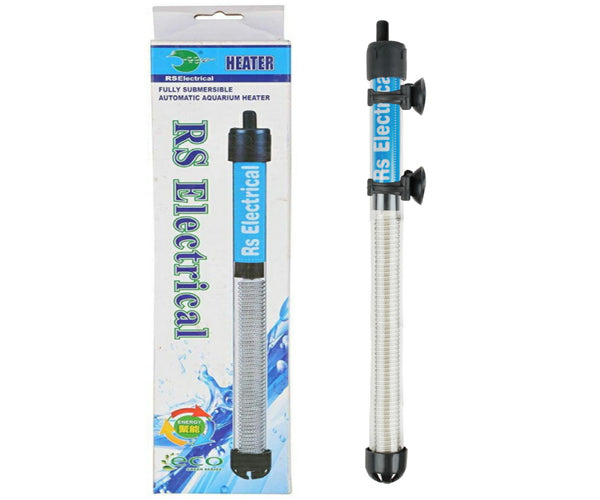
About & Function
The RS-50W is a submersible aquarium heater — a sealed glass or shatterproof-plastic tube containing a resistive heating element and a thermostat, fully submerged in the tank so the water itself is heated directly and evenly rather than warmed from outside through the glass. Inside, the element is usually a coiled wire wrapped around a ceramic or mica core; when the thermostat's bimetallic strip or electronic sensor detects the water has dropped below the target temperature, it closes a circuit and the element begins radiating heat directly into the surrounding water. A small indicator light on most units of this style glows while the heater is actively drawing power, which is a handy at-a-glance way to confirm it's cycling on and off normally rather than staying on constantly (a sign it may be undersized or the tank is unusually cold) or never coming on at all (a sign it may have failed or be miscalibrated).
Most tropical fish, shrimp, and many aquarium plants come from warm freshwater habitats near the equator and simply cannot thrive if their tank tracks room temperature, which fluctuates with the season, swings between day and night, and drops noticeably once heating or air conditioning switches off overnight. A heater like the RS-50W keeps that temperature stable around the clock, which matters far more to fish health than most new keepers expect. Fish are ectotherms — their metabolism, digestion, and immune response are all directly driven by water temperature — so a stable, species-appropriate range keeps their whole physiology running normally, while repeated swings of even a few degrees are a well-documented, avoidable source of stress that measurably suppresses immune function and opens the door to common opportunistic diseases like ich.
Requirements
Sizing a heater correctly for your tank volume is the single most important thing to get right — an undersized heater will run constantly at full output and still struggle to hold temperature during a cold snap, while a badly oversized one can overshoot the target and stress or even cook fish in the rare event the thermostat sticks in the "on" position, so matching wattage to volume is not just about efficiency but about a real safety margin.
A commonly used rule of thumb: roughly 5 watts per gallon (about 1.3 watts per litre) for tanks up to 55 US gallons (~210 litres), and roughly 3 watts per gallon (about 0.8 watts per litre) for larger tanks, since bigger volumes hold heat more efficiently relative to their surface area. On that basis, the 50W RS-50W is best suited to a tank of roughly 10 US gallons (about 38 litres) under normal indoor room conditions — stretch it much beyond that and it will run almost continuously even in a warm room, leaving little reserve capacity for a cold night.
Power: plugs into standard mains electricity — no battery option, and like all submersible heaters it must be positioned so the power cord and plug stay well clear of any water, ideally with a drip loop (a downward dip in the cord below the socket) so any water that runs down the cord drips off before it reaches the plug.
Placement and orientation: fully submersible, and most models of this style are designed to be mounted horizontally along the substrate for the most even heat spread, or vertically near a filter outlet or powerhead so the warmed water gets actively circulated through the whole tank rather than pooling in one corner while the rest of the tank lags behind. Never run it out of water, even briefly during a water change, since the glass tube can crack from thermal shock the moment it's plugged back in and heats up without water to conduct that heat away.
If your tank sits in an especially cold room, near an exterior wall, or by a draughty door or window, size up to the next wattage tier or run two smaller heaters rather than relying on one heater sitting right at the edge of its rated capacity — redundancy also means if one heater fails, the tank doesn't crash to room temperature overnight.
Compatibility
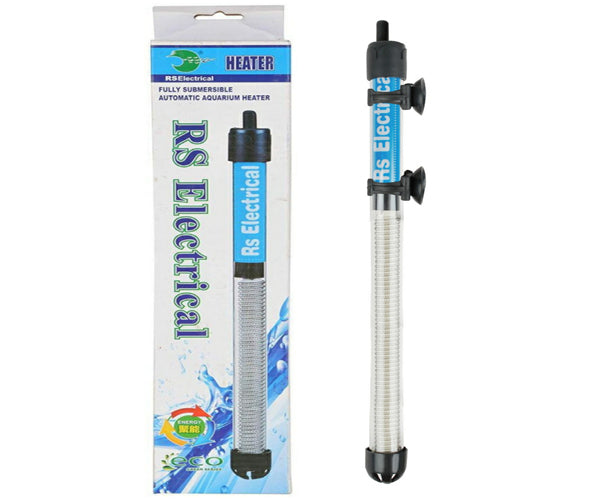
Specifications & Maintenance
Real-world specs and upkeep for the RS-50W:
- Power: 50 watts, standard mains voltage
- Recommended tank size: roughly 10 US gallons / ~38 litres, following the 5W-per-gallon rule for tanks under 55 gallons — treat this as an upper limit in a cool room, not a target to max out
- Typical target range: most tropical community fish are kept around 24-28°C (75-82°F); set the dial to suit the specific species in your tank rather than a generic default, since some species (bettas, many South American cichlids) prefer the warmer end and others (many livebearers, White Cloud Mountain minnows) do better cooler
- Placement: fully submerged, ideally near water flow from a filter or powerhead for even heat distribution rather than a still corner where warmed water can stratify
- Calibration check: the dial markings on budget submersible heaters are a starting point, not a guarantee — after installing, verify the actual water temperature with a separate digital or stick-on thermometer over a day or two and fine-tune the dial to match, since a few degrees of drift between the dial setting and true water temperature is common on this style of heater
- Settling-in period: give a newly installed heater 15-20 minutes submerged before switching it on, letting it reach ambient water temperature first, to reduce thermal stress on the glass
- Maintenance: wipe down periodically to keep the glass/casing free of algae buildup, which can insulate the element and throw off the thermostat's reading; unplug before doing any tank maintenance that lowers the water level, and never touch it while it's live and still hot straight out of the water
- Lifespan: like any submersible heater, the thermostat mechanism can drift or fail with age (typically after one to a few years of continuous use) — an inexpensive backup or floating thermometer used to spot-check temperature periodically is the simplest way to catch a failing heater before it becomes a problem