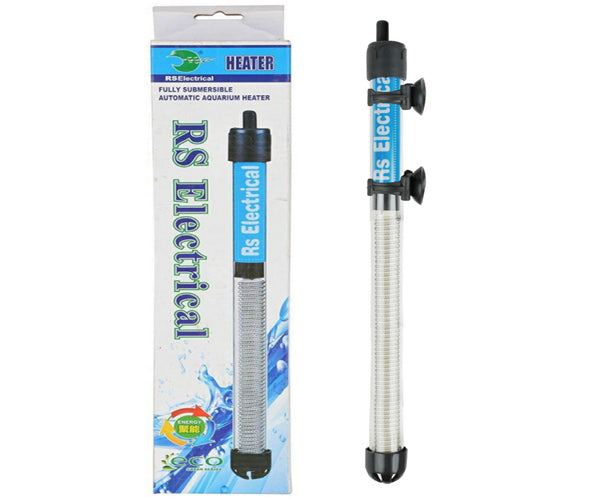
About & Function
The RS-75W is a submersible aquarium heater: a sealed glass or shatterproof tube holding a resistive heating element and a thermostat, sitting fully underwater so it warms the tank directly and evenly rather than heating the room around it. A dial on the body sets the target temperature, and the thermostat — typically a bimetallic strip or electronic sensor — cycles the element on and off automatically to hold that target, drawing its full 75W only in short bursts once the water is already near temperature rather than running continuously.
Almost all popular tropical aquarium fish, invertebrates, and many plants originate in consistently warm equatorial or subtropical water and simply cannot cope with a tank that tracks room temperature, which drifts with the seasons, swings between day and night, and dips noticeably once the heating or air conditioning in the house switches off overnight. A properly sized heater like the RS-75W removes that variable entirely, holding a steady target day and night regardless of what the room around the tank is doing. This matters more than many new keepers assume: fish are ectotherms whose metabolism, digestion, and immune function are governed directly by water temperature, so a stable range keeps their whole physiology working normally, while repeated swings are a well-documented source of stress that measurably weakens disease resistance.
A small indicator light built into most heaters of this style glows while the element is actively drawing power, giving a quick visual check that it's cycling normally — on for a while as the water is brought up or held near target, then off once it's reached, then on again as the water cools slightly and the cycle repeats. A light that never goes off can point to an undersized unit struggling in a cold room or a stuck thermostat, while a light that never comes on at all usually means a dead element or a tripped safety cutout, both worth investigating with a separate thermometer rather than assumed away.
Requirements
Heater wattage needs to match your tank volume closely — too little and it can't keep up on a cold night, too much and an overshoot (rare, but possible if the thermostat sticks) risks real harm. A widely used rule of thumb is roughly 5 watts per gallon (~1.3 W/litre) for tanks up to about 55 US gallons (~210 litres), tapering to roughly 3 watts per gallon (~0.8 W/litre) for larger tanks, since bigger volumes lose heat more slowly relative to their size. On that basis the 75W RS-75W suits a tank of roughly 15 US gallons (about 55-60 litres) under normal room conditions, with some headroom if the room runs a little cool.
Power: mains electricity via its own cable and plug — no battery option; keep the cord and plug well clear of splashes, ideally with a drip loop in the cord so any water that runs down it drips off before reaching the socket.
Placement and orientation: fully submersible, and best positioned near filter or powerhead outflow so the heat it generates gets actively circulated through the whole tank rather than staying pooled in one spot while the far side of the tank runs cooler. Many heaters of this style can be mounted either horizontally along the substrate or vertically depending on the tank's internal layout — check which your specific unit supports. Never let it run outside the water, even briefly during a water change, as the sudden thermal shock when it's plugged back in dry can crack the glass.
Allow a newly submerged heater to sit for 15-20 minutes before switching it on, so it reaches ambient water temperature gradually rather than heating from cold the instant it's powered.
If the room the tank sits in runs unusually cold, or the tank is near an exterior wall or draughty door or window, size up to the next wattage tier or run two smaller heaters rather than running one heater flat-out at the very edge of its rated capacity — a second unit also means the tank won't crash to room temperature if one heater fails.
Compatibility
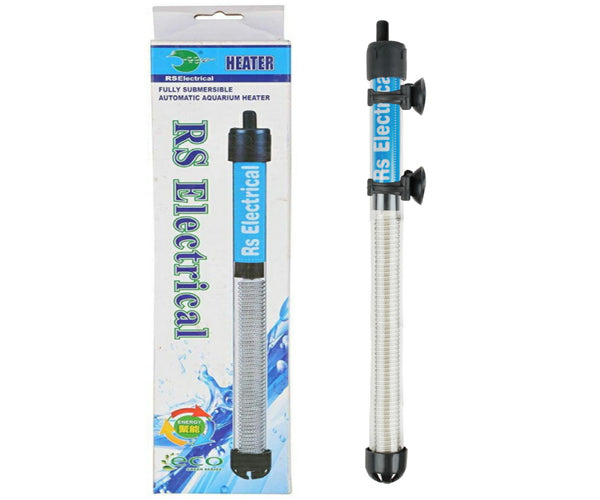
Specifications & Maintenance
Real-world specs and upkeep for the RS-75W:
- Power: 75 watts, standard mains voltage
- Recommended tank size: roughly 15 US gallons / ~55-60 litres, following the standard 5W-per-gallon rule — treat this as an upper limit rather than a target to stretch to
- Typical target range: most tropical community fish do well around 24-28°C (75-82°F); adjust the dial for the species you're actually keeping rather than leaving it on a generic default, since preferences vary meaningfully between species
- Placement: fully submerged near water flow for even heat distribution, avoiding still corners where warmed water can stratify away from the thermostat's own sensor
- Calibration check: the dial markings on this style of budget heater are a starting point, not a guarantee — after installing, track actual water temperature with a separate digital or stick-on thermometer over a day or two and fine-tune the dial to match what the thermometer actually reads
- Settling-in period: let a newly submerged heater sit unpowered for 15-20 minutes first to reach ambient water temperature, reducing thermal stress on the glass before it's switched on
- Maintenance: wipe algae buildup off the casing periodically (it can insulate the element and skew the thermostat's reading), always verify actual tank temperature with a separate thermometer rather than trusting the dial alone, and unplug it before any water change that drops the level near or below the heater
- Lifespan and failure signs: thermostats in this class of heater can drift or fail after roughly one to a few years of continuous use, so an inexpensive backup thermometer checked periodically is the simplest way to catch a heater that's started running hot, cold, or not cycling off at all before it becomes a real problem