About & Origin
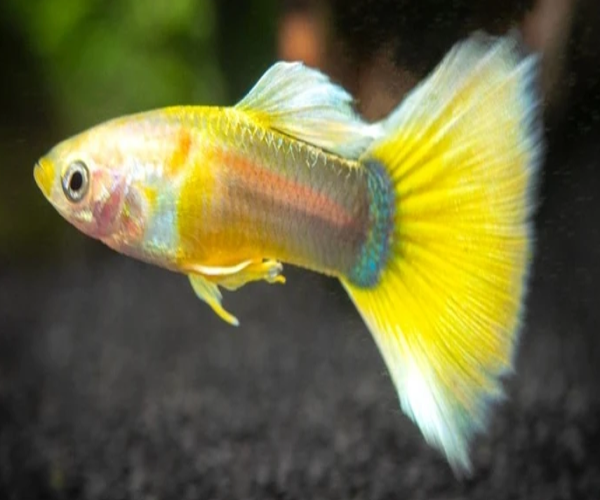
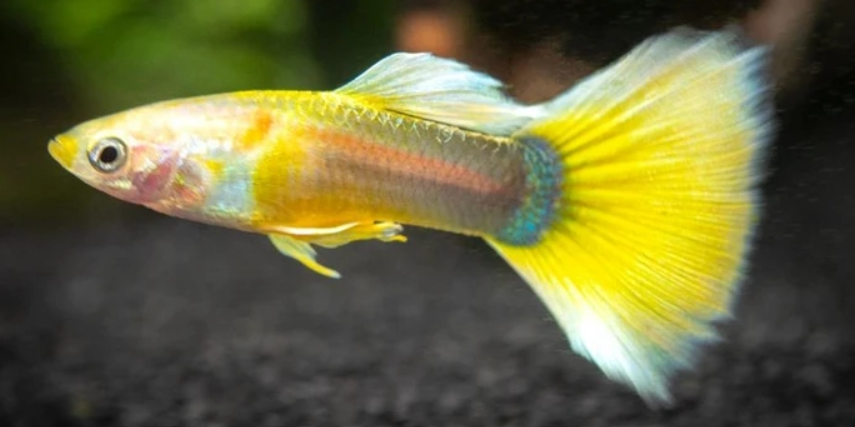
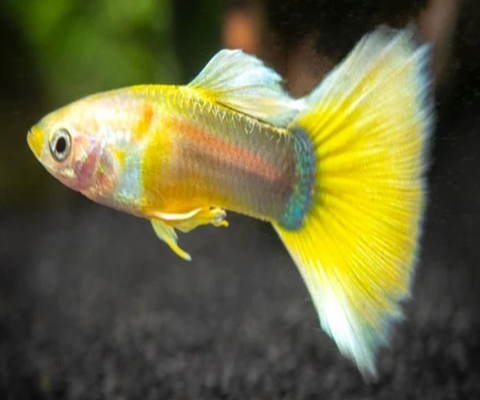
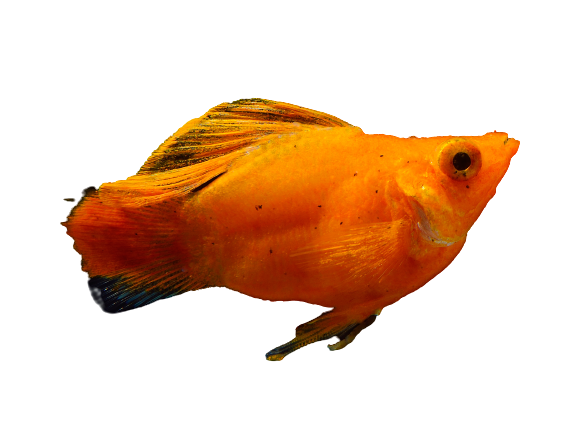
The Yellow Gold Tuxedo Guppy is a small livebearer fish, a colour strain of the guppy species Poecilia reticulata combining a warm yellow-gold front half with the classic darker tuxedo band toward the tail. Wild guppies originate from streams, ponds, and coastal waters across Venezuela, Trinidad, Guyana, and northern Brazil, and this strain is a purely ornamental color selection from that same hardy species.
In the wild, guppies live in shallow, warm, often nutrient-rich water and are famous among biologists for how fast they adapt to local conditions — including to predators, which has made them one of the most studied fish in evolutionary biology. In the aquarium hobby, that same adaptability is exactly what makes guppies such a reliable beginner fish.
This strain layers two separately bred traits on top of each other: the golden body-color gene (which lightens the base body tone from wild-type grey to a warm bronze-gold by reducing black melanophore density) and the tuxedo pattern gene (which darkens roughly the rear third to half of the body in a consistent band). Because these are two distinct, independently inherited traits rather than a single gene, holding both reliably in a breeding line takes more careful, deliberate pairing than a single-trait strain — which is part of why combination strains like this one are generally sold at a premium over plainer single-color guppies.
Like most fancy guppy strains, young fish typically arrive not yet fully colored up — the golden body tone and the darker tuxedo band both tend to strengthen and sharpen as the fish matures over its first couple of months, so a freshly arrived juvenile won't look quite as vivid as a mature adult of the same strain.
The Yellow Gold Tuxedo Guppy strain sold here is bred and raised for the aquarium trade specifically for its coloring and finnage; its care, temperament, and water needs are identical to any other guppy variety.
fishykart.com ships healthy, actively-colored stock, not fish pulled straight from a wholesale feeder tank.
Requirements
Standard guppy husbandry applies (10 gallon/38 litre minimum for a group of 6+, roughly 2 litres per adult, female-heavy sex ratio, omnivorous flake/micro-pellet diet with occasional live/frozen foods, floating or fine-leaved plants for fry cover, a tight lid since they jump, fry every 4-6 weeks once mature).
This strain specifically: like other tuxedo-pattern guppies, the darker rear band and the yellow-gold front are inherited as somewhat separate traits, so home-bred fry can vary in how much of each colour they show and how sharp the tuxedo line comes out. Warm-spectrum lighting brings out the gold tone more strongly than cool white lighting does.
Home breeding expectations: because this is a two-trait combination strain, pairing two Yellow Gold Tuxedo adults doesn't guarantee every fry inherits both traits cleanly — some offspring may show a stronger gold tone with a faint tuxedo band, others the reverse, and a smaller share may closely match the parents. Keepers wanting to preserve the exact combination over generations should selectively keep and pair only the best-matching fry rather than breeding the whole brood together indiscriminately.
Feeding for colour: foods containing natural carotenoids (spirulina-based flake, small live or frozen foods like daphnia) genuinely help maintain the gold tone's warmth over time, in the same way they support red/orange colouration in other fish — a plain, colour-neutral diet long-term can leave the gold looking flatter than it should.
Compatibility

Water & Care Conditions
- pH: 6.8–7.8
- Salinity / hardness: freshwater, moderately hard (10–20 dGH)
- Temperature: 24–28°C (75–82°F)
- Oxygenation: moderate surface movement, avoid stagnant water
Stability matters more than an exact number. Watch the yellow-gold front for dulling and the tuxedo band for blurring — both are early, visible cues of a water-quality issue.
Weekly 20-25% water changes keep colour and finnage healthy and reduce fin rot/ich risk; acclimate new arrivals slowly (20-30 minute drip) rather than a quick release.
Captive-bred and generally adaptable to ordinary dechlorinated tap water once roughly in range. Well-kept guppies typically live 2-3 years.
Guppies as a species do noticeably better in moderately hard, slightly alkaline water than in soft, acidic conditions — if local tap water runs soft, a small remineralizing addition or a pinch of aquarium salt helps replicate the mineral-rich water this species thrives in, often showing up as improved colour saturation and finnage condition within a few weeks of consistent water chemistry.
Because this strain layers two separate colour traits, both are worth watching independently when assessing health -- a fading gold front alongside an intact, sharp tuxedo band points more toward a nutrition or lighting issue than a water-quality one, while both fading together is the more typical signal of a genuine water-quality problem needing a water change and parameter check.