Axolotl Tank Mates: Why Fish, Shrimp and Snails Don't Work
Published: 2026-11-16 · FishyKart Blog
The only safe axolotl tank mate is another axolotl of about the same size. An axolotl (Ambystoma mexicanum) is a solitary ambush predator with external gills: it tries to eat anything that fits in its mouth, while fish that do not fit pick at those feathery gills. Shrimp, snails and fish all end up as food, as a choking or blockage risk, or as gill nippers. A single axolotl does not get lonely.
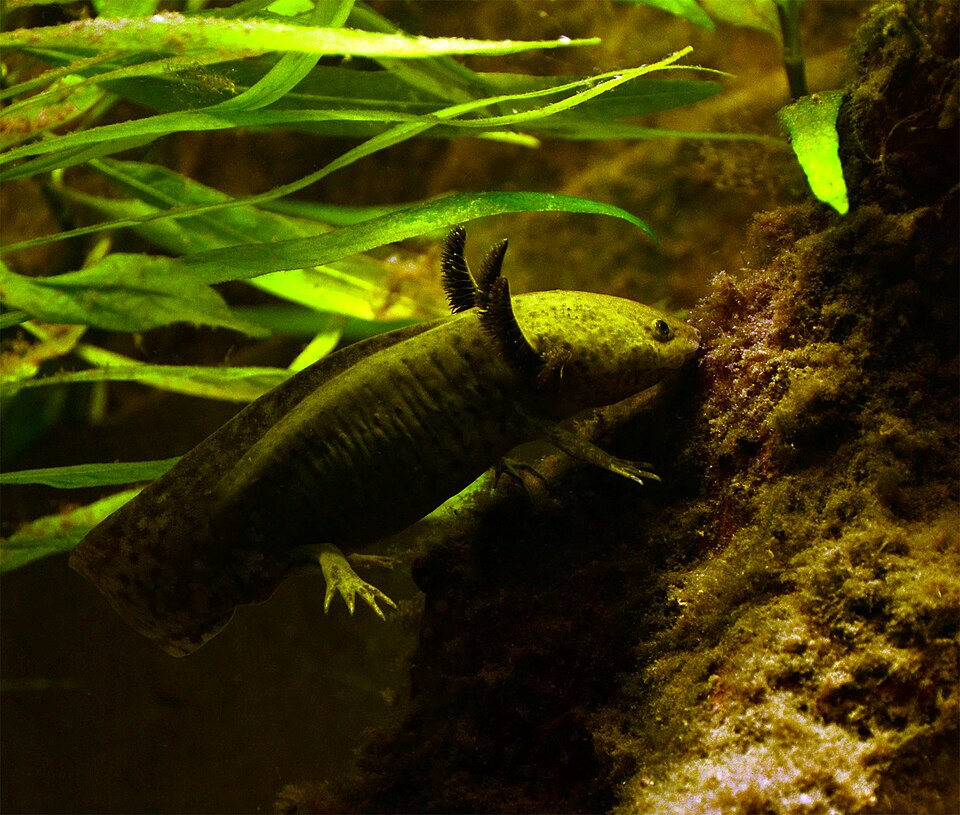
Photo: Vassil - Wikimedia Commons, CC0
Axolotl Tank Mates: Yes or No
| Tank mate | Verdict | Main problem |
| Axolotl of similar size | yes | needs extra space; watch for bites at feeding |
| Smaller or juvenile axolotl | no | bitten gills and legs, can be eaten |
| Goldfish | no | nip gills, heavy waste, grow too big to be eaten safely |
| White cloud minnows, small tetras | no | eaten, or pick at gills |
| Plecos and other suckermouth fish | no | can rasp the axolotl's slime coat; most need tropical water |
| Cherry and other small shrimp | no | become food; can carry parasites |
| Snails | no | swallowed shells can block the gut |
| Frogs, newts, turtles, crayfish | no | bites, claws, disease transfer, different needs |
Why Fish and Axolotls Do Not Mix
Three facts about the axolotl rule out almost every fish:
- It eats by suction. An axolotl opens its mouth fast and sucks in whatever moves in front of it. A fish small enough to swallow is food; one slightly too big can get stuck.
- Its gills are outside the body. The three pairs of feathery gills wave in the water and look like food or worms to many fish. Gills bitten again and again shrink, get infected and slow the axolotl's breathing.
- It needs cool water. The Ambystoma Genetic Stock Center at the University of Kentucky keeps axolotls at 15-18 C (60-65 F) and never above about 22 C (72 F). Most aquarium fish are tropical and need 75 F or more, so one of the two would always be kept at the wrong temperature.
Fish that do like cool water, such as goldfish and white cloud mountain minnows, solve only the temperature problem. Goldfish produce a lot of waste and nip; minnows are small enough to be eaten. Feeder fish are the worst choice, as they can carry parasites. Even in the wild, introduced fish are listed among the threats to axolotls in Xochimilco by San Diego Zoo Wildlife Alliance.
Keeping Two Axolotls Together
Axolotls can share a tank with each other, but they do not need to. If you want two, these rules prevent most injuries:
- Same size. The Stock Center warns that when mixed sizes are housed together, larger ones try to eat the smaller ones. Juveniles also bite each other's toes and gills, which is why young axolotls of about 2 inches and up are usually raised apart.
- More floor space. A 20 gallon long (30 x 12 inches) is the usual minimum for one adult; for two, plan on a 30-40 gallon tank or larger with a long footprint. Footprints compared in 20 gallon tank dimensions and 40 gallon tank dimensions.
- Hides for each. At least one cave or shaded spot per axolotl.
- Feed apart. Use tongs and feed each axolotl separately; most bites happen when both lunge at the same worm.
- Same sex, unless you plan to breed. A male and female together will spawn, and a female can lay hundreds of eggs. Sexing is possible only after maturity at about a year.
Watch the first weeks closely. Missing gill filaments or nipped toes mean the pair needs to be split; axolotls regrow lost parts, but repeated injuries invite infection.
What to Add Instead of Tank Mates
If the tank looks empty, decorate rather than stock it. Axolotls do well with:
- Live plants that tolerate cool water and low light, such as anubias and java fern tied to rock or wood; see java fern.
- Smooth caves and wood for shade, with no sharp edges.
- Fine sand or a bare bottom, never gravel.
Full setup steps are in our axolotl tank setup guide, daily care in the axolotl care guide, and how long a well-kept axolotl lives in axolotl lifespan.