Axolotl Tank Setup: Size, Substrate, Filter and Cooling
Published: 2026-10-31 · FishyKart Blog
An axolotl tank needs four things most fish tanks do not: floor space (a 20 gallon long, about 30 x 12 inches, is the minimum for one adult), no gravel, gentle flow and water that stays at 60-68 F (16-20 C). Get those right and the rest is a normal cycled aquarium. Feeding and daily care are covered in our axolotl care guide.
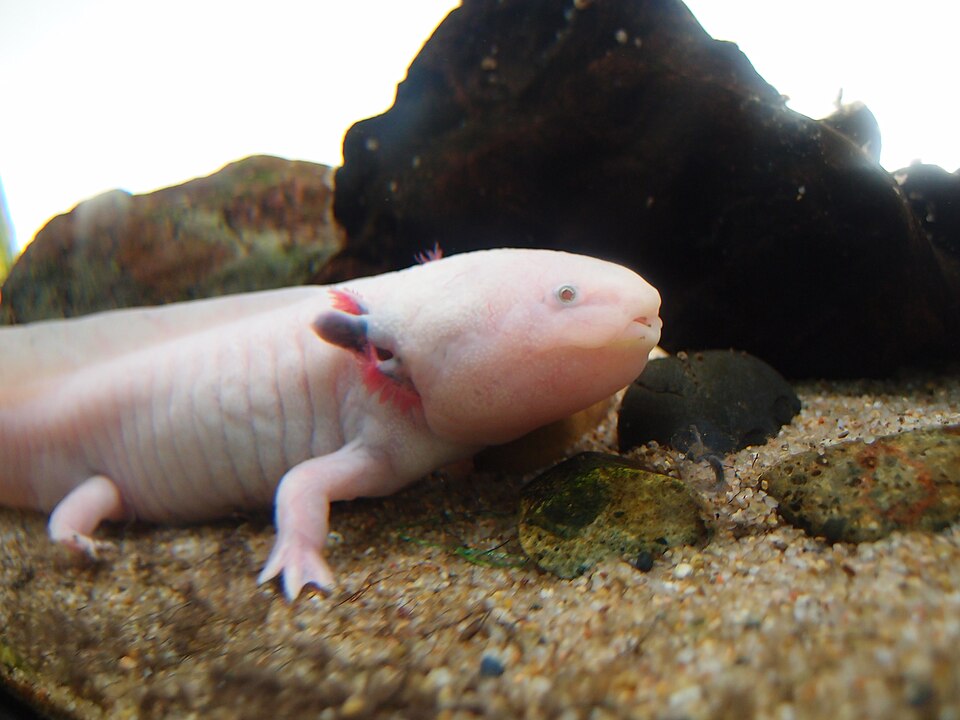
Photo: Guilhem Vellut - Wikimedia Commons, CC BY 2.0
Axolotl Tank Checklist
| Item | What to choose |
| Tank | 20 gallon long minimum per adult; 20-40 gal per axolotl |
| Lid | tight-fitting; axolotls can jump |
| Substrate | bare bottom or fine sand only |
| Filter | sponge filter or baffled low-flow filter |
| Temperature | 60-68 F; thermometer, fan or chiller if needed |
| Light | none or low; shaded hides |
| Decor | smooth caves, PVC pipe, ceramic pots, sturdy plants |
| Water | dechlorinated, cycled before the axolotl arrives |
Ranges follow a veterinary axolotl care sheet (Yarmouth Veterinary Center).
Tank Size and Shape
Axolotls spend most of their time on the bottom, so length and width matter more than height. A 20 gallon long gives one adult enough room to turn and walk; each extra axolotl needs roughly another 20 gallons. A larger volume also helps in two ways: waste is diluted, and the water warms up more slowly on a hot day.
Juveniles can start in 10-20 gallons, but axolotls grow fast and are adult-sized long before they mature at about 1.5 years, so most keepers buy the adult tank from the start.
Substrate: Bare Bottom or Fine Sand
Axolotls feed by sucking in food, and anything under the food goes in too. Gravel and small pebbles can block the gut, a common cause of death. Two safe options:
- Bare bottom: easiest to clean and safest for juveniles. Some axolotls dislike slipping on glass; a few large flat stones help.
- Fine aquarium sand: considered safe if small amounts are swallowed; many keepers wait until the axolotl is larger before adding it.
Any rocks or decor must be bigger than the axolotl's head.
Filter and Flow
Choose a sponge filter or a canister or hang-on-back filter with the outflow aimed at the glass or slowed with a baffle. If the gills are pushed forward or the axolotl keeps hiding from the outflow, the flow is too strong. An air stone adds oxygen without much current.
Cycle the filter before adding the animal: how to cycle a fish tank. A cloudy new tank is normal at first; see cloudy aquarium water.
Keeping the Water Cool
Temperature is where most axolotl setups fail. Keep the water at 60-68 F; avoid long periods above about 74 F.
- Place the tank in the coolest room, away from windows and heat sources.
- A clip-on fan blowing across an open water surface cools it by evaporation; top up with dechlorinated water.
- In warm climates or summers without air conditioning, an aquarium chiller is the dependable fix.
- Avoid the frozen water bottle trick as a long-term plan: it causes daily temperature swings.
No heater is needed in a normally heated home.
Hides, Plants and Light
Give at least one hide per axolotl: a cave, a length of PVC pipe or a ceramic pot. Axolotls prefer dim tanks, so skip strong lighting. Low-light plants that tolerate cool water work well; java fern and anubias can be tied to rocks, and floating hornwort gives shade.
Setup in 6 Steps
- Rinse the tank, fit the lid and place it in a cool spot.
- Add sand (optional), rinsed decor and hides.
- Fill with dechlorinated water and start the filter.
- Cycle the tank until ammonia and nitrite read 0 for several days.
- Check that the temperature holds at 60-68 F through a warm afternoon.
- Add the axolotl and feed lightly for the first days.
What Not to Put in an Axolotl Tank
- Gravel, glass beads or small pebbles.
- Fish, shrimp or snails as tank mates.
- Heaters set for tropical fish.
- Sharp or rough decor that can scratch delicate skin.
- Salt or medications without a vet's advice.