Axolotl Care: Water Temperature, Food and Daily Routine
Published: 2026-10-31 · FishyKart Blog
Axolotl care comes down to one rule: keep the water cool and clean. Axolotls (Ambystoma mexicanum) do best at 60-68 F (16-20 C), need about 20 gallons per adult, eat worms and sinking pellets, and live 10-15 years when their water stays stable. Heat, gravel and poor water quality cause most deaths. This guide covers the daily routine; the equipment side is in our axolotl tank setup guide.
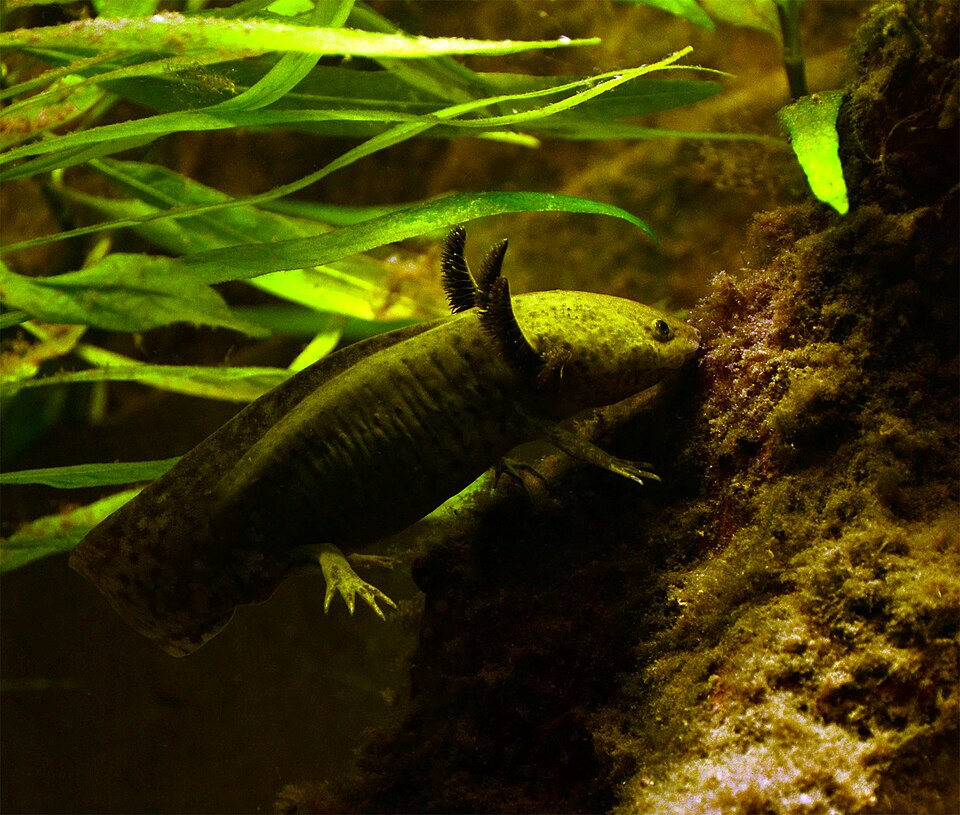
Photo: Vassil - Wikimedia Commons, CC0
Axolotl Quick Facts
| Parameter | Value |
| Adult size | about 8-12 in (20-30 cm) |
| Lifespan in captivity | 10-15+ years |
| Water temperature | 60-68 F (16-20 C) ideal; avoid long periods above 74 F |
| pH | about 6.5-7.5 |
| Ammonia / nitrite / nitrate | 0 / 0 / under 40 ppm |
| Tank | 20-40 gallon long per adult |
| Diet | carnivore: worms, sinking pellets |
| Feeding | juveniles daily, adults every 2-3 days |
Care figures follow a veterinary axolotl care sheet (Yarmouth Veterinary Center); size and wild data from the San Diego Zoo Wildlife Alliance Library fact sheet.
What Makes the Axolotl Different
The axolotl is a salamander that never leaves the water. It keeps its larval features for life, including the feathery external gills on each side of the head; biologists call this neoteny. It is also famous for regrowing lost limbs, tail and even parts of organs, which is why it has been studied in labs for decades.
In the wild, the axolotl survives only in a few canals and lakes of southern Mexico City around Xochimilco. The IUCN lists it as Critically Endangered (2019 assessment), with roughly 50-1,000 adults estimated in the wild. Every axolotl sold as a pet is captive bred.
Water Temperature: The Number That Matters Most
Axolotls are cold-water animals. Keep the tank at 60-68 F (16-20 C). Short dips to 55 F or rises to 72 F are tolerated, but weeks above about 74 F (23 C) lead to heat stress, loss of appetite and infections.
- Put a thermometer in the tank and read it every day.
- Keep the tank away from windows, heaters and direct sun.
- Most homes need cooling in summer, not heating in winter: a clip-on fan or an aquarium chiller is the usual answer.
If your room regularly sits above the mid 70s F in summer, solve cooling before you buy the animal.
Water Quality
Axolotls produce a lot of waste for their size, and their skin and gills are sensitive. The tank must be fully cycled before the axolotl arrives; see how to cycle a fish tank.
- Test weekly: ammonia 0, nitrite 0, nitrate under 40 ppm, pH around 6.5-7.5.
- Change 20-30% of the water weekly with dechlorinated water at the same temperature.
- Remove waste daily with a turkey baster or a small siphon.
- Keep the current gentle: strong flow stresses axolotls and bends their gills forward.
What to Feed an Axolotl
Axolotls are carnivores that hunt by smell and suck food in. Good staples:
- Earthworms (pesticide-free, chopped for juveniles): the best single food.
- Sinking carnivore pellets made for axolotls or carnivorous aquatic animals.
- Frozen bloodworms and brine shrimp as treats, more useful for juveniles than adults.
Feed juveniles daily and adults every 2-3 days, as much as they eat in a few minutes. Use tongs or a feeding dish so food does not mix with sand, and remove leftovers. Avoid feeder goldfish: they carry thiaminase and can bring disease.
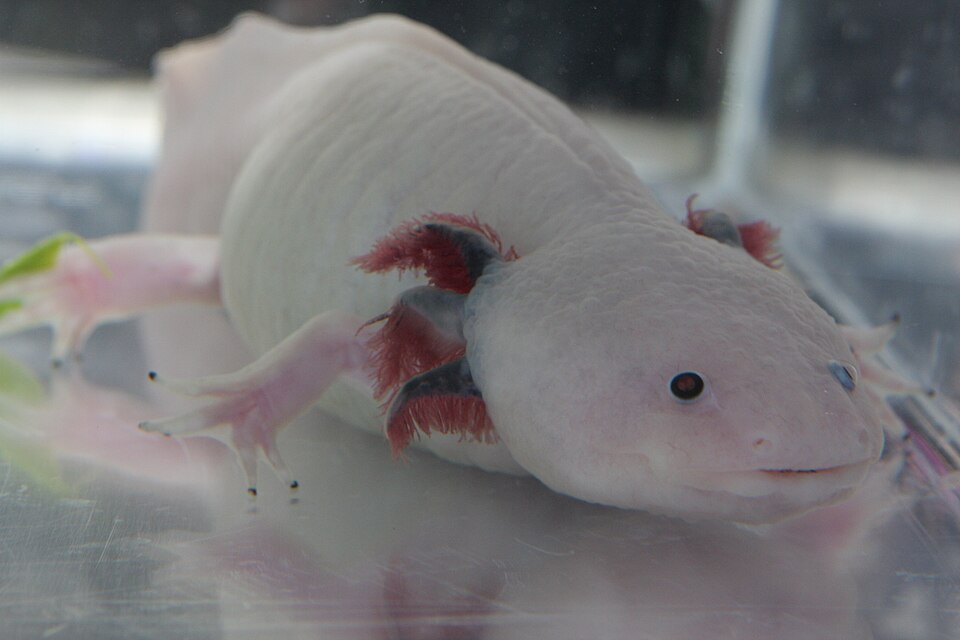
Photo: Henry Mühlpfordt - Wikimedia Commons, CC BY-SA 3.0
Daily and Weekly Routine
- Daily: check temperature, look at gills and skin, remove waste and leftovers.
- Every 2-3 days (adults): feed.
- Weekly: test water, change 20-30%, rinse the sponge filter in removed tank water.
- Yearly: a check-up with a vet who treats amphibians.
Warning Signs
Call an amphibian vet if you see any of these for more than a day or two:
- Gills curled forward or a curled tail tip (stress, often heat or water quality).
- Floating and struggling to get back down.
- White fuzzy patches on skin or gills (fungal infection).
- Red skin or shrinking gills (poor water quality).
- Refusing food together with lethargy.
The first step is almost always the same: check temperature and test the water.
Handling and Tank Mates
Do not handle axolotls for fun. Their skin is delicate and their bones are partly cartilage. To move one, use a soft net or a container and support the whole body.
Keep axolotls alone or with other axolotls of the same size. They eat fish, shrimp and snails that fit in their mouth, and fish such as barbs or tetras pick at the gills. Larger axolotls can also bite smaller ones.
Before You Buy: Is an Axolotl Legal Where You Live?
A few US states restrict axolotls, and since January 2025 federal law limits shipping them to Hawaii, Washington DC, Puerto Rico and US territories. Check our axolotl legal states guide before buying. Never release an axolotl outdoors.