Do Fish Sleep? What Science Says and How Aquarium Fish Rest
Published: 2026-11-26 · FishyKart Blog
Yes, fish sleep, just not the way people do. They have no eyelids and no bed, but most fish settle into regular periods of rest in which they slow down, lower their metabolism and react less to the world around them. In 2019, Stanford researchers recorded two distinct sleep states in the brains of zebrafish that resemble human deep sleep and REM sleep, evidence that sleep is at least 450 million years old.
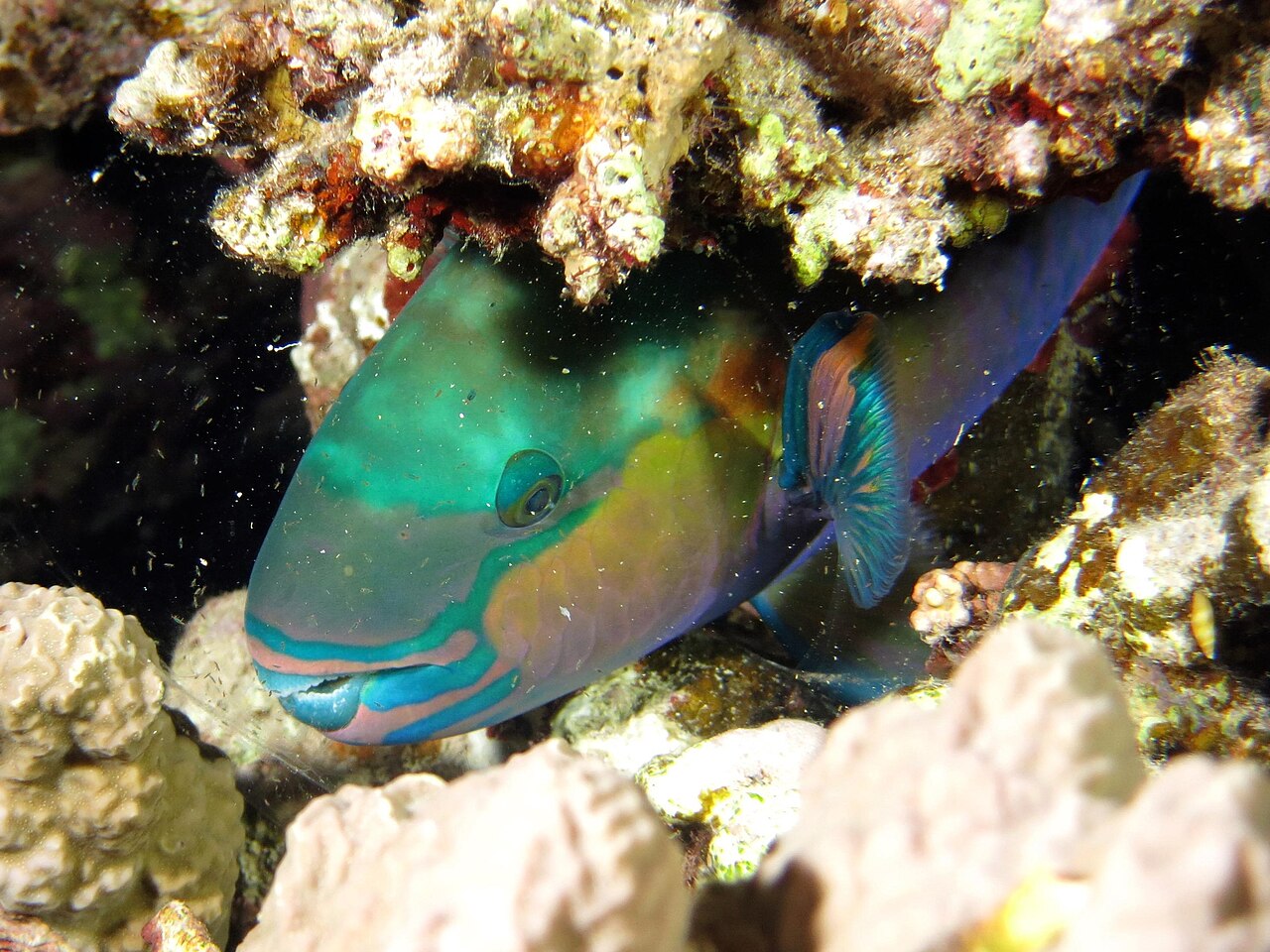
Photo: Jerome Paillet (IFREMER) - Wikimedia Commons, CC BY 4.0. A parrotfish photographed asleep in a coral shelter during a night dive.
How Fish Sleep: The Short Version
| Question | Answer |
|---|---|
| Do fish sleep? | Most fish rest daily; zebrafish show true sleep states in the brain |
| Eyes | Stay open; most fish have no eyelids |
| What the body does | Muscles relax, heart rate and breathing slow, response to stimuli drops |
| Where | Floating in place, wedged into rock or plants, on the bottom, or buried in sand |
| How long | Varies by species: about 13 hours a day in surface Mexican tetras, 2-4 hours in their blind cave relatives |
| In an aquarium | Needs a steady day and night cycle: about 8-12 hours of light |
Sources: NOAA National Ocean Service, Stanford Medicine (2019), National Geographic on the cavefish study (2011), National Geographic, Do fish sleep?, Aqueon; checked November 2026.
What Fish Sleep Looks Like
NOAA's National Ocean Service puts it simply: fish do not sleep the way land mammals do, but most fish do rest. During rest, fish reduce their activity and metabolism while remaining alert to danger. Some float in place, some wedge themselves into a secure spot in mud or coral, and some find a nest. The Pacific sand lance goes a step further and burrows into the sand to rest, save energy and hide from predators.
Because most fish have no eyelids, a sleeping fish keeps its eyes open. That is why people long doubted that fish sleep at all: the usual signs we look for, closed eyes and lying down, are missing.
The Zebrafish Study: Sleep in a Fish Brain
The strongest evidence comes from the zebrafish (Danio rerio), a common aquarium fish and lab animal. In a study published in Nature on July 10, 2019, a Stanford team led by Louis C. Leung and Philippe Mourrain watched the brain activity of young zebrafish under a microscope. The sleeping fish lost muscle tone, their heartbeat dropped and they stopped responding to stimuli. Their brains showed two distinct states:
- Slow bursting sleep, similar to the deep slow-wave sleep of mammals.
- Propagating wave sleep, similar to REM sleep, the stage in which people dream.
Because people and fish share these brain signatures, the researchers concluded that this kind of sleep evolved at least 450 million years ago, before any animal crawled out of the ocean. Zebrafish are the same species sold as zebra danios in pet stores.
How Long Do Fish Sleep?
Sleep time depends heavily on the species and its habitat. A 2011 study in Current Biology, led by Erik Duboue in Richard Borowsky's lab at New York University, compared Mexican tetras (Astyanax mexicanus) from rivers with blind populations from three caves, Pachon, Tinaja and Molino. Fish were scored as asleep when they had barely moved for a minute and responded less to a gentle poke. As reported by National Geographic:
- River fish slept about 13 hours a day, mostly at night.
- Cavefish slept only 2-4 hours a day, a loss of roughly 70-85% of their sleep.
Living in permanent darkness with scarce food, the cavefish evolved to stay awake and forage. The loss happened separately in each cave, which suggests strong pressure to cut sleep when food is hard to find.
Unusual Ways Fish Sleep
- Parrotfish in mucus "sleeping bags". Many parrotfish wrap themselves in a cocoon of mucus at night. In a study published in Biology Letters in November 2010, Alexandra Grutter's team at the University of Queensland showed that parrotfish without their cocoons were attacked more by gnathiid isopods, tiny blood-feeding crustaceans that bite fish at night.
- Fish that must keep swimming. Some sharks breathe by ram ventilation, pushing water over their gills as they swim, so they cannot stop completely. Others pump water with their mouths and can rest on the bottom; National Geographic reports that some carpet sharks even shut their eyes.
- Sand burrowers. The Pacific sand lance hides in sand to rest, as NOAA describes.
How to Tell if Your Aquarium Fish Is Sleeping
A sleeping aquarium fish usually:
- hangs still in midwater, near the bottom or among plants and decor;
- stays upright, with slow, steady gill movement;
- reacts slowly at first, then swims off when the light comes on or you approach.
When it is not sleep: a fish lying on its side, floating upside down, gasping at the surface or sitting still with clamped fins during the day needs attention. Test the water for ammonia and nitrite first; common causes are covered in fish swimming at the top of the tank and ammonia in a fish tank.
Helping Aquarium Fish Rest
- Keep a light schedule. Aqueon says all fish need day and night cycles and recommends about 12 hours of light a day for most tropical fish and plants, or 8-10 hours for tanks without live plants and for coldwater fish. A cheap outlet timer keeps it consistent.
- Do not leave the light on 24 hours. Constant light removes the night cycle and also feeds algae.
- Give hiding places. Plants, caves and driftwood let shy fish rest out of sight.
- Respect night owls. Corydoras, plecos and loaches such as the kuhli loach are often more active after dark; feed them a sinking food at lights out.
Fish also go long stretches without food while resting or on holiday; see how long fish can go without food.