Rummy Nose Tetra: Price in India and Care Guide
Published: 2026-11-03 · FishyKart Blog
The rummy nose tetra is a small Amazon tetra with a bright red head, a silver body and a black and white striped tail. It is famous for swimming in a tight, synchronised shoal, which makes it a favourite for planted tanks. At FishyKart a Rummy Nose Tetra is listed at ₹65. It grows to about 5 cm (2 inches), must be kept in a group of 10 or more in a tank at least 90 cm (3 feet) long, and needs 23-26°C with soft, slightly acidic water.
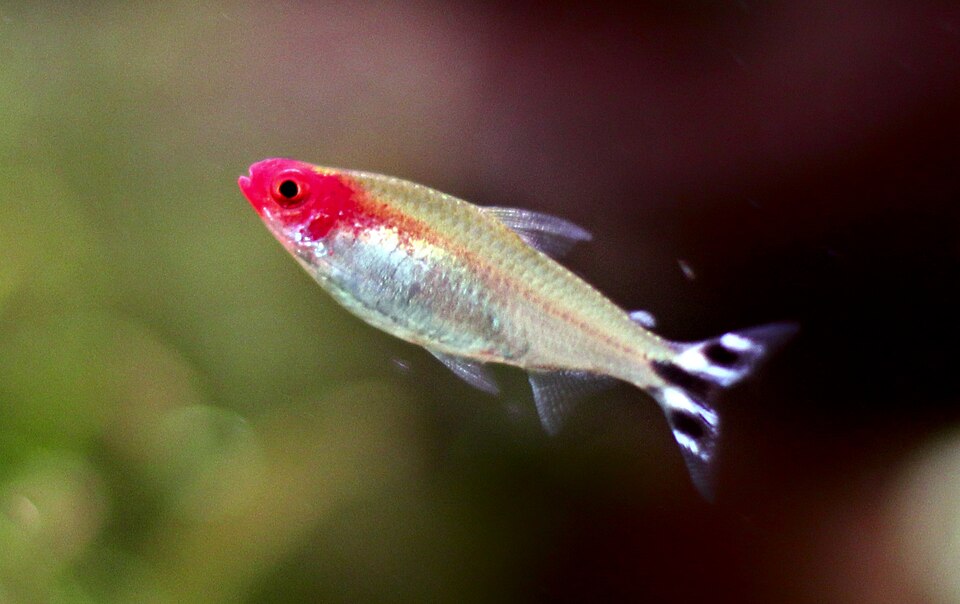
Photo: Soulkeeper - Wikimedia Commons, CC BY-SA 3.0
Rummy Nose Tetra Price in India
Prices below are taken from FishyKart's own store. They change with stock and offers, so open the product page for the current price.
| Fish | Price at FishyKart | Note |
|---|---|---|
| Rummy Nose Tetra | ₹65 (regular ₹80) | per fish; a shoal of 10 costs about ₹650 |
| Neon Tetra (tank mate) | ₹30 (regular ₹50) | same soft-water needs |
| Cardinal Tetra (tank mate) | ₹82 (regular ₹100) | warm, soft water |
| Harlequin Rasbora (tank mate) | ₹99 (regular ₹120) | peaceful mid-water shoal |
| Panda Corydoras (bottom partner) | ₹249 (regular ₹300) | peaceful bottom dweller |
The fish are cheap; the real cost is the group and a stable, mature tank. Rummy noses are more sensitive than neons or guppies and should not go into a brand-new tank.
Rummy Nose Tetra Care Sheet
| Parameter | Value |
|---|---|
| Scientific name | Petitella bleheri (formerly Hemigrammus bleheri); similar fish sold under the same name |
| Origin | Rio Negro and Rio Meta basins, Brazil and Colombia |
| Adult size | Up to 5 cm (2 in) |
| Group size | 10 or more |
| Minimum tank | 90 cm (3 feet) long for a group, about 100 litres or more |
| Temperature | 23-26°C (73-79°F) |
| pH | 5.5-7.0 |
| Hardness | 2-15 dGH |
| Diet | Omnivore: small flakes, micro pellets, daphnia, baby brine shrimp, bloodworm |
| Temperament | Very peaceful; shy with large or boisterous fish |
Sources: SeriouslyFish species profile for Petitella bleheri; FishBase species summary for Hemigrammus bleheri.
Three Fish Called "Rummy Nose"
Three similar species are sold as rummy nose tetras: the brilliant or firehead rummy nose (Petitella bleheri), the true rummy nose (Hemigrammus rhodostomus) and the false rummy nose (Petitella georgiae). SeriouslyFish notes that only P. bleheri has red that extends beyond the gill cover onto the body, which is the easiest way to tell it apart. Care is the same for all three.
The Red Nose as a Water Quality Signal
The red head is strongest in a calm, healthy fish in clean water. Rummy noses are well known for losing colour quickly when something is wrong, so many keepers use them as an early warning:
- Bright red: fish are settled and water is good.
- Pale after transport or at night: normal; colour should return within a day or two.
- Pale for several days: test for ammonia and nitrite, check temperature, and do a partial water change.
- Pale in hard, alkaline water: SeriouslyFish notes their colours fade in alkaline conditions.
Tank Setup
- Size: a 3 feet tank or larger for a shoal of 10-12; they are active swimmers and need open water in the middle.
- Mature tank: add them only to a fully cycled tank that has run for several weeks.
- Temperature: keep it at 23-26°C. A heater is needed in winter in most of India, and in summer the room should be shaded so water stays below about 28°C.
- Water: soft, slightly acidic water is ideal. Driftwood and leaf litter help lower pH gently. In hard-water cities, a stable pH close to 7 is safer than chasing a low number.
- Plants: dense planting at the back and sides, such as Java fern, Anubias and stem plants.
- Water changes: 20-25% weekly, with water at the same temperature.
Tank Mates
Rummy noses are very peaceful and do not compete well with boisterous or much larger fish. Good partners are small, calm fish that like the same soft, warm water: neon tetras, cardinal tetras, harlequin rasboras, ember tetras, panda corydoras, otocinclus and dwarf gouramis. In a big, warm tank they are a classic pairing with discus. Avoid cichlids such as Oscars and Flowerhorns, which eat them, and fin nippers such as tiger barbs. For a harder-water community, the widow tetra is a better choice.
Feeding and Breeding
Rummy noses are omnivores with small mouths. Feed small flakes or micro pellets once or twice a day, and add frozen or live daphnia, baby brine shrimp and bloodworm for the best colour. Mature females are rounder in the body than males. Breeding in home tanks is uncommon: the fish need very soft, acidic water, the eggs hatch in 24-36 hours and the fry become free swimming 3-4 days later, first eating infusoria, then microworm or baby brine shrimp.
Buy Rummy Nose Tetras at FishyKart
For more schooling tetras, see the types of tetra fish guide.
View Rummy Nose Tetra → Browse Tetras →