Harlequin Rasbora Care: Size, Group and Tank Mates
Published: 2026-10-28 · FishyKart Blog
The harlequin rasbora (Trigonostigma heteromorpha) is identified at a glance by the black triangle on its coppery-orange body, a mark that is the whole reason for its common name. It grows to about 1.5-2 inches, is often reported to live 5-8 years, and is one of the steadiest community fish you can buy: peaceful, adaptable and happiest in a shoal of 8 or more swimming in open midwater above a planted background.
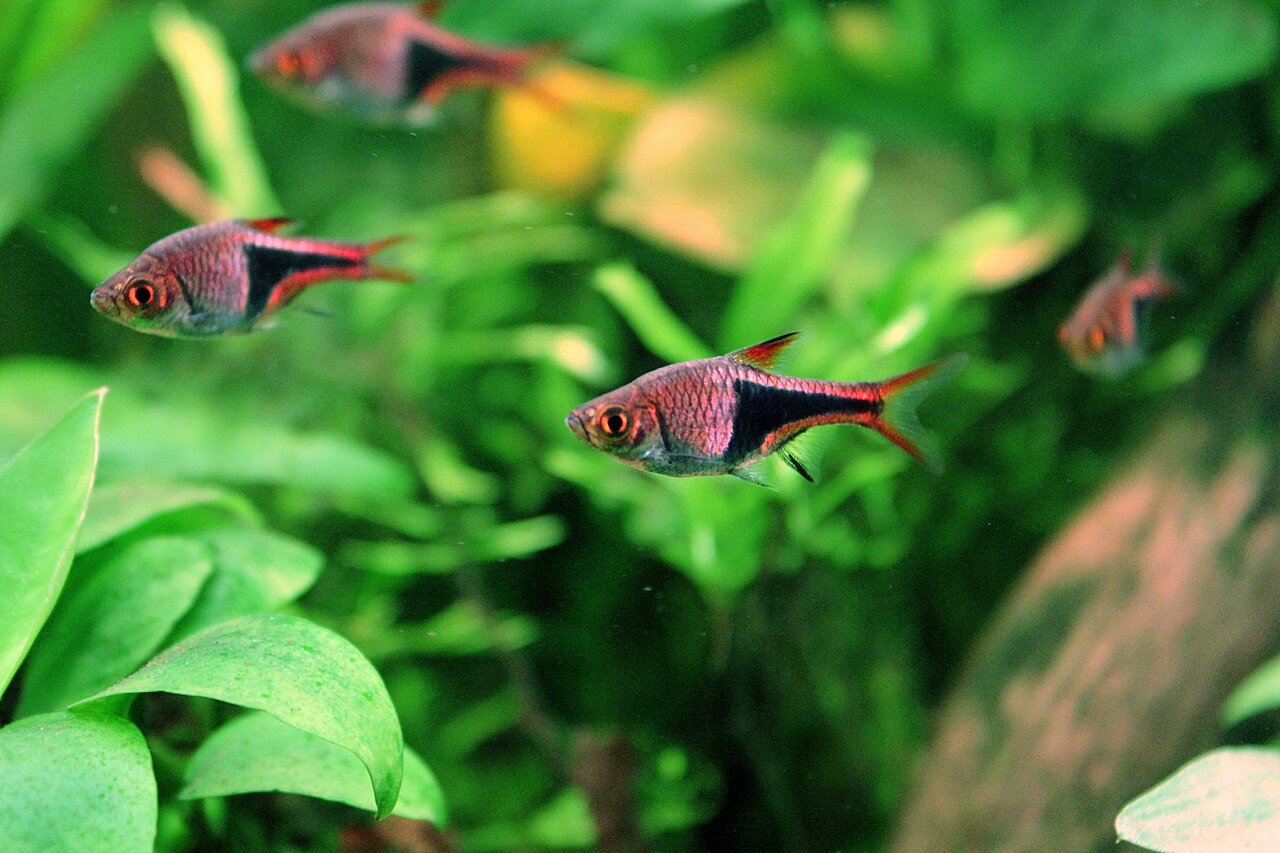
Photo: Juan R. Lascorz - Wikimedia Commons, CC BY-SA 3.0
| Parameter | Value |
| Scientific name | Trigonostigma heteromorpha |
| Origin | Peat swamps and streams of Malaysia, Singapore, Sumatra and southern Thailand |
| Adult size | 1.5-2 in (4-5 cm) |
| Lifespan | Often reported as 5-8 years |
| Group size | 8 or more |
| Temperature | 73-82°F (23-28°C) |
| pH | 6.0-7.5 |
| Minimum tank | 20 gallons |
| Temperament | Peaceful shoaling fish |
A Shoaling Fish That Needs Open Water
Harlequin rasboras swim as a loose group in the middle of the tank and tighten up when something startles them. They need swimming room, not just plant cover, so leave open water at the front and keep plants along the back and sides. A small group of three or four is the main cause of skittish, washed-out harlequins.
Water: Soft Is Best, But Not Essential
In the wild they live in soft, acidic blackwater, but captive-bred harlequins adapt to most stable tap water. What matters is stability: avoid big pH or temperature swings and keep nitrates low with weekly water changes. If you want to breed them, softer, more acidic water helps, and that is also where their colour is strongest.
Breeding Behaviour
Harlequins do something unusual for a small community fish: they lay eggs on the underside of broad leaves. A pair turns upside down beneath a leaf, often of a Cryptocoryne or an anubias, and sticks the eggs there. Adults eat eggs and fry, so breeding takes a separate tank, soft water and very fine first foods.
Feeding and Tank Mates
Harlequins eat flakes, small pellets and frozen foods such as daphnia and bloodworms. Good companions include tetras, corydoras, honey gouramis and otocinclus. Avoid fin-nippers like tiger barbs in small tanks and any fish large enough to eat them.
Harlequin rasboras are listed in our store as harlequin rasbora.