About & Origin
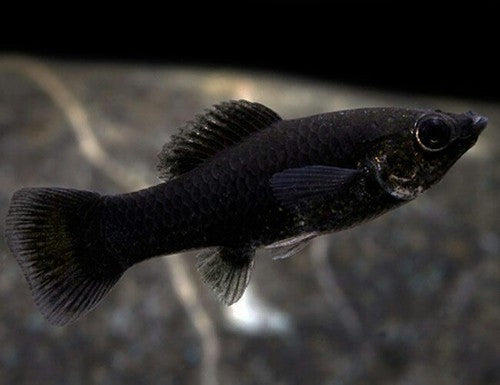
The Black Molly is a solid-black colour form of the livebearer species complex Poecilia sphenops / Poecilia latipinna, selectively bred over generations from wild mollies native to fresh and brackish waters of Central America and the Gulf Coast of the United States and Mexico. In the wild, mollies inhabit everything from freshwater streams to coastal lagoons with real salinity, which explains their unusually broad tolerance for water chemistry in captivity.
Black mollies are deep, solid black from nose to tail with a rounded, deep-bodied shape and a sail-like dorsal fin in some strains. They are active, constantly grazing swimmers that spend much of their day picking at algae and biofilm on surfaces, in addition to eating prepared foods.
As livebearers, mollies give birth to free-swimming fry rather than laying eggs, and a mixed-sex group like this combo pack will very likely breed readily once settled — a well-known, generally welcomed trait among molly keepers, though fry survival in a community tank is often low without separate protection.
This combo pack is a convenient way to start a small shoal at once, which suits mollies well since they are a genuinely social species that does best in numbers rather than as a lone fish.
Selective breeding has also produced several finnage variants alongside the solid black colouring — some black molly lines carry the tall, sail-like dorsal fin associated with Sailfin Mollies (Poecilia latipinna), while others have the more standard, shorter fin of Poecilia sphenops. Both are marketed simply as "black molly" and share essentially identical care requirements, so the distinction matters more for appearance than husbandry.
The solid-black colour form is prized precisely because it's genetically simple and stable to reproduce compared to more elaborate patterned strains, which is one reason black mollies remain one of the most widely available and affordable livebearers in the hobby despite looking strikingly different from the mottled wild-type molly.
Requirements
A group of mollies like this combo needs a minimum of about 75–100 litres to swim and shoal comfortably, more if the group is larger or shared with other fish — mollies are active, medium-sized livebearers, not a nano-tank species.
Mollies are omnivorous grazers: a quality flake or pellet food should be supplemented with regular algae/vegetable matter (blanched courgette, spirulina-based foods), since a shortage of green matter in the diet is a common, avoidable cause of poor condition in captive mollies.
Sex ratio matters for group harmony — males will persistently court females, so keeping more females than males (roughly 2–3 females per male) reduces stress on any individual female and is standard practice for a mixed-sex molly group.
Unlike most freshwater tropicals, mollies genuinely benefit from a small amount of aquarium salt or slightly brackish conditions, reflecting their coastal/brackish wild habitat — this isn't mandatory in pure freshwater but is a well-documented way to reduce disease susceptibility, particularly the fungal/bacterial issues mollies are somewhat prone to when stressed.
Good filtration and regular water changes matter more than usual for this species, since mollies are notably sensitive to poor or fluctuating water quality despite their reputation for hardiness in stable conditions.
Because this is a combo pack of multiple individuals, expect fry within the first few weeks if both sexes are present — female mollies store sperm and can produce multiple broods from a single mating, so even a group that appears all-female at purchase can sometimes still produce young later on, a detail worth knowing if population control matters to the keeper.
A tight-fitting lid is worth having, since mollies are surprisingly capable jumpers when startled, and like most livebearers they do best with subdued or filtered lighting rather than harsh direct sun, which can encourage nuisance algae faster than the fish themselves can graze it down.
Compatibility
Water & Care Conditions
Mollies are one of the more chemistry-flexible community fish, but they have real preferences that differ from many popular tropicals:
- pH: 7.5–8.5 — mollies do best in neutral-to-alkaline, harder water, unlike softer-water species such as tetras
- Hardness: moderate to hard (10–25 dGH); soft, acidic water is a common, avoidable stressor for this species
- Salinity: tolerates and often benefits from a small amount of aquarium salt or light brackish conditions, reflecting its coastal wild habitat, though pure freshwater is fine if parameters are otherwise stable
- Temperature: 24–28°C (75–82°F)
- Oxygenation: good surface agitation/oxygenation is appreciated, as with most active livebearers
- Water changes: weekly partial changes (20–30%) help keep the harder, more mineral-rich water this species prefers from drifting toward the soft, acidic conditions that stress it
Stability matters more than any single number here — sudden swings in pH or hardness are a more common cause of molly health problems than the exact values themselves.
A well-planted tank with some floating plants gives any resulting fry a real chance at survival in a community setting, since adult mollies (including their own parents) will readily eat newly-born fry if given the opportunity and no cover is available.
A slightly higher water temperature toward the upper end of the range, combined with the salt/hardness adjustments above, is a commonly used approach among molly keepers for managing outbreaks of ich or fungal issues, since this species tolerates both warmer water and mild salinity noticeably better than most freshwater tropicals.
Watch the group for the early signs of stress specific to this species — clamped fins, a hunched posture, or fish gathering listlessly near the surface usually point to a water-chemistry mismatch rather than disease, and are worth checking against the parameters above before reaching for medication.