About & Origin
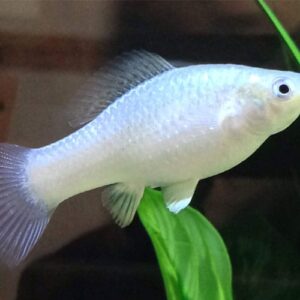
The White (or Silver) Molly is a pale, largely pigment-free colour form of the livebearer species complex Poecilia sphenops / Poecilia latipinna, selectively bred over generations from wild mollies native to fresh and brackish waters of Central America and the Gulf Coast of the US and Mexico. In the wild, mollies range from freshwater streams to coastal lagoons with real salinity, which explains their unusually broad tolerance for water chemistry in captivity.
White mollies are pale cream to white across the whole body, sometimes with a faint yellow or pink cast, and share the same deep-bodied shape and constant, active grazing behaviour as other molly colour forms — they spend much of the day picking at algae and biofilm on surfaces in addition to eating prepared foods.
As livebearers, mollies give birth to free-swimming fry rather than laying eggs, and a mixed-sex group like this combo pack will very likely breed readily once settled — a well-known, generally welcomed trait among molly keepers, though fry survival in a community tank is often low without separate protection.
This combo pack is a convenient way to start a small shoal at once, which suits mollies well, since they are a genuinely social species that does best in numbers rather than as a lone fish.
Selective breeding has also produced several finnage variants alongside the pale white colouring — some white molly lines carry the tall, sail-like dorsal fin associated with Sailfin Mollies (Poecilia latipinna), while others have the more standard, shorter fin of Poecilia sphenops. Both are marketed simply as "white molly" and share essentially identical care requirements, so the distinction matters more for appearance than husbandry.
Requirements
A pale-bodied fish like this shows the visible early signs of ich (white-spot disease) and some fungal/bacterial issues less clearly against its own colouring than a darker molly would -- worth keeping in mind, since it means relying a little more on behaviour (clamped fins, lethargy, reduced appetite) rather than spotting a visible symptom early, and checking the fish under good light during routine feeding is a reasonable habit for that reason.
Needs at least 75-100 litres for a group this size to swim and shoal properly -- mollies are active, medium-bodied livebearers, not a fish suited to a small or nano tank regardless of colour form.
Feed a quality flake or pellet as a base, but treat vegetable matter as a real requirement rather than a treat -- blanched courgette or spirulina-based foods matter here, since mollies are natural grazers and a diet that's too meat-heavy is a common, easily avoidable cause of poor condition.
Keep more females than males in a mixed group (roughly 2-3 to 1) -- male mollies court persistently, and an even or male-heavy ratio puts real, ongoing stress on individual females.
A little aquarium salt or mild brackish conditions genuinely suits this species, tracing back to its coastal wild habitat -- not mandatory in stable freshwater, but a well-documented way to reduce the fungal and bacterial issues mollies are somewhat prone to under stress.
A secure lid matters -- mollies jump more readily than their calm daytime behaviour suggests, especially when startled -- and subdued rather than harsh direct lighting helps keep nuisance algae from outpacing what the fish can graze down themselves.
Compatibility
Water & Care Conditions
Water chemistry needs are exactly the same as any other molly colour form -- coat colour is purely cosmetic and doesn't change what this fish needs biologically:
- pH: 7.5–8.5 -- neutral to alkaline, harder water, notably different from soft-water species like most tetras
- Hardness: 10–25 dGH -- soft, acidic water is a genuine, avoidable stressor here
- Salinity: tolerates and often benefits from a little aquarium salt or mild brackish conditions, echoing its coastal wild ancestry, though stable pure freshwater is also fine
- Temperature: 24–28°C (75–82°F)
- Oxygenation: appreciates good surface agitation, typical for an active livebearer
Because pale colouring makes redness, discolouration, or spotting easier to spot than on a darker fish, this is a reasonable species to keep a closer routine eye on during feeding -- a genuine practical upside to the colour choice beyond simple looks.
Consistency matters more than hitting an exact number on any of the above -- sudden pH or hardness swings cause more real problems for mollies than a slightly-off but stable baseline ever does.
Floating plants or dense cover give any fry a realistic chance of surviving in a community setup, since adult mollies -- including the fry's own parents -- will eat newborns on sight if no cover is available.
Warmer water toward the top of the range, paired with the salt/hardness notes above, is a commonly used combination among molly keepers when managing an ich or fungal outbreak, since this species handles both heat and mild salinity noticeably better than most freshwater tropicals.