About & Origin
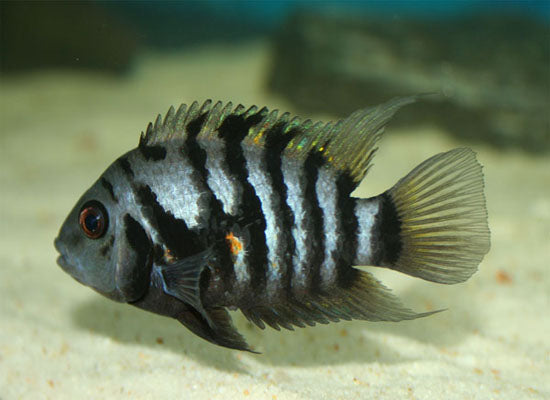
The Convict Cichlid (Amatitlania nigrofasciata) is a small Central American cichlid native to freshwater lakes and rivers from Guatemala to Panama, named for the bold black-and-grey vertical stripes that resemble old-fashioned prison uniforms. It's one of the most widely kept cichlids in the hobby, largely because it's tough, adaptable, and breeds so readily in home aquariums that it's often the first cichlid a keeper breeds by accident rather than on purpose.
In the wild convicts inhabit a wide range of conditions — rocky streams, lake margins, even brackish-influenced water near river mouths — which is exactly why they tolerate a broad range of aquarium water chemistry better than almost any other cichlid on this list.
Pairs are famously devoted parents, aggressively guarding eggs and free-swimming fry as a team; this parental drive is also the source of their reputation for aggression, since a breeding pair will treat the entire tank as a threat to the brood.
Sexing convicts is straightforward once they mature: males grow noticeably larger with pointed extensions on the dorsal and anal fins, while females stay smaller and develop a distinctive orange-to-pink patch across the belly, especially vivid when in breeding condition. A naturally occurring leucistic (pink/white, black-eyed) form, sometimes marketed as the "pink convict," turns up regularly in the hobby and breeds true alongside the standard grey-and-black pattern.
Convicts have also become one of the more notorious accidental introductions in the aquarium trade — their combination of extreme hardiness and prolific breeding has let escaped or released fish establish wild, self-sustaining populations well outside their native range, including warm-water canals and rivers in the southern United States and parts of Australia. It's a useful reminder never to release unwanted aquarium fish into local waterways, however hardy they seem.
Requirements
A single fish or a same-sex group can be kept in 80+ litres (20+ US gallons); a breeding pair needs considerably more space and ideally its own tank, since they become very aggressive defending fry.
Temperament: feisty and territorial, more so once paired and breeding; manageable with similarly robust Central American tankmates but not with small or slow-moving community fish. Aggression is very tank-size-dependent — the same pair that terrorises a 20-gallon tank can be a manageable presence in a well-decorated 55-gallon-plus setup with plenty of broken sightlines.
Diet: not fussy — a good cichlid pellet as a staple, with occasional live or frozen food (bloodworm, brine shrimp) for variety and conditioning ahead of breeding; they'll eat almost anything offered and are prone to overeating if fed too generously.
Décor: flat rocks or a clay pot/cave for spawning, plus enough rockwork to break sightlines between rival territories. Convicts are enthusiastic diggers and will rearrange loose substrate and uproot most live plants, so anchor decor securely and don't expect a delicate planted layout to survive alongside them.
Breeding: pairs form readily, lay several hundred eggs on a flat rock or cave wall, and both parents take turns fanning and guarding the clutch. Once free-swimming, the fry are shepherded in a tight school by both adults for weeks — a genuinely engaging behavior to watch, though it usually means removing other tankmates or the fry (or the parents) once spawning starts, since the pair's protectiveness intensifies sharply.
Compatibility caution: avoid slow, long-finned fish (fancy guppies, bettas, angelfish) that invite nipping, and be wary of housing two unrelated pairs in the same tank without ample space, since territorial disputes between rival convict pairs can turn serious.
Compatibility
Water & Care Conditions
Convicts are famously tolerant, which is a large part of why they're recommended to keepers with harder tap water who still want a cichlid without heavy chemical adjustment:
- pH: 6.5–8.0 — an unusually wide comfortable range
- Water hardness: soft to hard, roughly 5–20 dGH
- Temperature: 22–28°C (72–82°F)
- Oxygenation: standard filtration and aeration is sufficient; not a demanding species in this respect
- Filtration: a robust canister or hang-on-back filter rated for the tank size, since convicts are messy eaters and enthusiastic diggers that keep sediment stirred up
- Substrate: fine gravel or sand tolerated well; expect it to be rearranged regularly as the fish dig and defend territory
This tolerance is a real strength for beginners, but it isn't an excuse to skip maintenance — convicts still need regular water changes like any other fish, and their hardiness applies to established, stable conditions rather than sudden swings. A large weekly water change (25-30%) keeps nitrates down and colours vivid, and wild-caught or recently-imported stock should still be acclimated gradually even though captive-bred convicts are famously forgiving of ordinary tap water parameters in most regions.
Because they're so adaptable, convicts are often the species keepers first cycle a new tank with — not an ideal practice (fishless cycling is kinder), but a testament to how much ammonia and nitrite exposure they can shrug off compared with more delicate cichlids. That resilience shouldn't be relied on deliberately; a properly cycled tank with stable, tested parameters will always produce a healthier, longer-lived, more vibrantly coloured fish than one left to "tough it out." Sudden temperature drops are the one thing worth actively guarding against with a reliable heater, since rapid chills stress even this hardy species and can trigger ich outbreaks in an otherwise healthy tank.