About & Function
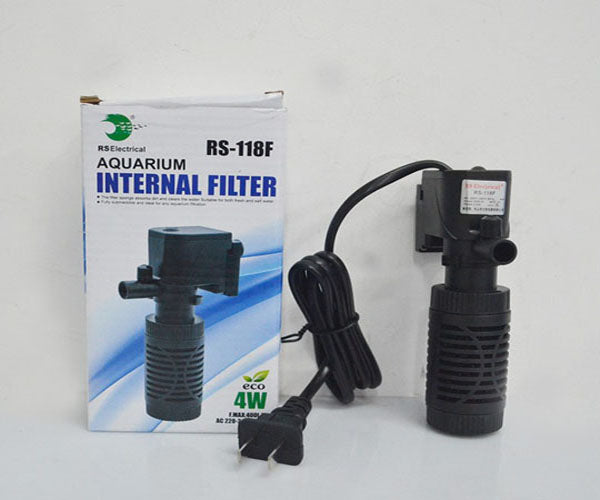
The RS 118F is a submersible internal filter, sitting at the smaller end of this filter line, built for small-to-medium freshwater aquariums. An internal filter sits entirely inside the tank, drawing water in through an intake, pushing it through a filter sponge or cartridge, and returning clean, oxygenated water via a spray bar or outlet nozzle at the top.
Filtration in any aquarium does three jobs at once: mechanical filtration traps floating debris and uneaten food; biological filtration hosts beneficial bacteria colonies (on the sponge media) that convert toxic ammonia and nitrite from fish waste into far less harmful nitrate; and the water movement it creates helps oxygenate the tank. Of these, biological filtration is the one that actually keeps fish alive long-term — it's the reason a filter should never be fully replaced or aggressively cleaned all at once, since that wipes out the bacteria colony the tank depends on.
Internal filters like this one are popular for smaller tanks specifically because they're compact, simple to install with no external plumbing or hoses to leak, and inexpensive relative to external canister systems — a sensible trade-off for a tank that doesn't need the much higher flow rates a canister filter provides.
The "118F" designation places it at the compact end of the RS internal filter range (below the 128F and 138F), suited to correspondingly smaller water volumes.
Being fully submersible and self-contained also means there's no external hose, canister, or hang-on housing to leak or take up space behind the tank — everything that could go wrong stays inside the aquarium itself, which is part of why internal filters remain a popular default choice for smaller setups even as canister and hang-on options have become more affordable.
Requirements
This is a mains-powered submersible filter — it plugs into a standard wall outlet and sits fully underwater to operate.
Power: runs on standard AC mains through its cord; like any submersible electrical equipment, it must remain fully submerged while powered on.
Tank size fit: as the smallest model in this filter range, the 118F suits small-to-medium tanks — roughly nano through small community tank territory — rather than larger, more heavily stocked aquariums, which would benefit from the higher flow rate of the 128F or 138F, or a hang-on/canister filter.
Installation: uses suction cups to mount against the inside glass, fully submerged; position the outlet flow so it doesn't blast directly at slow-swimming or long-finned fish (bettas, fancy guppies) but still creates gentle overall circulation across the whole tank rather than just one corner.
Cycling: a new filter needs several weeks to build up the beneficial bacteria colony that actually processes fish waste — adding a fully-stocked tank to a brand-new filter on day one risks an ammonia spike, so stocking gradually (or seeding the sponge with established filter media from an already-running tank) is the safer, faster approach.
Noise: a healthy, correctly-primed internal filter runs quietly with a steady hum; a rattling or buzzing sound usually means the impeller needs clearing of trapped debris, or that the unit isn't fully primed with water.
Priming after a power cut: if the filter loses power and the impeller chamber loses its water seal, it may need to be gently shaken or briefly lifted and resubmerged to clear an air bubble before it resumes normal flow when power returns.
Positioning height: mounting it a few centimetres below the waterline rather than right at the surface reduces the risk of the intake drawing in air and running noisy or dry if the water level drops slightly between top-offs.
Compatibility
Specifications & Maintenance
Realistic specifications and upkeep for this filter:
- Sizing: the smallest of the RS internal filter tiers (118F/128F/138F), best suited to small-to-medium tanks rather than heavily stocked or larger aquariums.
- Sponge/media cleaning: rinse the filter sponge in removed tank water (not tap water, whose chlorine kills the beneficial bacteria) roughly every 2–4 weeks, or when flow noticeably slows — squeeze gently rather than scrubbing hard, just enough to clear trapped debris while leaving the bacteria colony largely intact.
- Never fully replace media at once: replacing the whole sponge in one go wipes out the biological filter and can cause an ammonia spike — stagger any media replacement over time instead.
- Impeller check: if flow drops even after cleaning the sponge, check the impeller (the small spinning part that drives water flow) for debris or wear, a common cause of reduced output over time.
- Continuous operation: internal filters are designed to run 24/7 — turning them off overnight or for extended periods lets the bacteria colony they host start to die off from lack of oxygenated flow.
- Outlet direction: periodically check the spray bar or nozzle hasn't drifted to point at decor or glass instead of across the tank, which reduces effective circulation.
- Housing checks: inspect the outer housing periodically for cracks or a loose suction-cup mount, since a filter that shifts position mid-operation can end up partially exposed above the waterline and run dry.
- Replacement parts: sponge cartridges are the main consumable and are inexpensive to replace individually — the motor/impeller housing itself typically outlasts several sponge changes before it needs attention.
With periodic sponge rinsing and continuous operation, a filter like this reliably keeps a small-to-medium tank clear and biologically stable for years of service.