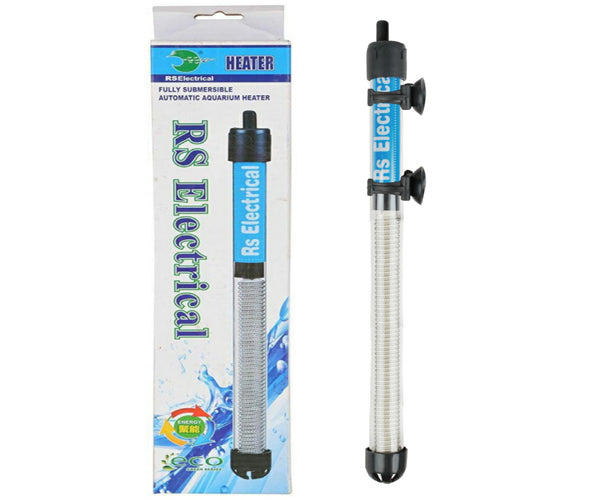
About & Function
The RS 200W is a submersible aquarium heater built for larger freshwater aquariums, sitting at the top of this range's heater lineup. Almost all tropical fish kept in home aquariums need stable, elevated water temperature year-round — a requirement most rooms cannot meet reliably on their own, especially overnight or through cooler seasons — and larger volumes of water need proportionally more heating power to hold a consistent target than a small tank does.
Like the rest of the range, it pairs a heating element with an internal thermostat that continuously reads the surrounding water temperature and cycles the element on and off to hold a set target, rather than heating without limit. This automatic regulation keeps a large volume of water stable rather than letting it drift with room temperature changes.
At 200 watts, this heater has the output to properly heat a genuinely large aquarium, where a smaller wattage unit would either fail to reach target temperature or would run continuously near its maximum output trying to keep up — neither of which is good for the heater's longevity or for stable water conditions.
Larger tanks are actually more forgiving of minor equipment hiccups in some ways (a bigger water volume changes temperature more slowly), but they still need correctly-sized heating to avoid a persistent gap between target and actual temperature, which is a real, if slower-developing, source of chronic fish stress.
Requirements
This is a mains-powered submersible heater — it plugs into a standard wall outlet and must be fully submerged before being powered on.
Power: runs on standard AC mains through its cord; never energise it while the heating element is out of water, since this risks cracking the element or causing a fire.
Tank size fit: using the common rule of thumb of roughly 5 watts per gallon for tanks up to about 55 gallons (dropping to around 3 watts per gallon for larger volumes), 200W comfortably suits tanks in the region of 35–45 gallons (roughly 130–170 litres) under normal room conditions — a colder room or larger volume may call for a second heater split across the tank rather than relying on one unit at its limit.
Placement: position it in an area of strong water circulation (near a filter outlet is ideal) so heat spreads evenly through a larger volume rather than pooling near the unit; in bigger tanks, using two smaller heaters at opposite ends is often more even than one larger unit in a single spot.
Safety: always unplug before water changes that would expose it to air, and let it cool fully before lifting it out to avoid cracking the element with sudden temperature change.
Compatibility


Specifications & Maintenance
Realistic specifications and upkeep for this heater:
- Wattage: 200W, suited to roughly a 35–45 gallon (~130–170 litre) tank under typical room conditions; larger volumes may be better served by two units rather than one heater working at its maximum continuously.
- Target temperature: general tropical freshwater range, typically 24–28°C (75–82°F) — confirm the specific needs of the fish species being kept.
- Always verify with a separate thermometer: the heater's own dial is a starting reference, not a guarantee — check actual water temperature independently, especially in the first week and after any adjustment.
- Cleaning: wipe the tube gently with a soft cloth during water changes to remove mineral scale and algae film, unplugged and cooled first.
- Failure modes: a heater can fail stuck-off (slow cooling) or, less often but more seriously, stuck-on (overheating) — periodic temperature checks catch both, and any unit behaving erratically should be replaced rather than trusted further.
- Adjustment settling time: after changing the target setting, allow several hours for a large volume of water to stabilise at the new temperature before rechecking — bigger tanks respond more slowly to heater adjustments than small ones.
- Redundancy for large tanks: splitting heating load across two smaller units rather than relying on one 200W heater at its limit gives you a safety margin if one fails, since the second unit can hold the tank at a survivable temperature while you replace the other.
With correct sizing (or a pair of units for very large volumes) and regular temperature checks, a 200W heater like this reliably holds a large tank at a stable, safe temperature over the long term.