About & Origin
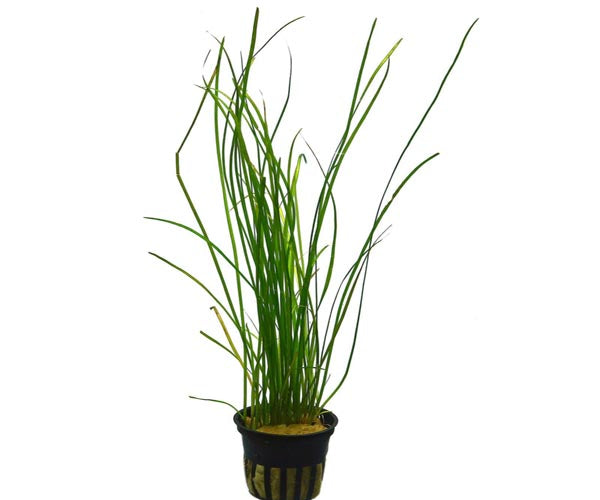
Vallisneria sp. "Mini Twister" is a compact, corkscrew-leaved cultivar related to Vallisneria americana, a grass-like aquatic plant naturally found rooted in the sediment of rivers, lakes, and ponds across the Americas, often growing in dense meadows in shallow, sunlit water. Where the wild species and most Vallisneria varieties grow long, straight, ribbon-like leaves, "Mini Twister" is a selectively maintained form prized specifically for its shorter blades that spiral and twist along their length, giving it a distinctive, curly texture unlike almost anything else commonly grown in the planted-tank hobby.
Like other Vallisneria, it grows from a central crown at its base rather than a branching stem, with new leaves emerging directly from that crown, and it spreads by sending out thin runners that produce new plantlets a short distance away — gradually forming a cluster of the same twisted foliage rather than staying as a single isolated plant. Every plantlet in an established cluster is a genetic clone of the original, connected (at least initially) by the runner that produced it.
Its smaller size (typically 10–15cm long and 1–2cm wide) sets it clearly apart from taller Vallisneria varieties, which are usually reserved for the very back of a tank where their height doesn't shade out anything else — "Mini Twister" is compact enough to plant between foreground and background zones, adding visual texture and gentle swaying movement to the mid-ground without growing tall enough to shade out plants placed behind it.
fishykart.com supplies live rooted Vallisneria "Mini Twister" plantlets rather than dried or artificial material, ready to establish directly in substrate.
Requirements
"Mini Twister" shares the easy-going nature of Vallisneria generally, making it a good choice even for less experienced planted-tank keepers looking to add some textural interest without extra difficulty.
Substrate: roots in ordinary gravel or sand without needing a rich nutrient substrate to survive, though root tabs or a nutrient-rich substrate will visibly speed up growth and improve leaf density and the tightness of the characteristic twist.
Light: tolerates low to moderate light well; under lower light it simply grows a little more slowly and produces slightly longer, looser leaves rather than failing outright.
CO2: not required for healthy growth — one of the more forgiving plants for a non-CO2 tank — though supplemental CO2 will noticeably speed growth and can produce denser, more tightly curled foliage.
Placement: its shorter, twisted leaves suit mid-ground planting in particular — between low foreground carpets and taller background plants — where its curling texture stays clearly visible rather than being lost among taller growth at the back of the tank.
Propagation and spread: spreads via runners into a cluster over time, same as other Vallisneria varieties — give it some open substrate nearby to expand into, and thin or replant excess plantlets elsewhere once the cluster becomes crowded.
Water movement: gentle to moderate flow keeps the twisted leaves swaying and looking their best, while very still water tends to let detritus and algae settle on the closely-spiralled blades more easily than on flatter-leaved plants, so it's worth positioning it somewhere with at least a little circulation.
Compatibility
Water & Care Conditions
"Mini Twister" tolerates a similar range of conditions to other Vallisneria americana varieties, and like them often does especially well in harder water than many popular aquarium plants prefer:
- pH: 6.5–8.0 — tolerant of alkaline, harder water, which makes it a workable background/mid-ground option for hard-water setups where softer-water plants often struggle
- Water hardness: soft to hard water (roughly 3–20 dGH); tends to grow especially well in harder, more mineral-rich tanks
- Temperature: 18–28°C (64–82°F), a comfortable range spanning unheated and tropical heated tanks alike
- Light: low to moderate is sufficient for steady growth; higher light with CO2 speeds growth and tends to produce tighter, more pronounced twisting, but neither is essential
As with other Vallisneria, avoid copper-based medications and fertilizers, which can harm the plant even at fish-safe doses, and avoid large sudden shifts in water hardness or trimming into the crown itself — both can trigger die-back of the leaves known as "melt," where foliage dissolves before the plant recovers from its crown and resumes normal growth. This is unsettling to see but rarely fatal on its own, as long as the underlying water conditions are otherwise stable and suitable for the plant; a firm, pale (not mushy or brown) crown is usually a sign it's still alive and will regrow.
Because the whole appeal of this cultivar is its twisted leaf shape, it's also worth noting that leaf twist can loosen somewhat under very low light or in a struggling plant — if new growth starts coming in straighter and less curled than expected, it's often a cue to check light levels and nutrient dosing rather than a permanent change in the plant itself.