Axolotl Life Cycle: Eggs, Larvae, Juveniles and Adults
Published: 2026-11-26 · FishyKart Blog
The axolotl (Ambystoma mexicanum) goes through four stages: egg, larva, juvenile and adult. Eggs hatch in about 2 weeks, larvae are about 1 inch long at 6-8 weeks, and adults are sexually mature at about 1 to 1.5 years. What makes the cycle unusual is the step it skips: unlike almost every other salamander, the axolotl never metamorphoses into a land animal and keeps its feathery gills for its whole 10-15 year life.
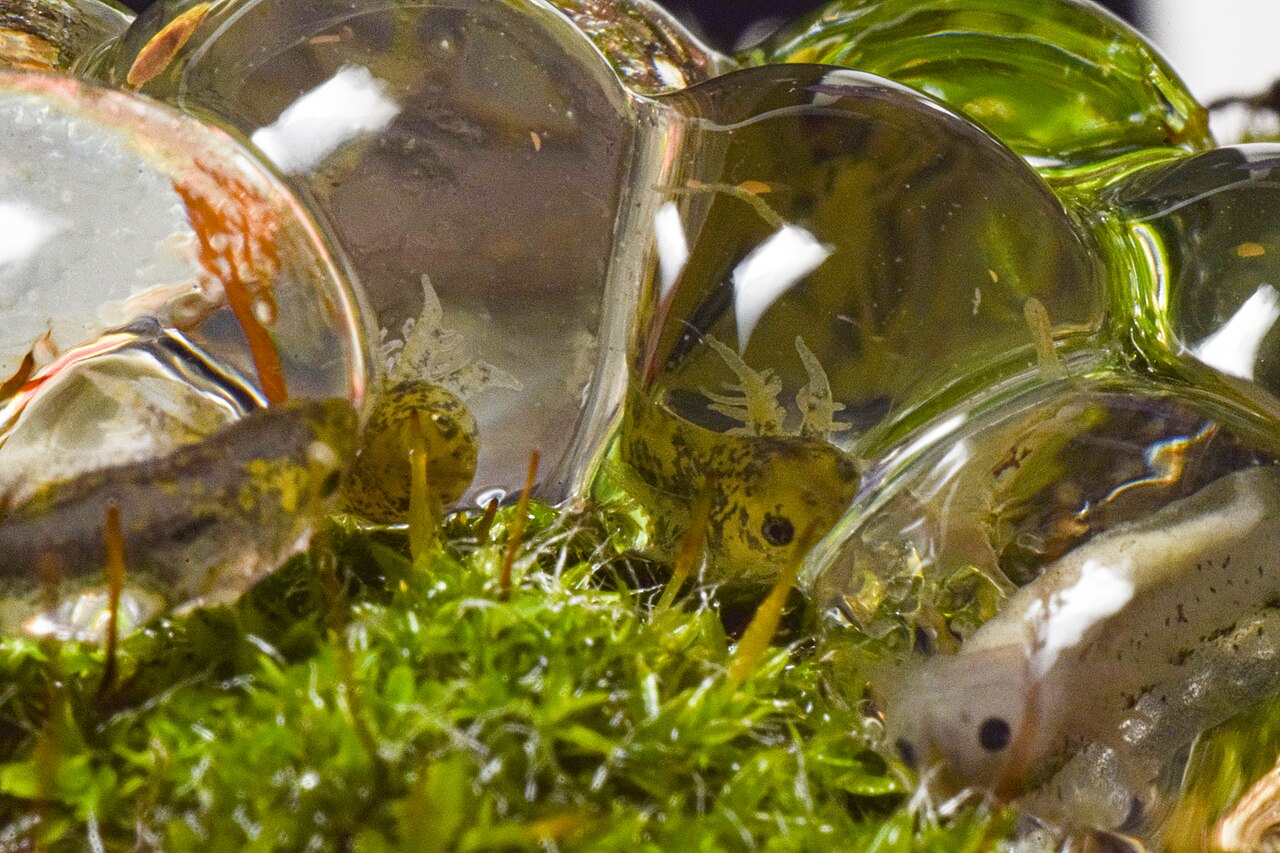
Photo: Brandon Antonio Segura Torres and Priscilla Vieto Bonilla - Wikimedia Commons, CC BY-SA 4.0. An axolotl egg clutch; each embryo sits in its own jelly capsule.
Axolotl Life Cycle Timeline
| Stage | Age | Size | Key changes |
|---|---|---|---|
| Egg | about 2 weeks (up to 3-4) | embryo 2-3 mm | laid in clumps on plants; embryo visible through the jelly |
| Hatchling larva | first days after hatching | well under 1 inch | gills and tail fin, no legs yet; starts eating tiny live food |
| Larva | 1.5-2 months | about 1 inch (2.5 cm) | legs develop, gills lengthen and branch; snaps at siblings |
| Juvenile | a few months to 1 year | 2 inches (5 cm) and up | switches from live food to pellets and worms; fastest growth |
| Adult | mature at about 1-1.5 years | about 8 inches (20 cm) at maturity | can be sexed and breed; keeps gills and stays in water |
Sources: San Diego Zoo Wildlife Alliance Library, axolotl reproduction and development; Ambystoma Genetic Stock Center, University of Kentucky, guide to axolotl husbandry; Caudata Culture species page; checked November 2026. Ages vary with temperature and feeding.
Stage 1: Courtship and Eggs
Axolotl breeding starts with a courtship that keepers call the "hula dance": the male and female circle and nudge each other. The male then drops up to 12 cone-shaped sperm packets (spermatophores) on the bottom, and the female picks them up to fertilize her eggs internally, according to San Diego Zoo Wildlife Alliance.
A female lays 200-1,500 eggs at a time, attaching them in clumps to underwater plants, and in managed care she can spawn every 3-6 months. Each embryo is 2-3 mm across. The eggs hatch after about 2 weeks at 20°C (68°F), but may take up to 3-4 weeks; the Ambystoma Genetic Stock Center at the University of Kentucky, which supplies axolotls to US labs and schools with National Science Foundation support since 1969, gives two to three weeks at room temperature.
Adults eat their own eggs, so breeders move the plants or eggs to a separate container with clean, cool water.
Stage 2: Larvae
A newly hatched axolotl is a tiny larva with gills and a tail fin but no legs. Within hours it starts hunting anything small enough to swallow, which is why breeders feed live baby brine shrimp daily. Front legs appear first and back legs later, the reverse of a frog tadpole, and the gills grow longer and branch.
Growth in the first weeks is slow by adult standards: the Ambystoma Genetic Stock Center expects larvae to be about 1 inch long at 1.5 to 2 months. Survival is the bottleneck. San Diego Zoo Wildlife Alliance suggests hatchling survival of about 30-40%; out of a clutch of 1,000 eggs that leaves roughly 300-400 young, before predators such as introduced fish take their share (see axolotl predators).
Stage 3: Juveniles
At about 1 1/2 inches (4 cm) the stock center starts adding pellets to the brine shrimp, and by 2-3 inches (5-8 cm) juveniles no longer need live shrimp. This is the most dangerous stage for siblings: if mixed sizes share a tank, larger juveniles try to eat smaller ones, and young axolotls kept together often end up missing toes or feet. The stock center houses every young axolotl of 2 inches (5 cm) or more on its own.
Juveniles grow faster than at any other stage. Size by age, month by month, is in how big do axolotls get, and the food for each stage is in what do axolotls eat.
Stage 4: Adults That Never Grow Up
Axolotls become sexually mature and can be sexed at about one year, according to the Ambystoma Genetic Stock Center; San Diego Zoo Wildlife Alliance gives around 1.5 years. Caudata Culture puts maturity anywhere from 6 months to over a year, usually at a length of about 8 inches (20 cm). Adults then breed while still looking like giant larvae, with external gills and a tail fin. Biologists call this paedomorphosis, or neoteny.
In captivity adults live about 10-15 years; the details are in axolotl lifespan.
Why Axolotls Skip Metamorphosis
Close relatives such as the tiger salamander lose their gills and move onto land in a metamorphosis driven by thyroid hormone. In the axolotl, thyroid hormone levels stay low throughout development, because the hormone axis from the brain to the thyroid gland is never fully switched on, researchers including S. Randal Voss of the University of Kentucky explained in Frontiers in Endocrinology (2019). The tissues still work: given thyroid hormone in the lab, an axolotl can start and complete metamorphosis.
Do not try this at home. Forced metamorphosis is a lab procedure, and a pet axolotl does not need it to be healthy. Natural metamorphosis is extremely rare; Caudata Culture links the known cases mainly to hybrid ancestry or unusual water chemistry such as high iodine.
What the Life Cycle Means for Keepers
- Keeping a male and female together means eggs. With hundreds of eggs per spawn, have a plan for the young before you pair axolotls.
- Keep the water cool at every stage. The stock center keeps its axolotls at 15-18°C (60-65°F) and never above about 22°C (72°F). Full setup in axolotl care.
- Separate by size. Larvae and juveniles nip and eat each other; adults are safer with axolotls of a similar size (see axolotl tank mates).
- Check local law. Some US states restrict keeping or breeding axolotls; see where axolotls are illegal.