Blue Gourami: Three Spot Gourami Care, Size and Color Forms
Published: 2026-11-06 · FishyKart Blog
A blue gourami is not its own species: it is the most common color form of the three spot gourami (Trichopodus trichopterus), the same fish sold as opaline, gold, cosby or marbled gourami. It grows to about 6 inches (15 cm), needs at least a 36 x 12 inch tank base (a standard 30 gallon footprint), and lives at 75-86°F (24-30°C) in almost any tap water between pH 5.5 and 8.5. The catch is temperament: some adults turn mean, so plan the tank around that.
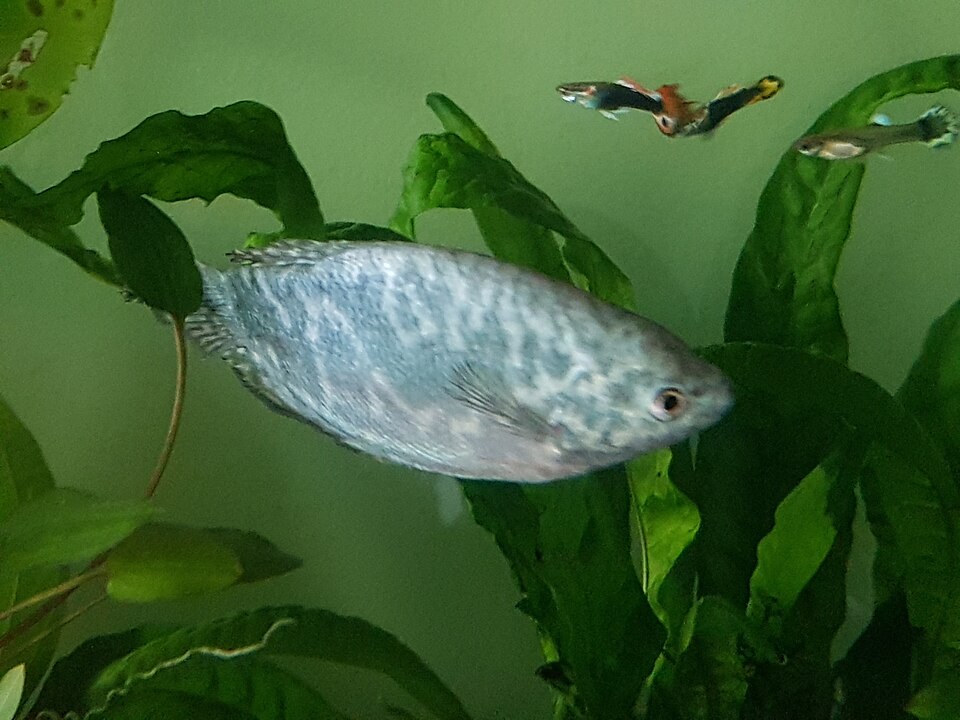
Photo: Igormaksym - Wikimedia Commons, CC BY-SA 4.0
Quick Reference
| Parameter | Value |
|---|---|
| Scientific name | Trichopodus trichopterus |
| Other names | Three spot, opaline, gold, cosby gourami |
| Adult size | Up to 6 in (15 cm); common size about 4 in (10 cm) |
| Tank | 36 x 12 in base minimum (30 gallons); 40 gallons for a pair |
| Temperature | 75-86°F (24-30°C) |
| pH / hardness | 5.5-8.5 / 3-35 dGH |
| Native range | Mekong basin and nearby Southeast Asia |
| IUCN status | Least Concern (assessed 2019) |
Sources: SeriouslyFish species profile for Trichopodus trichopterus (size, tank base, temperature, pH, hardness, range, behavior, breeding); FishBase species summary (common length, 22-28°C range, habitat, air breathing, IUCN status).
Blue, Opaline, Gold: One Fish, Many Names
The wild three spot gourami is blue-grey with two dark spots on each side, one mid-body and one at the base of the tail; the eye counts as the "third" spot. Breeders have fixed several color forms, and SeriouslyFish lists gold, opaline, cosby, marbled and silver as the ones in the trade. In US stores you will usually see these labels:
- Blue gourami: an even powder-blue body, the classic store fish.
- Opaline gourami: blue with darker, marbled patches, close to the cosby pattern.
- Gold gourami: yellow-gold with a faint marbled pattern and no blue.
- Silver or platinum: pale, almost white forms.
Because every form is the same species, a gold and a blue gourami can live together, breed together and need the same care. Do not confuse them with the pearl gourami (Trichopodus leerii), a calmer cousin of similar size, or the much smaller dwarf gourami, whose blue forms are also sold as "powder blue".
Tank Size and Setup
A blue gourami bought at 2 inches grows to 4-6 inches, so size the tank for the adult. SeriouslyFish asks for a base of at least 36 x 12 inches (90 x 30 cm); FishBase suggests a minimum tank length of 100 cm, about 40 inches. In US tank sizes that means:
- 30 gallon (36 x 12 in): one blue gourami with a school of mid-sized fish.
- 40 gallon breeder (36 x 18 in): a male with one or two females; the extra depth front to back gives a female room to escape.
- 55 gallons and up: a mixed community with other medium gouramis.
FishBase describes the three spot gourami as an obligate air breather from lowland marshes, swamps and seasonally flooded forest. It has a labyrinth organ and must reach the surface, so leave a gap under the lid and keep surface agitation gentle. Floating plants and tall stem plants mimic its swampy home and give females and smaller fish cover.
Water Parameters
Few aquarium fish handle such a wide range. SeriouslyFish lists 75-86°F (24-30°C), pH 5.5-8.5 and 3-35 dGH; FishBase gives 72-82°F (22-28°C) and pH 6.0-8.0. The overlap, about 77-80°F at pH 6.5-7.5, works for most US tap water after dechlorination. Use a heater: a typical room in winter sits below the range, and a blue gourami that stays cold loses color and appetite. Change 25-30% of the water weekly.
Temperament and Tank Mates
SeriouslyFish is blunt: "Some individuals can become very spiteful as they mature, while others remain peaceful." Males are the main problem, especially when they guard a nest. Recommended tank mates are robust fish that will not be bullied and will not nip the long ventral feelers:
| Good choices | Avoid |
|---|---|
| Rosy barbs, cherry barbs | Bettas and male dwarf gouramis (same body shape, constant fights) |
| Larger tetras such as rummy nose and Colombian tetras | Fin nippers: tiger barbs, serpae tetras |
| Clown loaches (in big tanks), kuhli loaches | Shrimp and tiny fry-sized fish |
| Bristlenose pleco, corydoras | Large cichlids that can bully or eat it |
Keep one male per tank. A pair of pearl gouramis can share a large tank with a single blue, but watch the first weeks closely. If a blue gourami starts chasing everything, rehoming it is often the only lasting fix.
Feeding
SeriouslyFish calls the species a "fairly generalised omnivore" that eats plants, algae, small invertebrates and zooplankton in the wild and is "unfussy" in the aquarium. A good routine: quality flakes or small pellets daily, frozen bloodworm, brine shrimp or daphnia two or three times a week, and some vegetable matter.
Male vs Female and Breeding
The male is larger and grows a long, pointed dorsal fin; the female is smaller, with a shorter rounded dorsal fin and a fuller belly. Like most gouramis, the male builds a bubble nest at the surface, often under floating plants. SeriouslyFish reports 500-1,200 eggs per spawn, hatching in about 20-30 hours, with fry free swimming 4-5 days later. FishBase notes the male guards the eggs until the fry swim. Remove the female after spawning and the male once the fry swim; the fry need infusoria or other very fine food first.
View Blue Gourami → Browse Gouramis →