Salvini Cichlid — Care Guide & Price in India
Published: 2026-04-11 · FishyKart Blog
The Salvini Cichlid (Trichromis salvini), also known as the Yellow Belly Cichlid or Tricolour Cichlid, is a stunning Central American cichlid prized for its vivid colouration — a bright yellow belly, teal-blue iridescent sides, and bold black lateral blotches. Native to the Atlantic coastal rivers of Mexico, Guatemala, Belize, and Honduras, the Salvini is a medium-aggressive cichlid that grows to 22 cm (8.5 inches) for males and 15 cm (6 inches) for females. It requires a minimum 200-litre (50-gallon) tank, water at 24–28°C, and pH 6.5–8.0. Lifespan is 10–13 years in captivity. In India, Salvini cichlids cost ₹150–₹600 depending on age and size.
What Is the Salvini Cichlid?
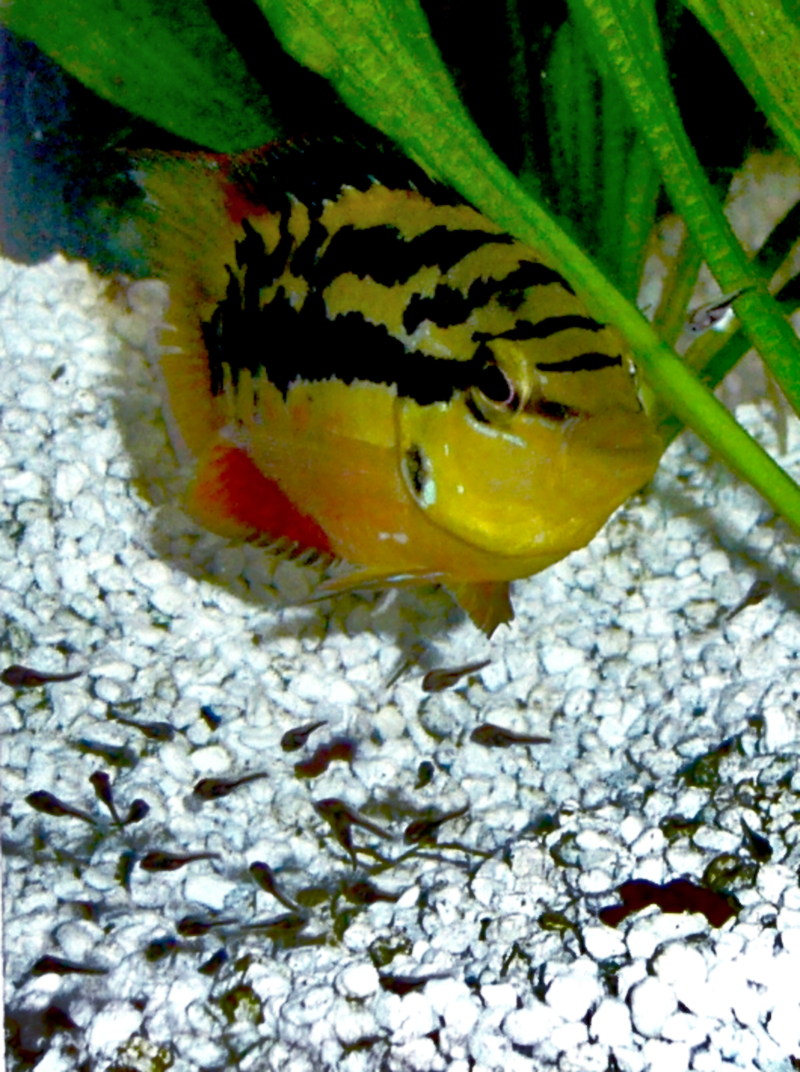
The Salvini Cichlid belongs to the family Cichlidae and was previously classified as Cichlasoma salvini before being moved to the monotypic genus Trichromis — named for its distinctive three-colour pattern. It is a sexually dimorphic species: males are significantly larger and more colourful, with brighter yellow underparts and more pronounced iridescent scaling. Females develop an intense red-orange flush on the belly when breeding — one of the most vivid colour changes seen in cichlids. Juveniles are drab with faint horizontal striping, so colouration only fully emerges at 6–8 months.
In the wild, Salvinis live in lowland rivers, lagoons, and lake margins with dense vegetation and rocky substrate. They are pair-bonding cichlids that form strong monogamous bonds and show highly committed parental care, defending their fry aggressively against intruders many times their size.
Salvini Cichlid Price in India
- Juvenile (3–5 cm): ₹150–₹250
- Sub-adult (6–10 cm): ₹250–₹400
- Adult male (full colour): ₹400–₹600
- Breeding pair: ₹900–₹1,500
Buy Salvini Cichlid online at FishyKart — live arrival guarantee, express delivery across India.
Salvini Cichlid Colours & Appearance
The Salvini’s colouration is one of the most complex of any Central American cichlid:
- Body base: Bright yellow to golden-yellow on the lower half; creamy white on the upper body
- Iridescence: Teal, blue-green, and turquoise scales across the flanks and gill covers
- Lateral blotches: Two bold black spots on the midline — one behind the gill plate, one near the tail base — connected by faint horizontal banding
- Fins: Dorsal and caudal fins edged in red or orange in breeding condition
- Breeding females: Belly turns vivid crimson-orange — a reliable visual cue that eggs have been laid

Care Requirements
Tank Requirements
- Minimum tank size: 200 litres (50 gallons) for one fish; 300 litres (75 gallons) for a pair
- Temperature: 24–28°C (optimal 26°C)
- pH: 6.5–8.0 (ideal 7.0–7.5)
- Water hardness: 8–20 dGH (moderately hard)
- Filtration: High-turnover canister filter; Salvinis produce significant waste
- Substrate: Sand or fine gravel — they dig, especially before and during spawning
- Decor: Flat rocks, clay pots, driftwood for hiding and spawning sites. Avoid delicate plants — use Anubias or Java Fern tied to rocks or driftwood
- Lighting: Moderate; bright light enhances yellow and blue iridescence
- Water changes: 25–30% weekly
Feeding Salvini Cichlid
Salvinis are omnivores that eat well in captivity and are not fussy feeders:
- Staple: High-quality medium cichlid pellets (Hikari Cichlid Gold, New Life Spectrum)
- Protein: Frozen/live bloodworms, brine shrimp, earthworms, small prawns
- Vegetables: Blanched spinach, zucchini, peas — aids digestion and reduces aggression
- Avoid: Feeder goldfish (disease risk), excessive beef heart (fatty liver)
Feed adults once or twice daily. Juveniles benefit from 3 small meals per day for faster, healthier growth. Remove uneaten food promptly to maintain water quality.
Behaviour & Compatibility
Aggression & Behaviour
The Salvini is a medium-to-high aggression cichlid — significantly more aggressive than a Firemouth or Blue Acara, but generally less intense than a Green Terror or Flowerhorn. Aggression spikes dramatically during spawning, when pairs will attack anything that enters their territory including fish twice their size. Outside breeding, a single Salvini can be kept with other robust species in a large tank. They are active, intelligent, and curious — highly responsive to their owner and quick to learn feeding routines. Expect substrate rearrangement as they establish territory.

Tank Mates
Choose only robust, similarly sized fish that can handle occasional aggression:
- Good matches: Firemouth Cichlid, Convict Cichlid, Jack Dempsey (in large tanks), large Plecos, Silver Dollars, Severum
- Use caution: Green Terror or Oscar — can coexist in very large tanks (400+ litres) but conflict is possible
- Avoid: Guppies, mollies, tetras, angelfish, discus, shy cichlids — all will be harassed or eaten
Provide multiple clear sight-breaks (rocks, large driftwood) so subordinate fish can escape line of sight. A species-only setup with a single Salvini or a bonded pair is the simplest and safest option.
Breeding Salvini Cichlid
Salvinis are open substrate spawners and prolific breeders in home aquariums:
- Condition the pair with high-protein live/frozen foods for 2 weeks before breeding
- Provide flat stones, clay pots, or cleaned substrate areas as spawning sites
- Females lay 200–500 eggs, which turn amber-coloured after fertilisation
- The female’s belly turns vivid crimson-orange at spawning — a reliable breeding indicator
- Eggs hatch in 48–72 hours at 26°C; fry are free-swimming within 5–7 days
- Both parents guard fry intensely; tank mate aggression increases dramatically during this period
- Feed fry baby brine shrimp, microworms, or finely crushed fry food
Buy Salvini Cichlid Online in India
Why Buy from FishyKart?
FishyKart is India’s trusted online aquarium fish store with a live arrival guarantee on every order. Our Salvini cichlids are locally bred and fully acclimatised to Indian water conditions — no import stress, no disease risk from long international transit. We ship overnight express to Mumbai, Delhi, Bangalore, Hyderabad, Chennai, Kolkata, Pune, and all major Indian cities.
Buy Salvini Cichlid → Browse All Cichlids →