Mollys & Platies




Molly Fish & Platy Fish — Care Guide & Buy Online
Mollies (Poecilia sphenops and related species) and Platies (Xiphophorus maculatus) are hardy freshwater livebearers native to Central America and Mexico, widely regarded as the best beginner fish for new aquarium hobbyists. Unlike egg-laying species, livebearers give birth to free-swimming fry, making breeding straightforward and observable. Both species tolerate a wide range of water parameters (pH 7.0–8.5, temperature 22–28 °C), adapt to hard water, and accept all standard aquarium foods. A 20-gallon (75-litre) tank is sufficient for a small group. Mollies and Platies are peaceful community fish compatible with Tetras, Corydoras, Guppies, and Dwarf Gouramis — making them the cornerstone species for any community aquarium. FishyKart delivers live Mollies and Platies across India.
Molly Fish Types
The Common Molly (Poecilia sphenops) and Sailfin Molly (Poecilia latipinna) are the two main species, selectively bred into dozens of colour and fin variants:
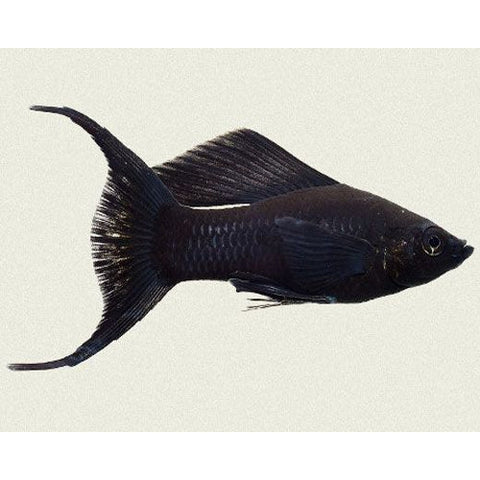
- Black Molly: Uniformly jet-black colouration across body and fins — one of the most popular aquarium fish in India. Hardy and widely available. Males reach 6 cm; females up to 8 cm.
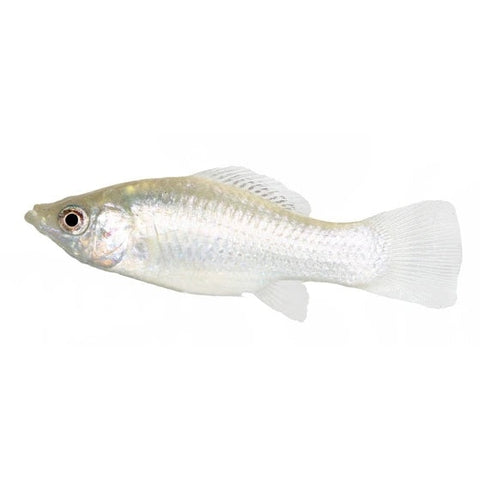
- White / Silver Molly: Albino or white variant of P. sphenops; pale body with red eyes. Particularly visible against dark substrates and planted backgrounds.
- Dalmatian Molly: White body with irregular black spots mimicking Dalmatian dog markings. Available in short-fin and lyretail variants.
- Balloon Molly: A selectively bred variant with a rounded, balloon-shaped body caused by a shortened spine. Available in black, orange, and marble colours. Slightly more sensitive than standard Mollies — requires stable water parameters.
- Sailfin Molly (Poecilia latipinna): Males develop an impressive tall dorsal fin when mature. Requires a slightly larger tank (80+ litres) and slightly higher temperatures (24–28 °C) than common Mollies.
- Gold / Sunrise Molly: Orange-gold body; one of the most colourful Molly variants. Males display intense colouration during courtship.
Platy Fish Types
The Southern Platy (Xiphophorus maculatus) and Variable Platy (Xiphophorus variatus) are the two main species behind the hundreds of commercially available Platy variants:
- Sunset Platy: Deep orange body fading to yellow toward the tail — one of the most vivid Platy colour forms. Extremely hardy; ideal first fish for children and beginners.
- Mickey Mouse Platy: Named for the three black spots at the base of the tail fin that resemble Mickey Mouse's silhouette. Available in red, yellow, and blue body colours.
- Wagtail Platy: Characterised by black fins contrasting against a coloured body (red, yellow, blue). "Wagtail" refers to the contrasting tail fin pattern.
- Blue Mirror Platy: Iridescent blue scaling covering most of the body; relatively rare and commands a small price premium.
- Rainbow Platy: Multi-coloured body displaying red, orange, yellow, and blue sections — a visually striking variety popular in community tanks.
Tank Requirements
- Tank size: 75 litres (20 US gallons) minimum for a group of 6–8; allow 10 litres per adult fish
- Temperature: 22–28 °C — both species tolerate the lower end, making them suitable for unheated tanks in warm Indian climates
- pH: 7.0–8.5 — livebearers prefer neutral to alkaline water; add crushed coral to the filter if your tap water is acidic
- Hardness: 10–25 dGH — hard water is beneficial and replicates native Central American habitats
- Filtration: Standard HOB or internal filter; moderate flow; livebearers are not sensitive to current
- Ratio: Keep 2–3 females per male to prevent females from being harassed by constant male courting behaviour
- Salt: Mollies (but not Platies) benefit from 1 tablespoon of aquarium salt per 20 litres — reduces stress and prevents disease
Feeding Mollies & Platies
Both Mollies and Platies are omnivores with a strong herbivore component — they graze algae constantly in nature and require vegetable matter in their diet to thrive.
- Staple: High-quality tropical flake or micro pellet with vegetable content (spirulina flake ideal) — twice daily
- Vegetable supplements: Blanched zucchini, spinach, cucumber; spirulina wafers — 3× per week
- Protein supplements: Frozen brine shrimp, daphnia, bloodworms — 2× per week
- Avoid: High-protein carnivore foods as staple — causes digestive issues and shortened lifespan in livebearers
Breeding — Livebearers
Mollies and Platies are livebearers — females retain fertilised eggs internally and give birth to free-swimming fry rather than laying eggs. This makes them among the easiest fish to breed in captivity.
- Gestation period: 28–40 days depending on temperature and species
- Fry count: Mollies: 20–100 fry per birth; Platies: 20–50 fry per birth
- Fry survival: Adults will eat fry — provide dense floating plants (Water Sprite, Hornwort) or a breeding box for fry protection
- First foods: Fry are large enough to accept crushed flake food and baby brine shrimp from birth
- Note: Females can store sperm for up to 6 months — a single female can produce multiple batches of fry without re-mating
Why Buy from FishyKart?
FishyKart stocks Black Molly, Dalmatian Molly, Balloon Molly, Sunset Platy, Mickey Mouse Platy, and Wagtail Platy year-round, sourced from established breeders across India. All fish are quarantined and health-checked before dispatch. We ship in oxygen-sealed, insulated packaging with a live arrival guarantee across India. Livebearers are available as juveniles and adults; breeding trios (1 male + 2 females) available on request.