Customer Reviews
About & Origin
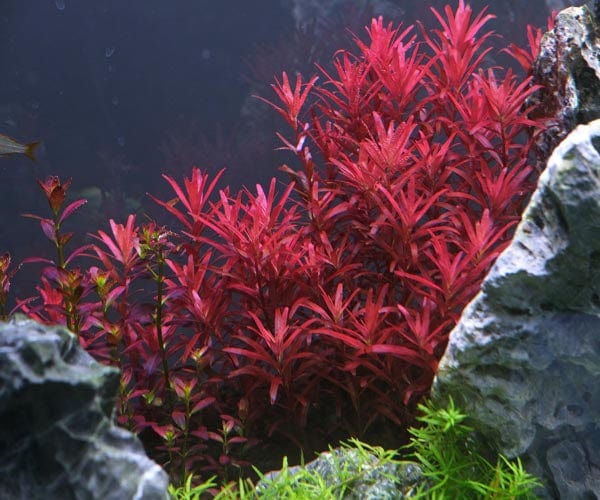
Rotala rotundifolia is an aquarium stem plant, one of the most widely grown in the hobby, native to wetlands, rice paddies and shallow standing water across South and Southeast Asia. This "Twilight" form is a coloured cultivar of the species, grown for the warm pink-to-reddish tones its upper leaves take on under strong light, contrasting with greener growth lower down the stem.
It grows upright with small, narrow leaves arranged in whorls, forming a soft, bushy column when planted in groups. Its colour and density are strongly light-driven: under intense light it grows compact and vividly coloured, while under weaker light it stretches taller and stays mostly green.
The "Twilight" name refers to a specific selected cultivar line of Rotala rotundifolia bred and propagated for a particularly pronounced pink-to-magenta gradient along the upper stem, distinct from the more common plain "red" rotundifolia or the green "Green Mint" form also sold under the same species. Because rotundifolia has been in aquarium cultivation for decades, breeders and nurseries have selected numerous colour-strain variants over the years, and Twilight is one of the more visually dramatic ones, prized specifically for the smooth colour transition from green at the base to vivid pink-red near the growing tip rather than a flat, uniform red throughout.
Like other Rotala rotundifolia forms, it's exceptionally well documented in the hobby, with decades of accumulated grower experience behind it — there's very little genuine mystery to keeping it happy compared with newer or rarer imported cultivars, which makes it a reasonably safe choice even for a first attempt at a colour-focused stem plant.
In an aquascape it's typically used as a mid-tier colour accent — more demanding and more rewarding than a plain green filler stem, but considerably easier and more forgiving than the true high-tech "red" showpiece species that need constant CO2 and light management to avoid melting back to green.
Requirements
An approachable stem plant for anyone wanting to try a coloured species without jumping straight to the most demanding reds.
Light: strong lighting is what actually produces the pink/red "twilight" colouration — under moderate or low light it will still grow, but stays mostly green and grows taller and looser.
CO2: not strictly required for survival, but CO2 supplementation noticeably improves colour intensity and keeps growth compact rather than leggy.
Substrate: does well in a nutrient-rich substrate, and benefits from regular liquid fertilizing (especially iron/micronutrients) for the best colour.
Trimming & propagation: a fast grower needing regular trimming to stay tidy; cut healthy tops and replant them as cuttings, which root easily.
Group planting for effect: the signature colour gradient reads best when the plant is grown in a dense group rather than as isolated stems — a proper planted row or block, trimmed to a consistent height, shows off the green-to-pink transition far more effectively than a few scattered stems ever could.
Positioning relative to the light source: because colour intensity depends so directly on light exposure, stems planted directly under the strongest part of a light fixture will colour up more than the same species planted in a shaded corner of the same tank — worth factoring into where exactly it's placed, not just what light fixture the tank overall is running.
Realistic expectations: in a genuinely low-tech tank with weak lighting, this plant will survive and grow but essentially present as a plain green stem plant — buyers specifically chasing the pink "twilight" effect should have at least moderate-to-strong lighting in place before expecting to see it.
Maintenance rhythm: under good light expect noticeable growth week to week, meaning this isn't a low-maintenance "set and forget" plant in a high-tech tank — budget for trimming roughly every one to two weeks to keep a group looking tidy rather than sprawling over neighbouring plants.
Compatibility
Water & Care Conditions
Tolerant of a fairly wide range of conditions, though light is the main driver of its signature colour:
- pH: 6.0–7.5
- Water hardness: adaptable, general community-tank hardness is fine
- Temperature: 20–28°C (68–82°F)
- Light: moderate to high — strong light (plus CO2 and iron dosing) is what brings out the pink/red "twilight" tones, more so than any single water parameter
In lower light it remains healthy but stays mostly green, so lighting is the main lever to adjust if you're growing it specifically for colour.
CO2 and oxygenation: not required for basic survival, but supplemental CO2 injection is one of the most effective ways to intensify colour alongside strong light, and a healthy, well-fertilised group under good light will often visibly pearl (release fine oxygen bubbles) during the brightest part of the photoperiod — a reassuring sign the plant, light, and CO2/nutrient balance are all working together well.
Nutrient dosing: iron and other trace elements matter more for this cultivar's colour than for a plain green stem plant — a fertiliser regime adequate for basic green growth may still leave the "twilight" pink underdeveloped if it's light on micronutrients, so keepers specifically chasing strong colour should make sure their dosing routine covers trace elements, not just the primary nitrogen-phosphorus-potassium macros.
Overall, this is a plant where water chemistry sets the outer bounds of what's achievable but light and nutrients decide how close to that potential the plant actually gets — two tanks with identical pH and hardness can produce visibly different results in colour depending entirely on lighting strength and fertilising consistency.
It also tolerates the routine swings of a normal water-change schedule without complaint, so there's no need for unusually gentle or unusually frequent water changes purely for this plant's benefit — standard community planted-tank maintenance suits it fine.