About & Origin
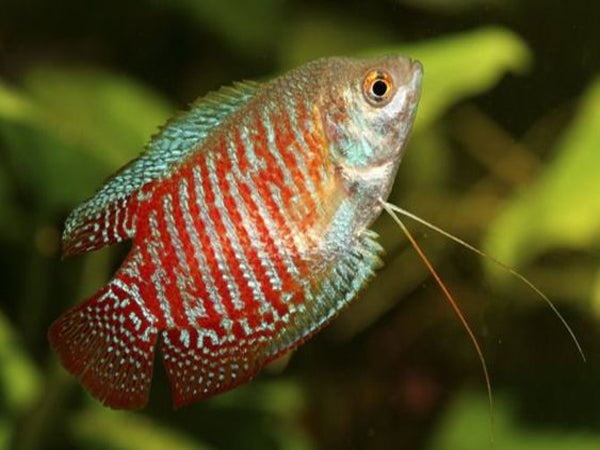
The dwarf gourami (Trichogaster lalius, sometimes still listed under its older name Colisa lalia) is a small labyrinth fish native to slow-moving, densely vegetated waters of the Ganges and Brahmaputra river basins in India and Bangladesh. Like other labyrinth fish, it has evolved a specialised labyrinth organ that lets it gulp atmospheric air at the surface, an adaptation to the oxygen-poor, still, weed-choked water it comes from in the wild.
Males are the brightly coloured, striped fish typically sold in the trade; females are plainer silver-grey. In the wild and in the tank, males build bubble nests at the surface among floating plants and can become territorial toward other males, and sometimes toward similarly-shaped or brightly coloured fish, once mature.
Multiple distinct colour strains have been developed over time through selective breeding from the original red-and-blue wild pattern, including solid powder blue, flame red, and neon blue lines -- all the same species and sharing identical care needs, differing only in colouration and marketed name, not in temperament or requirements. Adults stay genuinely compact, typically 6-9cm at full size, making them a manageable centrepiece fish for a modest planted community tank rather than requiring anything oversized or particularly deep.
Requirements
Dwarf gourami are a rewarding centrepiece fish but do best with a bit of specific care.
One male per tank: two male dwarf gourami in the same tank will usually fight; keep a single male, optionally with one or more females, or a male alone as a centrepiece fish.
Calm tankmates and surface access: avoid fin-nippers, since males display long, trailing fins; also avoid strong surface agitation/current that makes it harder for them to reach the surface to breathe air, and leave some floating plant cover, which they use for security and, if breeding, bubble-nest building.
Water quality note: dwarf gourami are more prone than most community fish to a viral condition sometimes called "dwarf gourami disease" when kept in stressed or poor-quality conditions -- stable, clean, well-cycled water genuinely matters more for this species than for hardier tankmates.
Diet is easy -- flake or micro-pellet staple with occasional live/frozen foods (bloodworm, brine shrimp) appreciated.
Tank size: a 60cm/24in tank upward suits a single male comfortably, with more room needed for a male-female pair or trio to give a chased female somewhere to retreat.
Breeding: if keeping a male-female pair with breeding in mind, provide dense floating plant cover for the male's bubble nest and be prepared to remove the female after spawning, since males can turn aggressive toward her once eggs are laid and he takes over guarding duties.
Compatibility
Water & Care Conditions
Coming from warm, still, densely planted South Asian waters:
- pH: 6.0–7.5
- Hardness: soft to moderately hard, roughly 5–19 dGH
- Temperature: 24–28°C (75–82°F)
- Oxygenation: unusually tolerant of low-oxygen, still water thanks to its labyrinth organ, but still benefits from generally clean, well-maintained water -- being able to gulp air at the surface doesn't mean poor overall water quality is genuinely safe for it long-term
Gentle filtration with minimal surface turbulence suits it better than a powerful, high-flow setup.
Weekly partial water changes (20-25%) and stable, uncrowded conditions are the single best preventative against the stress-linked illnesses this species is somewhat prone to -- a calm, well-maintained tank matters more for a dwarf gourami's long-term health than for many hardier community fish.
Watch for early warning signs -- clamped fins, faded colour, reduced appetite, or unusual patches or spots on the body -- and act quickly rather than waiting around, since this species can decline noticeably faster once genuinely stressed or ill than many other, hardier community fish would in the very same situation. A quarantine period of two to three weeks for new stock before adding to an established display tank is also a genuinely worthwhile precaution for this species specifically.