About & Origin
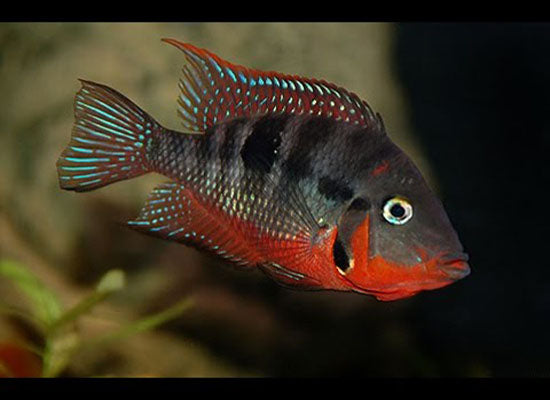
The firemouth cichlid (Thorichthys meeki) is a Central American cichlid native to slow-moving rivers, lakes, and cenotes of the Yucatán Peninsula in Mexico and Belize. Its name comes from the vivid red-orange throat and belly that males flare dramatically during territorial and courtship displays -- one of the more theatrical behaviours in the freshwater hobby.
Compared to many of its cichlid relatives it has a reputation as one of the more manageable, less relentlessly aggressive Central Americans, making it a common 'first cichlid' for keepers stepping up from community tanks.
It's a substrate-sifter by nature, constantly sieving sand through its gills in search of small invertebrates, and it will dig and rearrange a planted tank's layout as a matter of course.
The throat-flare display that gives the species its name is a genuine, striking piece of behaviour to watch: when confronting a rival or displaying to a mate, a firemouth extends its gill covers outward and puffs its bright red throat and belly forward, sometimes alongside fin-spreading and lateral body-flexing, to look as large and imposing as possible without any actual physical contact -- a bluff display that usually settles disputes before they turn into real fighting. Males are generally larger with more pointed fins and more intense throat colour than females, though sexing younger fish reliably can be tricky.
Firemouths also form monogamous breeding pairs and are attentive, protective parents, guarding both eggs and free-swimming fry fiercely against anything that strays too close -- a trait that, combined with the throat display, is part of why this species has long been a favourite for keepers interested in observing natural cichlid breeding and parenting behaviour without the extreme aggression of larger cichlids.
Requirements
A single pair or specimen does well from around 150-200 litres (40-55 gallons) up, with soft sand for digging, and rockwork or driftwood arranged to create broken sightlines and territories -- important because firemouths, like most cichlids, will claim and defend a patch of the tank once settled.
It's semi-aggressive rather than outright vicious: territorial squabbles with similarly sized, similarly robust fish are normal, but it generally leaves fast-swimming open-water fish alone if there's enough space to avoid confrontation.
Diet is easy -- a good cichlid pellet as a staple, supplemented with sinking wafers, blanched vegetables, and occasional live or frozen food. It grows to around 13-15cm.
Because it's a constant sand-sifter, fine, rounded sand rather than sharp gravel matters for both comfort and appearance -- coarse or sharp-edged substrate can irritate the gills and mouth over time given how much of it passes through them daily. Plants that aren't firmly rooted or potted will regularly get uprooted in the process, so hardy, well-anchored species or pots buried under the sand tend to survive a firemouth's housekeeping far better than delicate carpeting plants.
If a breeding pair forms, expect a noticeable jump in territorial aggression toward anything sharing the tank once eggs or fry are present -- having a backup plan (a divider, or a second tank) is worth considering if breeding behaviour emerges in a mixed community setup.
Filtration should be sized generously despite the firemouth's relatively modest adult size -- constant substrate sifting stirs up detritus and keeps the water column busier than a similarly sized non-sifting fish would, so a filter rated for a notably larger tank than the nominal volume helps keep water genuinely clear and stable rather than just nominally cycled.
A tight-fitting lid is also worth having: like many active cichlids, a startled or chasing firemouth can and will jump given the chance, particularly during territorial disputes or when first introduced to a new tank.
Tankmate introductions go more smoothly when new fish are added at the same time as the firemouth, or when the firemouth is the newer arrival into an already-established community, rather than dropping new fish into a tank where a firemouth has already had time to fully claim it as its own territory.
It's also worth noting that "semi-aggressive" doesn't mean tolerant of everything: while a firemouth generally leaves fast open-water swimmers alone, it will actively challenge similarly shaped, similarly sized bottom-dwelling or territorial fish that compete for the same space, so stocking choices matter as much as raw tank size in keeping the peace.
Compatibility
Water & Care Conditions
A hardy, adaptable Central American species that tolerates a wider range of water chemistry than most soft-water community fish:
- pH: 6.5–8.0
- Water hardness: moderately hard, 8–20 dGH
- Temperature: 24–27°C (75–81°F)
- Oxygenation: moderate flow, standard cichlid-tank filtration is sufficient
- Substrate: fine, rounded sand rather than sharp gravel, to suit its constant sand-sifting feeding behaviour and protect its gills and mouth from abrasion
- Water changes: weekly partial water changes of 20-30% help keep parameters stable given a cichlid-sized bioload, especially in a smaller setup
- Decor: broken sightlines with rock and driftwood help diffuse territorial disputes, letting a subordinate fish retreat out of a dominant fish's direct line of sight
- Common issues: generally hardy and disease-resistant when kept in stable water; ich and stress-related colour loss are the most commonly seen issues, both usually linked back to water quality or overcrowding rather than the species being inherently delicate
- Feeding schedule: feed once or twice daily, only what's consumed within a couple of minutes -- this species is an enthusiastic eater and will beg persistently, but overfeeding contributes to poor water quality faster in a heavily-sifted sand-bed tank than in a bare-bottom setup
- Lighting: not especially light-sensitive; moderate aquarium lighting suits it fine and helps show off its throat and body colour without needing anything specialised
- Growth rate: reaches most of its adult size within the first 12-18 months given good food and space, so plan tank size around the mature fish rather than the smaller size it's typically sold at
- Acclimation: a hardy species overall, but still benefits from a slow, drip-style acclimation over 30-60 minutes when first introduced, especially if moving between noticeably different water parameters
- Longevity: a well-kept firemouth commonly lives 10 years or more, so it's worth choosing tankmates and setup with that long a timeframe in mind rather than for a short-term arrangement