Customer Reviews
About & Origin
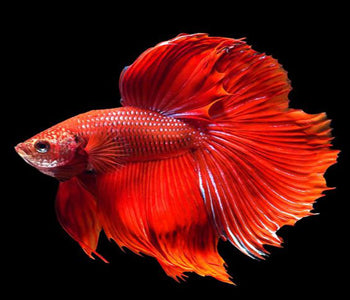
The Full Moon (or "Halfmoon Plus"/round-tail) is a tail-shape variety of the Betta (Betta splendens), bred for a tail that opens into a very wide, almost perfectly circular fan. This red-coloured example is native, like all bettas, to the slow-moving rice paddies, ditches, and floodplains of Thailand, Cambodia, Vietnam, and Laos.
The huge circular tail is a breeding achievement rather than a wild trait, and combined with a deep, saturated red body colour, makes for one of the more visually striking betta varieties in the hobby.
Aside from fin shape, it shares the same biology as every other betta: a labyrinth organ for breathing surface air, and the same solitary, territorial nature in males inherited from its wild ancestors.
"Full Moon" describes a solid, unbroken colour across the entire body and fins of Betta splendens — here a deep, uniform red — distinguishing it from marbled, bi-colour, or multi-pattern strains.
This is purely a colour-pattern trade name rather than a fin-type or scientific classification, and can appear across various tail shapes; all bettas share the same wild labyrinth-fish origin in Thailand's shallow rice paddies and floodplain waters.
The full-moon tail form spreads to a complete 180-degree half-circle when flared, and combined here with a deep, solid red body and fin colour — one of the most classic and widely bred betta colour forms. Like all betta varieties it is Betta splendens, native to Thailand's rice paddies and slow-moving waterways, prized in the aquarium trade purely for selectively bred colour and fin traits.
The combination of the full 180-degree tail spread with deep red colouring makes this one of the more dramatic and widely admired betta show forms.
Requirements
Keep singly, or as the sole betta in a community — never with another male betta. Its oversized circular tail is heavier and more delicate than a standard betta's, so calm water with minimal current matters more than usual, and smooth décor helps prevent fin damage.
Avoid fin-nipping tankmates entirely, given how large and vulnerable this variety's tail is.
Feeding is easy — a good quality betta pellet as a staple, with occasional live or frozen treats.
One male per tank, kept alone or with carefully chosen, calm, fin-safe tankmates — never housed with another male betta.
A betta-specific pellet as the dietary staple, being primarily carnivorous, with occasional live or frozen bloodworm or brine shrimp for variety.
A tank of at least 20 litres with a heater and gentle filtration is recommended for a genuinely healthy long-term home.
The wide fin spread of a full-moon tail is more delicate than a standard veiltail's and benefits from gentle filter flow and soft, snag-free decor to avoid tearing. As with every betta, keep only one per tank — never house two bettas together, and choose tankmates carefully if any are added at all.
A varied diet of quality betta pellets plus occasional live or frozen bloodworm/brine shrimp helps maintain deep red colouration and healthy condition, with small regular feedings suiting its small stomach better than one large feeding.
A mature, cycled tank suits it far better than a freshly set-up one, and stable conditions support both long-term health and consistently deep red colouration.
Regular partial water changes of around 25-30% weekly, combined with stable temperature control, keep this fish healthy and its red colouring deep and vivid over the long term.
Compatibility

Water & Care Conditions
Standard betta parameters, with extra emphasis on calm water given its oversized tail:
- pH: 6.0–7.5
- Salinity / hardness: freshwater only, soft to moderately hard water
- Temperature: 24–28°C (75–82°F) — a stable heater is essential
- Light: moderate, with floating plant cover appreciated
- Oxygenation: tolerant of still, low-oxygen water via its labyrinth organ; strongly prefers calm water, as its very large tail makes swimming against current more effortful
- Fin care: avoid rough or sharp decor that could snag the wide, delicate fin spread
- Colour maintenance: a varied, high-protein diet and stable water conditions help keep red colouration deep and vivid rather than fading
- Diet: quality betta pellets as a staple, with occasional live/frozen foods for colour and condition
- Longevity: typically lives 2-4 years, occasionally longer with excellent care
- Tank position: spends most time in the upper-to-middle water column near the surface
- Filtration: gentle flow is best, avoiding strong current that can tire the wide full-moon fin spread
As a labyrinth fish it supplements gill breathing with atmospheric air, tolerating lower dissolved oxygen and stiller water better than most fish.
Gentle flow and smooth decor without sharp edges protect this species' fins, which are more delicate and prone to damage than many other fish.
Unlike most tropical fish, this fish genuinely needs a tight-fitting lid with an air gap underneath, not to prevent jumping alone but because it periodically surfaces to gulp air through its labyrinth organ, and a fully sealed lid with no airspace can leave the air it breathes stale and humid.
A heater is essential despite the labyrinth organ's tolerance for lower oxygen -- bettas are true tropical fish and become lethargic, prone to illness, and short-lived in unheated, too-cool water, contrary to the common misconception that they can live in a small unheated bowl.