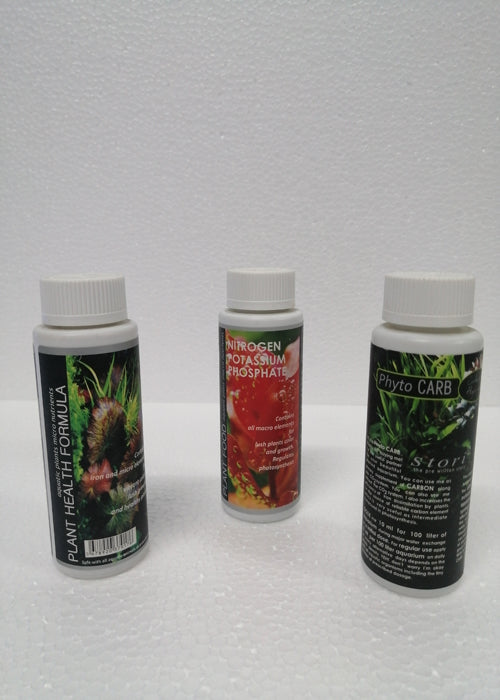
Buy combo Pack of Plant Medicine
- PLANT FOOD 120ML
- ALGEA REMOVAL MEDICINE 100ML
- PLANT NUTRICIAN 120 ML
About & Origin
This combo bundles three plant-care products aimed at a planted freshwater tank: a Plant Health Formula, a Nitrogen-Potassium-Phosphate (macro-nutrient) supplement, and a Phyto Carb product (typically a liquid carbon source used as a lower-cost, lower-effort alternative or supplement to pressurised CO2 injection).
Together they cover the three main levers of good plant growth alongside light: overall plant health/micronutrients, the core N-P-K macro-nutrients plants draw down fastest, and available carbon — the building block plants need most for photosynthesis and new growth, and the one most often missing in a non-CO2-injected tank.
Bundling these three is a practical way to fully fertilize a planted tank without having to research and buy each nutrient category separately, particularly useful for keepers running a low-tech planted tank without pressurised CO2 equipment.
Low-tech planted tanks (no pressurised CO2) are more carbon-limited than most beginners expect -- even with strong light and full macro/micro fertilization, growth plateaus once available carbon runs out, which is exactly the gap a liquid carbon product like the Phyto Carb component in this set is meant to fill without the cost and complexity of a full CO2 injection system.
For a keeper just getting into planted tanks, buying the three components separately can mean researching three different nutrient categories from scratch -- a pre-bundled set removes that research step and gets a reasonably complete fertilizing routine running from day one.
The three-part split mirrors how experienced planted-tank keepers generally think about fertilization -- macro-nutrients (N-P-K), micronutrients/trace elements, and carbon are treated as three separate, largely independent inputs, each with its own signs of deficiency and its own dosing rhythm. Buying a combined kit is essentially a shortcut to that same balanced approach without needing to source and calculate each part separately.
This kind of bundle is aimed squarely at low-tech tanks -- setups with real light and real plants but no pressurised CO2 system -- where the gap between "adequate" and "thriving" growth usually comes down to exactly these three inputs rather than equipment.
Requirements
Each product covers a different part of plant nutrition and is dosed on its own schedule — check each bottle rather than assuming they're interchangeable.
Liquid carbon products (the Phyto Carb component) should be dosed carefully per the label, since overdosing liquid carbon can stress sensitive plants and some shrimp species — start on the lower end of the range in a shrimp tank.
Light still matters: even with all three nutrient categories covered, plants still need adequate light to actually use those nutrients — fertilizing a very dim tank mostly just feeds algae.
Dose after water changes, into fresh water, for best uptake.
Realistic expectations: liquid carbon is a genuine help but not a full substitute for pressurised CO2 for the most demanding carpeting/high-light plant species -- for a low-to-moderate light tank with easier plant species, though, it's often all the extra carbon boost that's needed.
Staggering the three products: since each has its own dosing schedule, many keepers find it easiest to dose all three on the same day each time (e.g. right after the weekly water change) rather than tracking three separate calendars.
New tanks: introduce all three at a reduced dose initially and build up over a couple of weeks, giving both plants and any livestock time to adjust to a fuller fertilizing routine.
Reading plant response: if the N-P-K supplement and micronutrient formula are both being dosed correctly but stem plants still stall out, liquid carbon availability is often the missing third factor rather than a need for even more macro/micro nutrients -- it's easy to keep increasing the wrong input when growth plateaus.
Algae as a warning sign: if algae increases noticeably after starting this combo, it usually means nutrients are outpacing what the tank's light and plant mass can actually use -- scale back rather than assume more of everything will fix it.
Compatibility


Dosage & Usage Guidelines
Dose each of the three products per its own individual ratio, typically a few times a week:
- Plant Health Formula: overall micronutrients/plant conditioning
- N-P-K supplement: core macro-nutrients
- Phyto Carb: liquid carbon source, dose carefully — start low in shrimp tanks
- Liquid carbon vs. pressurised CO2: a real help for low-to-moderate light tanks, not a full substitute for the most demanding species
- Good fit for: low-tech planted tanks without CO2 injection equipment
- Shrimp tanks: start liquid carbon at the low end of the dose range and observe before increasing -- shrimp are more sensitive to it than fish
- Storage: keep all three bottles together, cool, dark, tightly sealed, and check each for a use-by date
- Signs of overdosing carbon: plant tissue that looks bleached or melted at the growing tips, or unusual stress in shrimp, both mean cutting the dose back
- Track results over weeks: give a new dosing routine two to three weeks before judging whether it's working
- Stalled growth despite feeding: if macro and micro nutrients are already covered but growth still plateaus, carbon is the most likely missing piece
- Keep bottles labelled/organised: with three separate schedules running, a simple written or app-based dosing log helps avoid missed or doubled doses
- Water changes reset the baseline: dose right after a partial water change so nutrients go into fresh water rather than being diluted away shortly after
- Good fit for beginners: a bundled set removes the guesswork of researching each nutrient category separately when first setting up a planted tank
Store all three together, cool and dark, and dose after water changes into fresh water. Introduce all three gradually over the first couple of weeks in a new planted tank rather than dosing at full strength immediately, giving both plants and any livestock time to adjust.