About & Origin
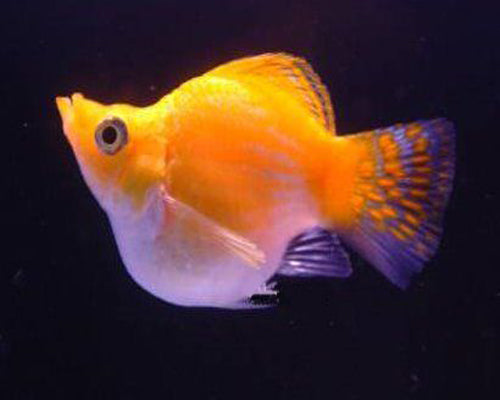
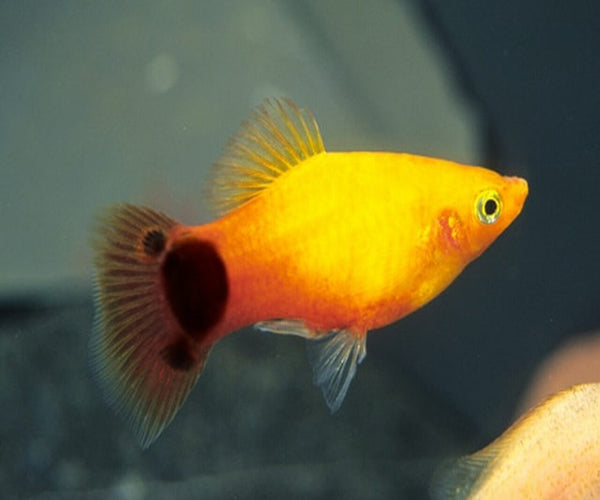
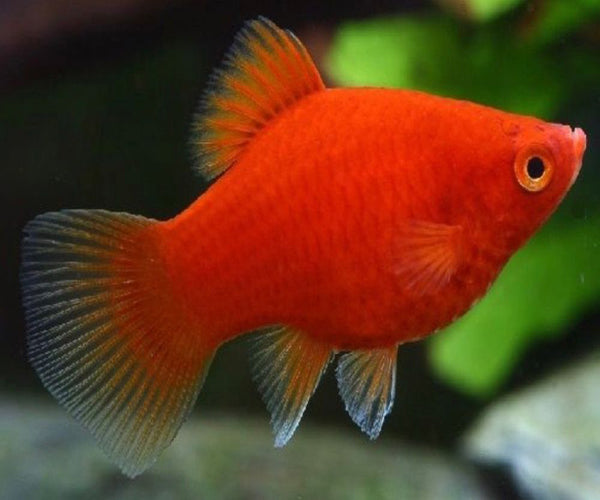
The Orange Balloon Molly combines the vivid orange colour form with the "balloon" body shape of Poecilia sphenops, the short-finned molly -- a species whose wild ancestors range across fresh, brackish, and coastal waters of Central America and the southern United States.
As with other balloon-form mollies, the shortened, rounded body is the product of decades of selective aquarium breeding for spinal curvature rather than something found in wild populations, and it's worth knowing upfront that balloon-bodied fish are somewhat more prone to internal organ compression and mild swimming difficulty than standard-bodied mollies -- a genuine trade-off for the distinctive rounded look.
Behaviourally it's a typical molly: an active livebearer that gives birth to free-swimming fry, breeds readily in mixed-sex groups, and grazes algae/biofilm alongside general omnivorous feeding.
Mollies as a species are unusually tolerant of brackish and even fully marine salinity for extended stretches, a trait inherited directly from wild populations living in coastal estuaries and mangrove-fringed waters of Central America and the southern United States. Decades of aquarium-trade selective breeding have produced numerous named forms layered onto this adaptable base species — sailfin, lyretail, and balloon-body variants among them — and the orange balloon combines two separately selected traits (the vivid orange colour and the rounded balloon shape) rather than being a single simpler mutation. Because the balloon trait affects the skeleton itself rather than just outward appearance, prospective buyers should go in with clear eyes about what they're choosing, even though it remains a widely available and popular strain in the trade. As with other livebearers, males carry a modified anal fin, the gonopodium, used for internal fertilisation, while females grow noticeably larger over time, though the balloon body shape makes sexing slightly less obvious at a glance than on a standard-bodied molly.
Requirements
Standard molly husbandry applies (hard/alkaline water, tolerates a light dash of aquarium salt, female-heavy groups, grazing omnivore diet with vegetable matter, standard filtration) — plus the same honest caveats as any balloon-bodied molly.
The rounded shape is a selectively bred spinal deformity, not extra body fat — a shortened, curved spine that some keepers choose not to support for welfare reasons, and which can affect swimming and, in some fish, organ function and lifespan versus a standard-bodied molly.
Practical adjustments: keep current gentle rather than strong (a curved spine swims less efficiently against flow), and favour smaller, more frequent feedings over one or two large ones — the compressed body has less room for a big meal to sit comfortably.
Group composition: keep more females than males, roughly 2–3 to 1, since males court almost constantly and a female-heavy ratio spreads that attention out and reduces stress on any one fish. Mollies breed readily — a mature female can produce a new brood every 4–6 weeks — and given the balloon shape's reduced mobility, a densely planted or otherwise sheltered tank helps fry (and any stressed adults) find cover from more mobile tankmates.
Diet: an omnivorous diet with real vegetable content — blanched zucchini, spirulina flake — supports the grazing behaviour mollies show naturally, alongside a quality flake or pellet staple. Feed smaller portions more frequently rather than one or two large feedings, given the compressed digestive space this body shape has.
Tankmates: avoid fast, boisterous, or fin-nipping species — a balloon molly's reduced swimming speed and manoeuvrability make it a poor match for tankmates that would otherwise out-compete it for food or territory. A tank of 75cm (30in) or more comfortably suits a small group without crowding.
Compatibility
Water & Care Conditions
- pH: 7.5–8.5 (alkaline)
- Hardness: moderately hard to hard, roughly 15–30 dGH
- Salinity: freshwater to brackish; a small dose of aquarium salt is well tolerated
- Temperature: 24–28°C (75–82°F)
- Water changes: weekly 20-25%
"Shimmying" — swaying side-to-side without moving forward — points to soft, acidic, or unstable water rather than illness. On this body shape, also keep an eye on buoyancy and how easily it holds position in the water, since the curved spine itself can cause swimming difficulty independent of water chemistry.
Correct hard/alkaline water keeps this strain reasonably hardy, though — as with any balloon-shaped livebearer — expect somewhat reduced swimming ability and lifespan compared to a standard-bodied molly. Skip it for a soft, acidic community setup.
A gently sloped, buffered substrate (crushed coral or aragonite sand mixed into a standard substrate) is a common, low-effort way to help maintain the harder, more alkaline water this species prefers over the long term, particularly in regions where tap water runs naturally soft.
Even with correct water chemistry, be realistic about lifespan and activity level expectations: balloon-bodied mollies are widely reported to live somewhat shorter lives than standard-bodied siblings, commonly in the 2–3 year range rather than the 3–5 years a standard molly might reach, and swim visibly less efficiently for the same reason. Weekly 20–25% water changes and stable, well-buffered hardness remain the single biggest factor in this strain's quality of life — more so than for most other common livebearers, given how much less margin for error a compressed, curved-spine body has when conditions slip. Fin rot and ich are the two most common health issues to watch for, both far more often triggered by inconsistent water than any special vulnerability tied to the balloon shape itself.