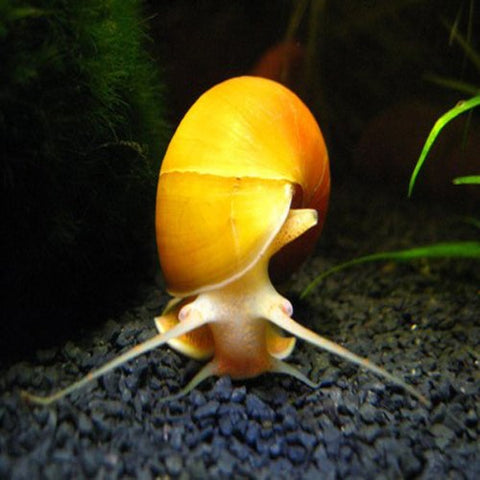
APPLE SNAIL

APPLE SNAIL

  • Sale
  • Rs. 99.00
  • Regular price Rs. 200.00
Tax included. Shipping calculated at checkout.


Ampullariidae, common name the apple snails, is a family of large freshwater snails, aquatic gastropod mollusks with a gill and an operculum. This family is in the superfamily Ampullarioidea and is the type family of that superfamily.

About & Origin

Apple snails (genus Pomacea) are large freshwater snails native to South America, found in slow-moving rivers, ponds, and marshes. They're among the largest common aquarium snails, with some species reaching golf-ball size or bigger, and are named for their rounded, apple-like shell shape. They breathe using both gills and a lung-like structure, and regularly come up to the surface for air, so tanks need some airspace below the lid.

They are active scavengers and grazers, spending most of their time moving slowly across the glass, substrate, and decor eating algae, biofilm, and leftover food.

One of the more distinctive things about apple snails is how they reproduce: females climb out of the water at night and lay clusters of bright pink or orange eggs on the underside of the tank lid, on emergent decor, or on anything else just above the waterline, since the eggs need to stay out of water to develop properly. A single clutch can hold anywhere from a few dozen to several hundred eggs, hatching in one to three weeks depending on temperature -- worth knowing if you'd rather not end up with an accidental colony, since an unfertilised female won't lay viable eggs but a mixed-sex group will.

Individual snails can live 1–3 years with good care, and unlike many smaller aquarium snails they're large and visible enough to genuinely function as a display animal in their own right, not just background cleanup crew -- shell colouration varies widely between golden, brown-banded, blue, and near-black depending on the specific line, and the soft body itself often shows equally varied mottled patterning that only becomes visible once the snail is active and extended from its shell.

Requirements

Apple snails are easy to keep but have one habit worth knowing before adding one to a planted tank.

Plants: apple snails are not fussy grazers -- alongside algae and leftover food, they will readily eat soft-leaved live plants (though they generally leave tougher plants like Anubias and Java Fern alone). In a heavily planted tank, expect some grazing damage to delicate species.

A secure lid and some airspace: because they surface to breathe air, a gap-free lid matters -- apple snails are capable of climbing out through small gaps.

Shell health: like all snails, they need calcium available in the water to maintain a strong shell; very soft, mineral-poor water can lead to shell pitting or erosion over time.

They are undemanding scavengers otherwise, happily cleaning up leftover food and algae alongside a normal flake/pellet diet.

Escape risk: beyond just climbing out through gaps, apple snails are also capable of surviving out of water for surprisingly long periods (hours, sometimes longer in humid conditions), so a snail found stuck to the underside of the lid or wandering outside the tank isn't necessarily dead -- return it to water and it will often recover.

Egg-laying mess: if keeping more than one snail, expect egg clusters on the lid and glass above the waterline periodically; these are harmless but some keepers prefer to scrape them off before they hatch to keep the population in check, since a tank can become overstocked with snails surprisingly fast otherwise.

Handling: apple snails have an operculum (a hard trapdoor) they retract into when startled -- this is a completely normal defensive reaction, not a sign of illness, and the snail will re-emerge once it feels safe again.

Compatibility

Best with tough, snail-resistant plants and peaceful community fish:

Water & Care Conditions

Apple snails do best in stable, mineral-rich water that supports healthy shell growth:

  • pH: 7.0–8.0 (acidic water gradually erodes the shell)
  • Hardness: moderately hard to hard, roughly 8–25 dGH; adequate calcium is important for shell strength
  • Temperature: 22–28°C (72–82°F)
  • Oxygenation: not demanding -- they supplement gill breathing with surface air access

Avoid copper-based medications in a tank housing snails -- copper is toxic to snails (and shrimp) even at doses safe for fish.

Keep a close eye on general water hardness over time rather than treating it as a one-off setup step: in very soft or acidic water, the shell can slowly thin, pit, or develop rough white patches as calcium leaches out faster than the snail can replace it. If this happens, raising general hardness (crushed coral in the filter, or a commercial GH-boosting mineral supplement) usually halts and can partially reverse early shell damage, though severe erosion is permanent.

Because apple snails surface regularly to breathe air directly rather than relying purely on gills, a completely sealed tank with no airspace under the lid isn't appropriate -- leave a small gap or use a lid designed with ventilation, in addition to keeping the lid itself secure enough to stop escapes.

Sudden, large water changes or a big swing in temperature can stress an apple snail more than it would a fish -- introduce new water gradually when doing maintenance, and acclimate a newly bought snail slowly by floating the bag and mixing tank water in over 20–30 minutes rather than dropping it straight in.

A snail that stays retracted into its shell for an extended period, feels unusually light, or produces a foul smell when the shell is gently lifted is likely dead rather than resting -- a healthy snail resists being pulled from its shell and reacts to touch.