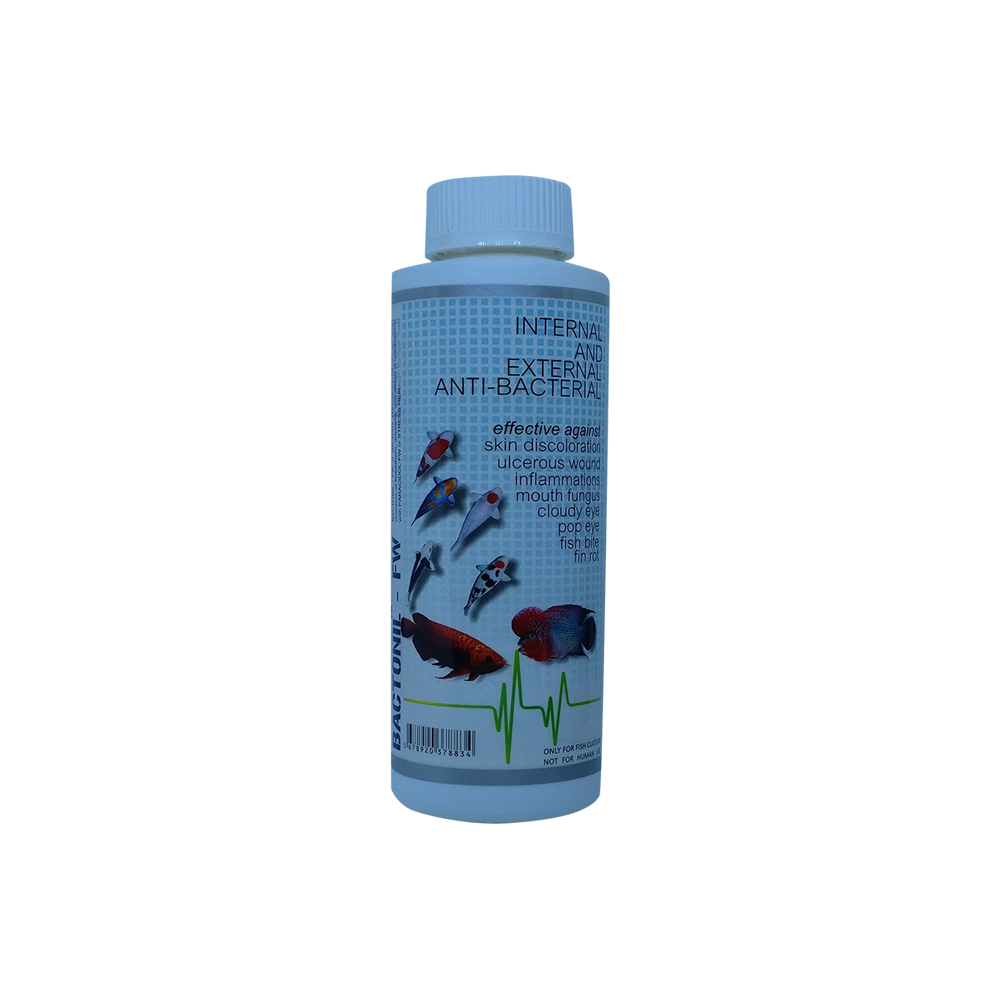
About & Origin
Bactonial is a broad-spectrum antibacterial treatment for freshwater aquarium fish, used to support recovery from common bacterial infections — fin rot, ulcers, mouth fungus (which is usually bacterial rather than a true fungus, despite the name), cloudy eye, red patches, and infected wounds.
Bacterial infections like these are often secondary problems, taking hold after a fish is stressed, injured, or already weakened by a parasite or poor water quality — so treatment usually works best alongside cleaning up the underlying cause (a water change, fixing overstocking, separating an aggressive tankmate) rather than as a standalone fix.
It's formulated for freshwater systems and is described by the manufacturer as safe to use with the full range of aquatic animals typically kept in a community tank.
One thing worth knowing before reaching for an antibacterial: it's not always obvious from the outside whether a problem is bacterial, fungal, or parasitic in origin, since several conditions produce overlapping symptoms (frayed fins, redness, cloudiness). If a course of antibacterial treatment doesn't show improvement within a few days, it's worth reconsidering whether the actual cause might be fungal or parasitic instead.
Bacterial infections tend to progress faster than fungal ones, which is why catching early signs -- a slightly frayed fin edge, a small red patch, a bit of cloudiness on one eye -- and starting treatment promptly generally gives a better outcome than waiting to see if it clears up on its own.
Requirements
Filtration: remove activated carbon from your filter before dosing, since it will absorb the medication and reduce how well it works.
Course length: visible improvement in bacterial infections is often reported within the first day or so of treatment, but the full course (check the bottle for the specific schedule) should be completed rather than stopped as soon as symptoms start improving, to avoid the infection returning.
Underlying cause: treat the water quality issue or physical stress that likely triggered the infection at the same time — a bacterial treatment alone won't fix overcrowding, poor filtration, or an aggressive tankmate causing repeated injuries.
Isolating a badly affected fish into a separate hospital tank makes it easier to dose accurately and monitor recovery than treating a full display tank.
Reported speed: visible improvement is often reported within roughly 12 hours of starting treatment for straightforward bacterial cases, though the full course should still be completed rather than stopped as soon as things look better.
Shrimp and scaleless fish: as with most fish medications, check the product's own safety notes before dosing a tank that also holds dwarf shrimp, snails, or scaleless species (loaches, some catfish) -- these groups are frequently more sensitive to treatments that are otherwise gentle on scaled fish, and a hospital-tank approach lets you treat the affected fish without exposing tankmates that don't need it.
Compatibility

Dosage & Usage Guidelines
Dose per the ratio on the bottle (commonly around 10ml per 50 litres for this type of product) for the full recommended course, not just until visible symptoms fade.
- Filtration: remove carbon media before dosing
- Freshwater use only
- Common symptoms it targets: fin rot, ulcers, mouth fungus, cloudy eye, red patches, infected wounds
- Storage: cool, dark place, tightly sealed
- Address the cause too: water quality, overstocking, or aggressive tankmates often need fixing alongside treatment
- Dosage: commonly around 10ml per 50 litres, freshwater only
- Reported response time: visible improvement often within 12 hours for typical bacterial infections
- Sensitive livestock: check product-specific safety notes before dosing a tank with shrimp, snails, or scaleless fish
- Shelf life: potency fades over long-term storage even sealed -- check for a use-by date and avoid dosing with medicine that's been open a long time
If a fish doesn't show any improvement after a full course, it's worth reassessing whether the underlying problem is genuinely bacterial rather than fungal or parasitic, since the visible symptoms of all three can look fairly similar at a glance. A hospital tank also makes it much easier to spot a lack of progress early, since you're watching one fish closely rather than trying to track subtle changes across a full display tank.